The skeleton in brief
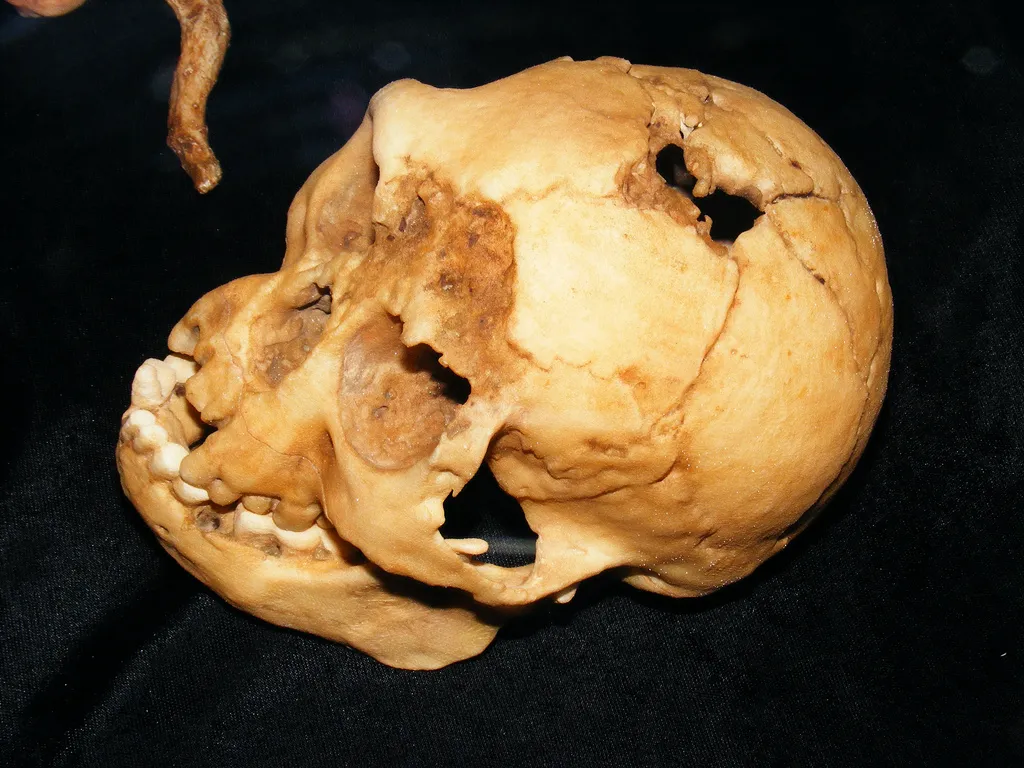
LB1 is the best-preserved skeleton of Homo floresiensis, the small human relative of the Indonesian island of Flores. She is a nearly complete skeleton of an adult, probably a woman of about 30, who stood only about 1.06 metres (3 ft 6 in) tall. Her brain was about 380 cubic centimetres, close to a chimpanzee’s, yet she lived long after the age of Australopithecus, and she was found with stone tools.
The find
In September 2003 a joint Indonesian and Australian team led by Mike Morwood and Radien Soejono was digging in Liang Bua cave, hoping to find traces of the first modern humans who passed through the islands on their way to Australia. Instead they found the skeleton of a very small adult. The bones were not fossilised and were as soft as wet blotting paper, so they were left to dry before they could be removed. Peter Brown and colleagues described the species in the journal Nature in 2004, with LB1 as the type specimen. Remains of at least 14 or 15 individuals have been found since.
Dates
The first estimate put LB1 at about 18,000 years old, which would have made her a contemporary of modern humans in the region. A re-examination of the cave layers in 2016 found that the bones are older, between about 100,000 and 60,000 years, while stone tools linked to the species go on until about 50,000 years ago, around the time modern humans reached the region.
The argument
Some researchers argued that LB1 was a modern human with a disease that makes the head small, such as microcephaly. More specimens with the same unusual features have since made this less likely, and most researchers now accept a separate species. Where it came from is still discussed: it could be a dwarfed form of Homo erectus, as animals on islands often shrink, or a descendant of an earlier and smaller kind of human that left Africa. Jaw and teeth about 700,000 years old from another Flores site, Mata Menge, may be an early form of it.
Where it is
The Flores bones belong to Indonesia. They are kept in Indonesia, and the photograph on this page shows a replica of the skull.
Sources
- Brown, P. and others (2004). A new small-bodied hominin from the Late Pleistocene of Flores, Indonesia. Nature 431: 1055 to 1061.
- Sutikna, T. and others (2016). Revised stratigraphy and chronology for Homo floresiensis at Liang Bua in Indonesia. Nature 532: 366 to 369.
- Smithsonian National Museum of Natural History, Human Origins Program: Homo floresiensis.