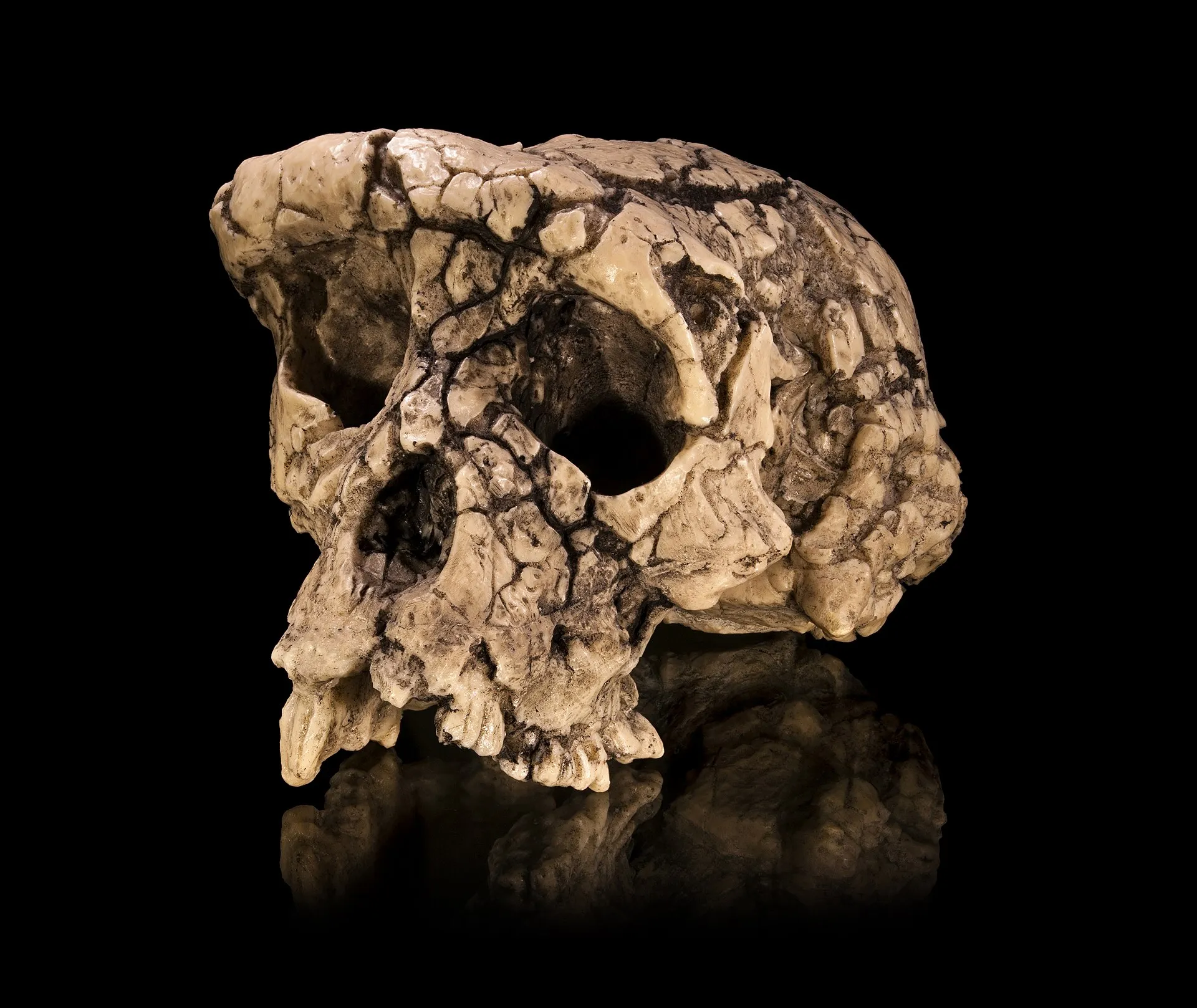
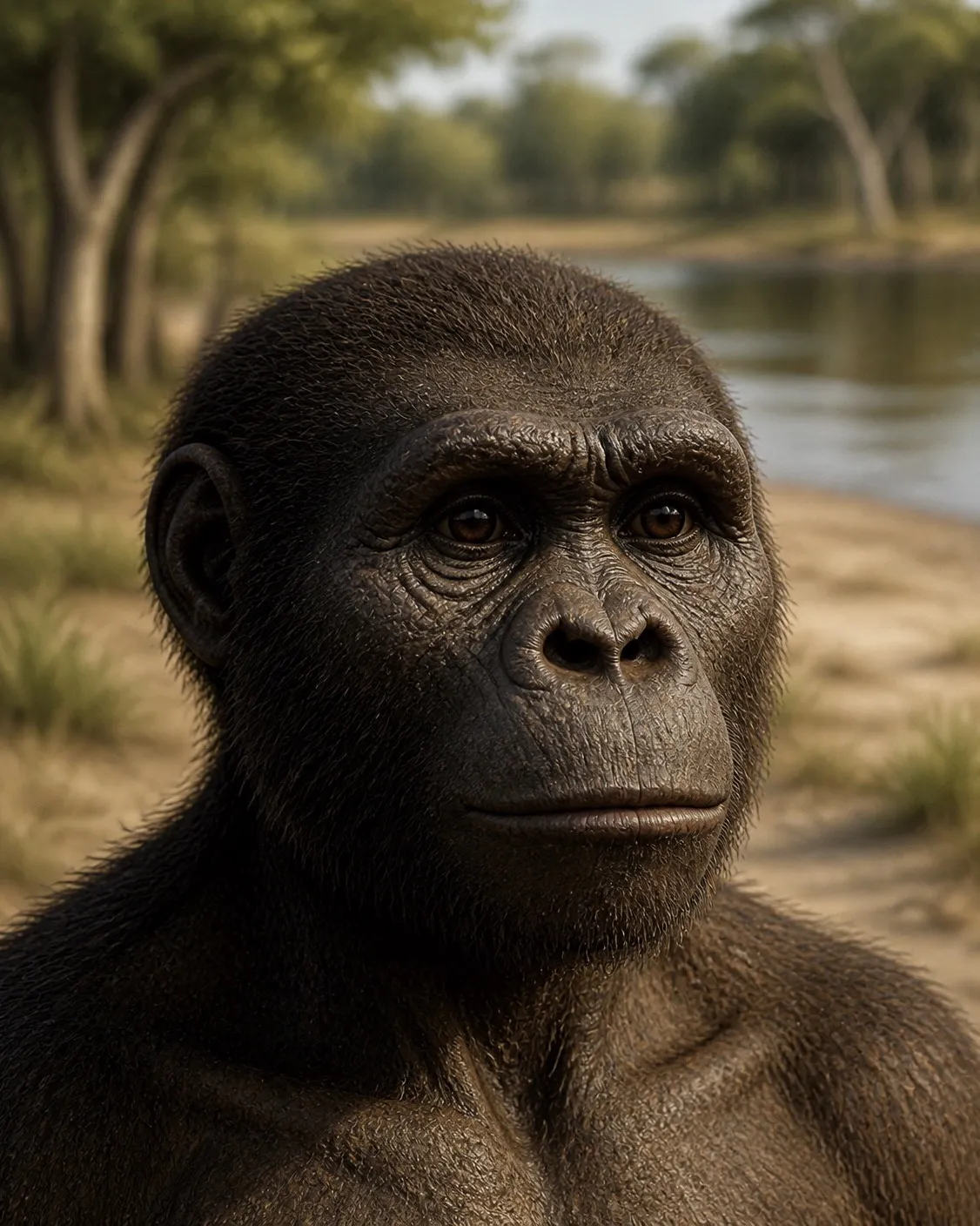
The skull in brief
Toumai (catalogue number TM 266-01-060-1) is the best specimen of Sahelanthropus tchadensis. It is a skull that is nearly complete but badly deformed, found with five jaw and teeth fragments, and it is dated to about 7 million years ago, near the end of the Miocene. Its brain was small, about the size of a chimpanzee’s, but its face is flatter than an ape’s, its canine teeth are small, and its brow ridge is thick.
The name
The skull was named Toumaï by the president of Chad at the time, Idriss Déby. In the local Daza language the word means “hope of life”, and it is given to children born shortly before the dry season, whose chances of survival are slim. The species name refers to Chad, and the genus name to the Sahel, the dry belt south of the Sahara.
The find
On 19 July 2001 the skull was found on the surface at a place called Toros-Menalla in the Djurab Desert of northern Chad, by a team of Chadian and French researchers, in a mission led by Michel Brunet of the University of Poitiers. Ahounta Djimdoumalbaye, a Chadian member of the team, is credited with spotting it. Brunet’s team described it in the journal Nature in July 2002.
The place surprised researchers: it lies about 2,500 kilometres west of the Rift Valley, where almost all early finds had been made. The age comes from the animals found with it and from later dating of the sediments, which gave about 7.2 to 6.8 million years.
The argument over walking
The question is whether Toumai walked on two legs, which would make it a human relative, or on four, as an ape did. The skull was the only part first described, and Brunet’s team argued from the position of the hole at its base (the foramen magnum) that the head sat on top of an upright spine. Others, including Milford Wolpoff, noted that the crushing makes this hard to judge, and argued it was an ape.
A thigh bone from the site, which turned up in storage in Poitiers, was described in 2020 as not that of an upright walker. In 2022 Guillaume Daver, Franck Guy and colleagues reported a femur and two forearm bones that they say came from the same site, and argued that they show upright walking along with tree-climbing. Others say the thigh bone looks like an ape’s. The question is still open, and some researchers doubt it was on the human line at all.
Where it is
The skull belongs to Chad and is kept in N’Djamena, the capital. Casts are used in museums elsewhere, and the photograph on this page is of a cast.
Sources
- Brunet, M. and others (2002). A new hominid from the Upper Miocene of Chad, Central Africa. Nature 418: 145 to 151.
- Daver, G. and others (2022). Postcranial evidence of late Miocene hominin bipedalism in Chad. Nature 609: 94 to 100.
- Smithsonian National Museum of Natural History, Human Origins Program: Sahelanthropus tchadensis.