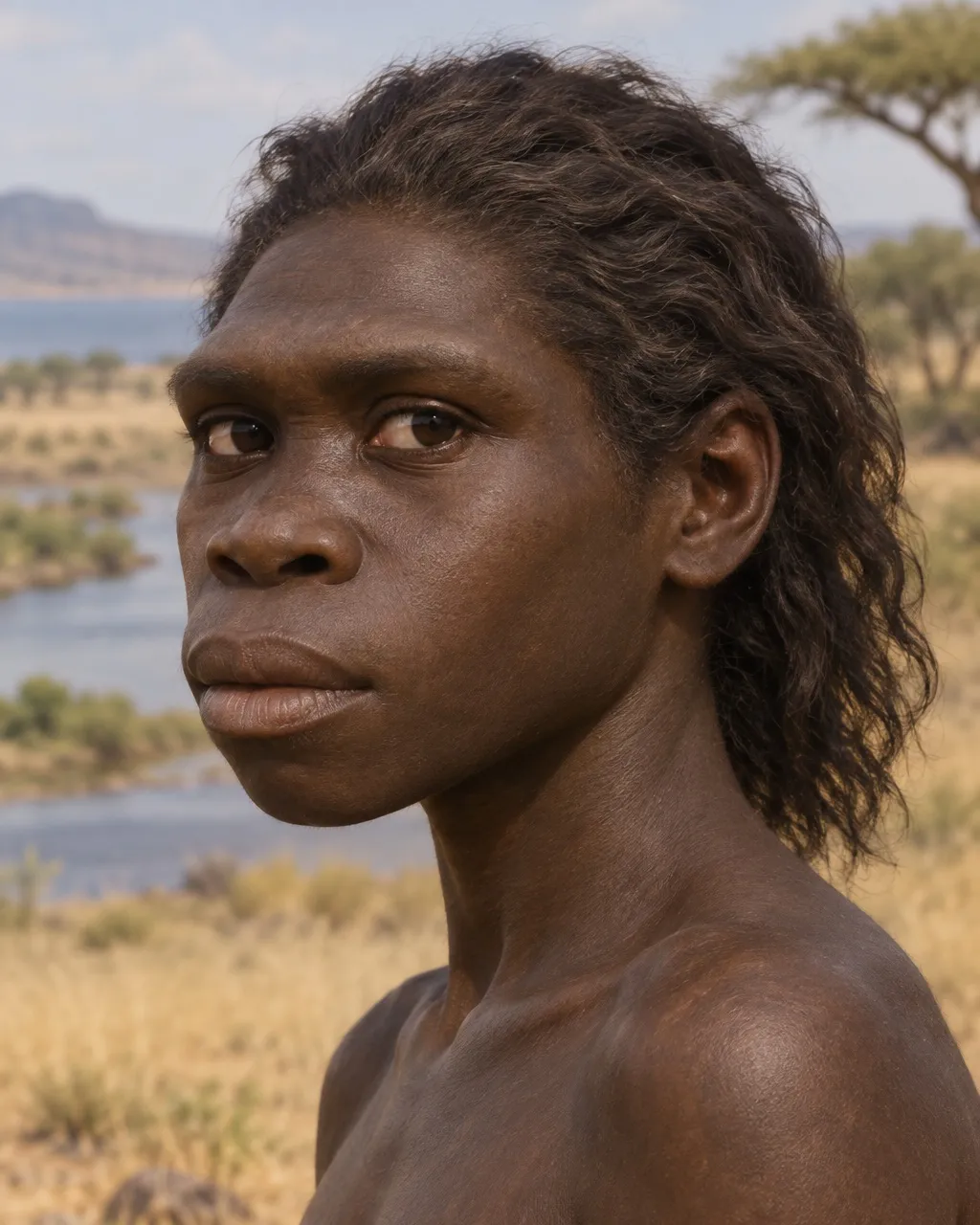
Eugène Dubois (1858 to 1940) was a Dutch doctor and anatomist who joined the colonial army to look for human ancestors in Southeast Asia. At Trinil on Java in 1891 and 1892 his excavations produced a skullcap, a tooth and a thigh bone, which he named Pithecanthropus erectus. Now called Homo erectus, it was the first known fossil of the species.
A doctor with a plan
In the 1880s, the only known fossil humans that looked very different from us were the Neanderthals of Europe. Eugène Dubois, a young anatomy lecturer at the University of Amsterdam, thought one could be found in the tropics, where apes still lived. He could not get money for an expedition, so in 1887 he joined the Royal Dutch East Indies Army as a medical officer, to the dismay of his colleagues, and sailed for what is now Indonesia.
The riverbank at Trinil
At Trinil, on the Solo River in East Java, his excavations turned up a tooth in September 1891 and a skullcap the next month. In August 1892 they found a nearly complete thigh bone about 15 metres away, in what he took to be the same layer. The skull was low and small, while the thigh bone looked much like a modern one. Dubois concluded they came from one creature that walked upright, and in 1894 he named it Pithecanthropus erectus, the “upright ape-man”.
The digging was not done by Dubois alone. It was done by Javanese workers who were forced to labor under colonial rule, and their names are not in the usual accounts.
Many scientists doubted him. Some saw an ape, some a human, and some doubted that the bones belonged together. Similar fossils from China and Java in the 20th century settled the matter, and the species is now Homo erectus. Whether the thigh bone truly belongs with the skull is still questioned.
Back in the Netherlands
Dubois returned home in 1895. He became curator at the Teylers Museum in Haarlem in 1897 and a professor at the University of Amsterdam in 1899, and later spent years studying the link between brain size and body size. He died at Haelen in 1940.
His fossils kept giving up new information long after his death. In 2014 a team studying shells he had collected at Trinil reported a freshwater mussel shell with a zigzag engraved on it, about 430,000 to 540,000 years old, which made it the oldest known engraving at the time.
The return to Indonesia
The Trinil fossils stayed at Naturalis in Leiden for more than a century. A Dutch committee concluded that they had been taken from Indonesia in a colonial setting and should go back, and on 26 September 2025 the Netherlands agreed to return the collection of about 28,000 objects. The Java Man fossils themselves were handed over in December 2025, for the National Museum of Indonesia in Jakarta. The rest was due to follow during 2026.
Where to see the finds
- National Museum of Indonesia, Jakarta: the Java Man skullcap, tooth and thigh bone, returned from the Netherlands in December 2025
- Naturalis Biodiversity Center, Leiden: held the Dubois collection for more than a century. The remaining fossils were due to go to Indonesia during 2026, so check before you travel.
Sources
- Joordens, J. C. A. and others (2014). Homo erectus at Trinil on Java used shells for tool production and engraving. Nature 518: 228 to 231.
- Shipman, P. (2001). The Man Who Found the Missing Link: Eugène Dubois and His Lifelong Quest to Prove Darwin Right. Simon and Schuster.
- National Geographic: 'Java Man,' the first Homo erectus discovered, is finally going home
- Archaeology Magazine (19 December 2025): Java Man fossils returned to Indonesia
- Wikipedia: Eugène Dubois (checked for dates, 2026-11-03)
Last checked 3 November 2026. Spotted a mistake? Tell us.