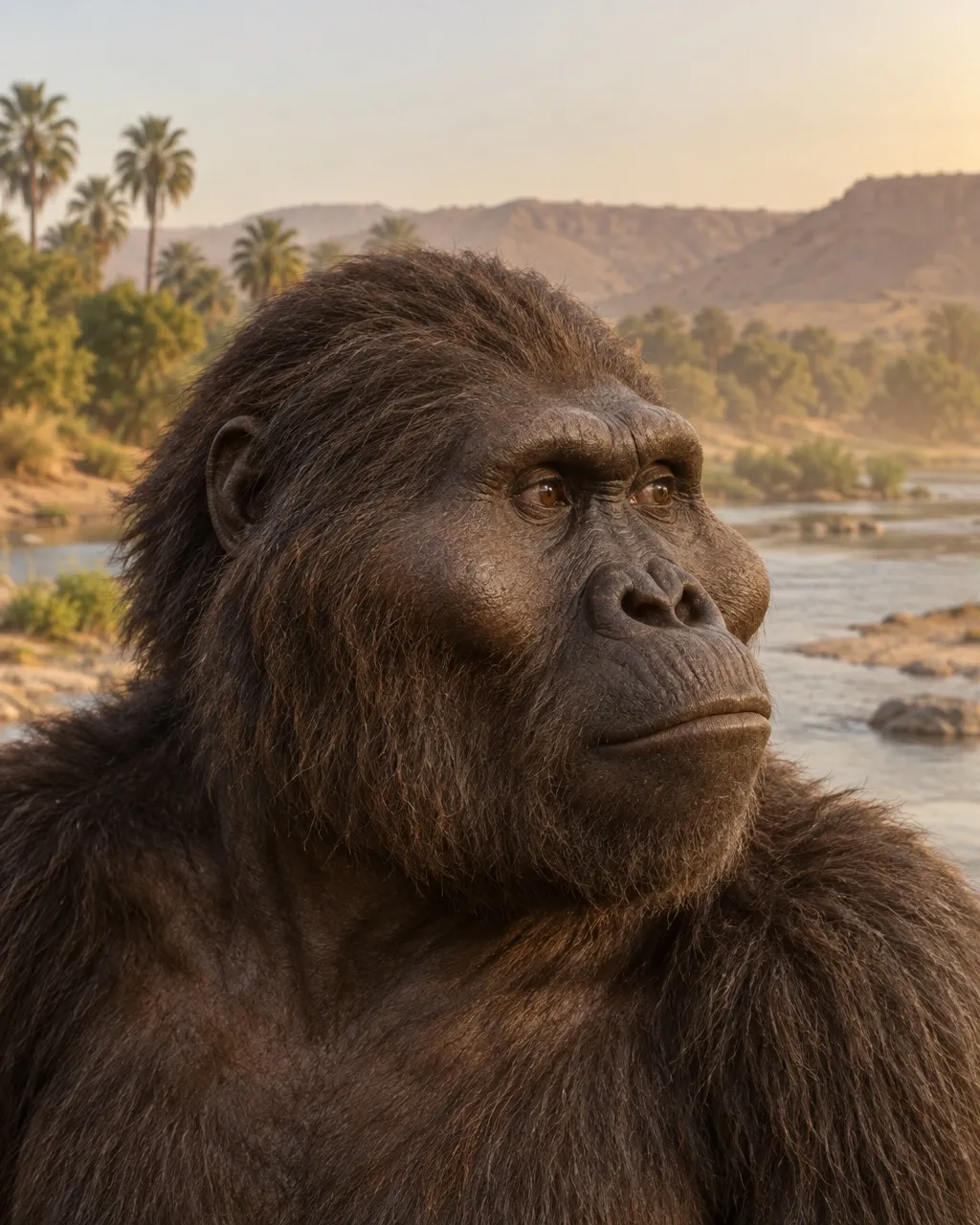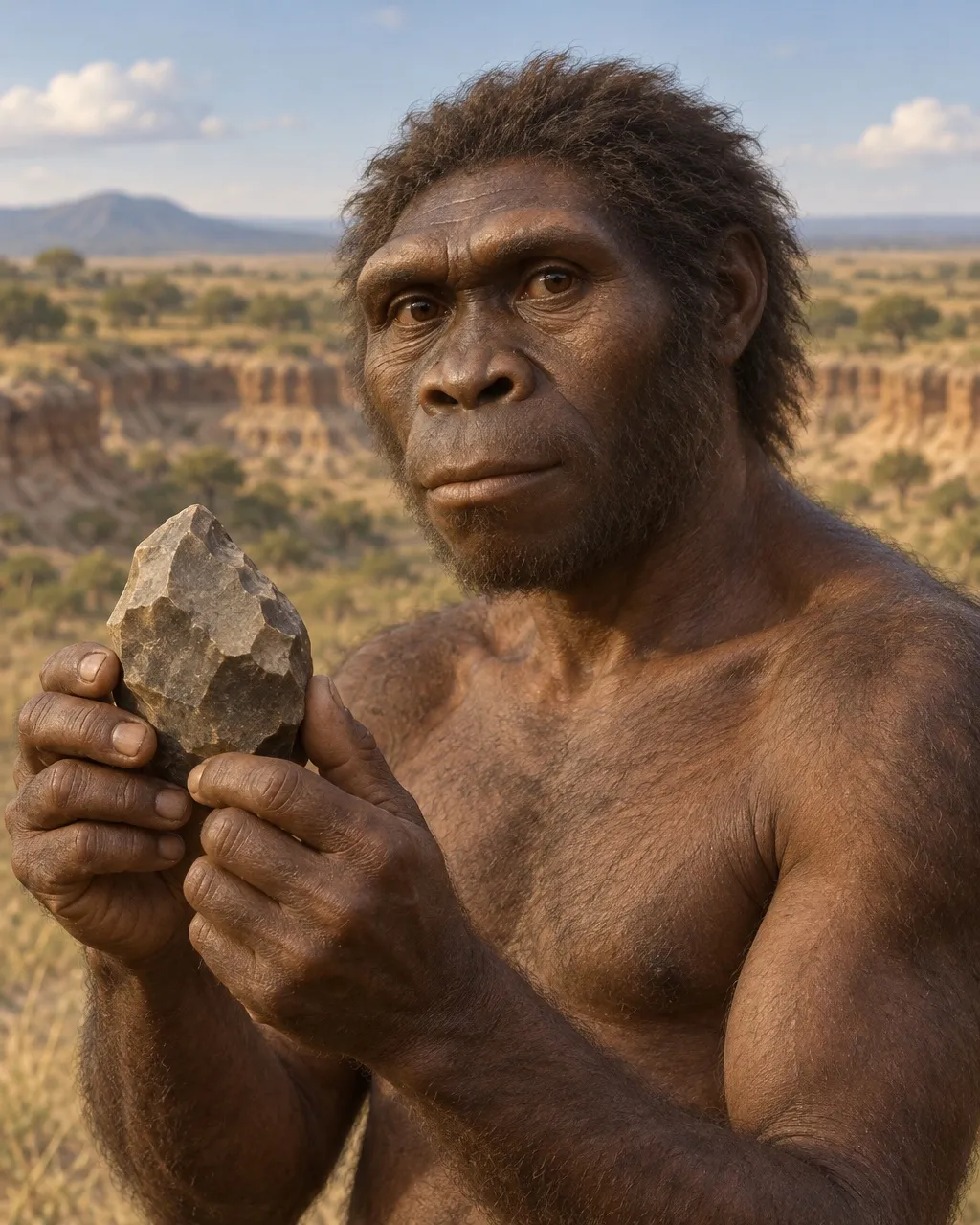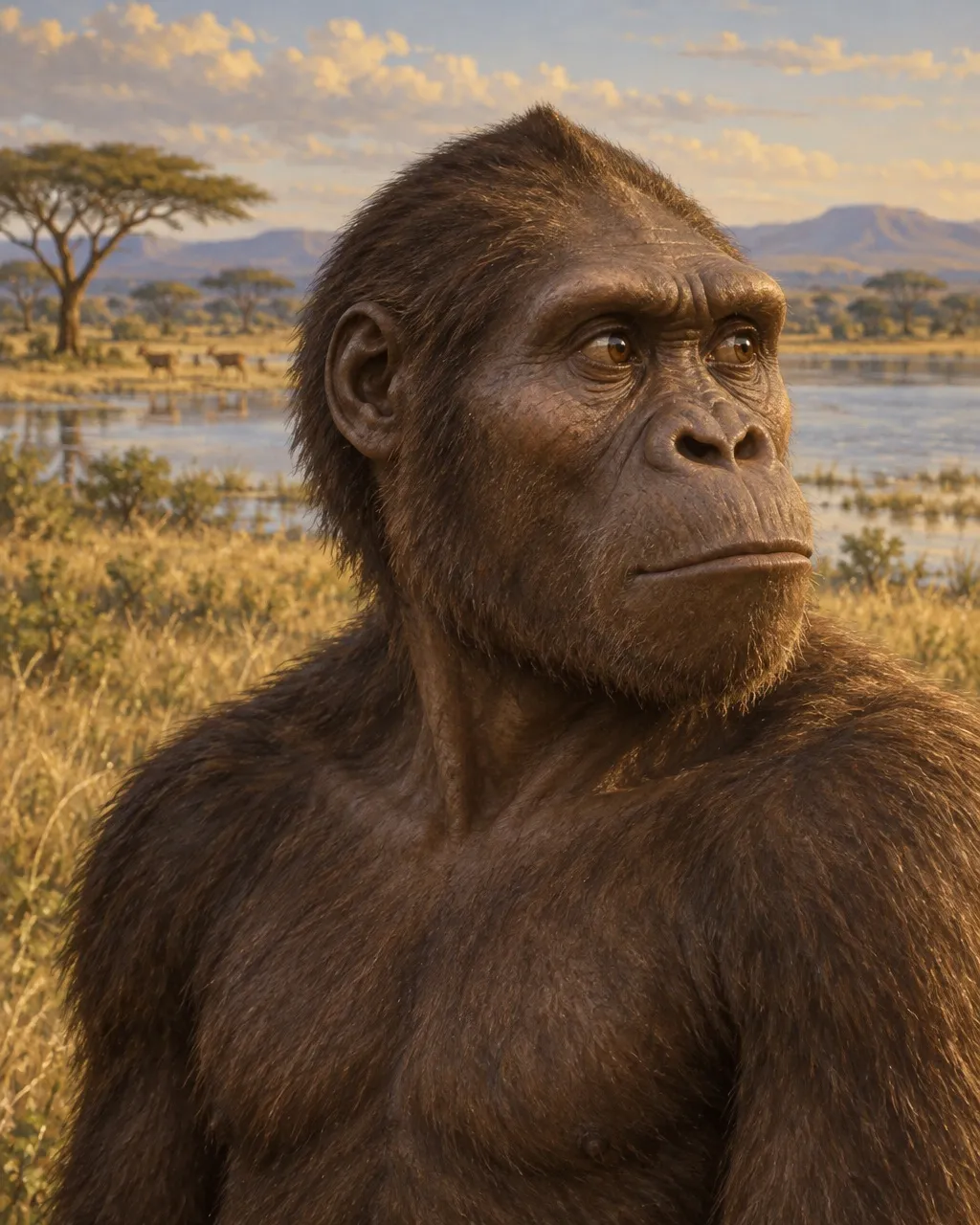
Australopithecus garhi is a species of early human relative known from a partial skull and other fossils found at Bouri, in the Middle Awash of Ethiopia, about 2.5 million years old. It had a small brain and huge back teeth. Animal bones cut with stone tools were found nearby, so it may have been one of the first meat-eating toolmakers.
The species in brief
Australopithecus garhi lived about 2.5 million years ago in the Afar region of Ethiopia. It is known from a partial skull, some teeth and jaw pieces, and possibly a partial skeleton, all from a small area called Bouri in the Middle Awash. The time between 3 and 2 million years ago is one of the least known stretches of human evolution, and it is just when our own genus, Homo, and the first stone tools appear. That makes these few fossils especially interesting.
Discovery
A team led by the Ethiopian paleoanthropologist Berhane Asfaw and the American Tim White first found hominin fossils at Bouri in 1990, and worked there again from 1996 to 1998. In 1997 Yohannes Haile-Selassie, a member of the team, found pieces of a skull scattered on the surface at a locality called BOU-VP-12. Put back together, it became BOU-VP-12/130: the top and sides of a braincase and an upper jaw with its teeth.
Asfaw, White and colleagues named the new species in Science in April 1999. Another skull piece and lower jaws from nearby sites were also described, but the team kept them apart from the name because they could not be sure they were the same species.
How old it is
The fossils come from a layer called the Hata Member of the Bouri Formation. A volcanic ash bed within it was dated by argon-argon dating to about 2.5 million years ago. That is a date for these fossils only. More finds are needed to know how long the species lasted.
The skull and teeth
The braincase is small, about 450 cubic centimetres, in the range of other australopiths and about a third of ours. Along its top runs a low ridge, a sagittal crest, where large chewing muscles attached. The face juts forward, and there is still a gap between some upper canines and incisors, an old ape-like feature.
The real surprise was the teeth. The premolars and molars are enormous, as big as those of the robust Paranthropus species. But the skull is not built like a Paranthropus skull: the face is not dished, and the canines and front teeth are not shrunken the way they are in Paranthropus. The team concluded that A. garhi was descended from Australopithecus afarensis, Lucy’s species, and was a different lineage from the robust ones.
The skeleton from Bouri
In the same layer, a short walk from the skull, the team found a partial skeleton, BOU-VP-12/1, with parts of a thigh bone, arm bones and a foot bone. Its thigh bone is long compared with its upper arm, more like Homo than like Lucy, which suggests longer strides. But its forearm is still long compared with its upper arm, an ape-like proportion. Because there is no skull with it, the team did not assign the skeleton to A. garhi. Many researchers treat it as probably the same species, but that is not certain.
Butchered bones
The most talked-about finds at Bouri are not hominin bones at all. Jean de Heinzelin, J. Desmond Clark and colleagues described antelope and other animal bones from the same Hata layer with clear cut marks from stone tools, and a leg bone that had been broken open, probably for its marrow. They showed that someone at Bouri was cutting meat off carcasses and getting at marrow 2.5 million years ago.
No stone tools were found with the bones, perhaps because good stone was scarce at Bouri and tools were carried in and out. Oldowan stone tools of about the same age, about 2.6 to 2.5 million years old, are known from Gona, not far to the north. The team suggested that A. garhi, the only hominin known at Bouri, was the butcher. That idea is still unproven: early Homo was already living in the Afar by then, and so were other kinds of australopiths.
Where it fits in the family tree
Asfaw, White and colleagues proposed A. garhi as a candidate ancestor of Homo: in the right place, at about the right time, and possibly using stone tools. Other scientists suggested its big teeth link it to the robust Paranthropus line instead, or that the skull could be an unusual late A. afarensis.
Discoveries since then have made the picture busier. In 2015 Brian Villmoare, William Kimbel and colleagues described a jaw of early Homo from Ledi-Geraru, also in the Afar, about 2.8 million years old, older than A. garhi. In 2025 the Ledi-Geraru team reported teeth of an Australopithecus about 2.63 million years old that do not match either A. afarensis or A. garhi. They concluded that as many as four hominin lineages, early Homo, Paranthropus, A. garhi and the new Ledi-Geraru australopith, lived in eastern Africa between 3 and 2.5 million years ago. A. garhi may be a close cousin of our ancestors rather than the ancestor itself, but until more of it is found, nobody can say for sure.
Where to see it
The Bouri fossils are kept at the National Museum of Ethiopia in Addis Ababa. Casts of the skull are on show in some museums.
Sources
- Smithsonian National Museum of Natural History, Human Origins Program. Australopithecus garhi.
- Australian Museum. Australopithecus garhi.
- Asfaw, B., White, T., Lovejoy, O., Latimer, B., Simpson, S. and Suwa, G. (1999). Australopithecus garhi: a new species of early hominid from Ethiopia. Science 284: 629 to 635.
- de Heinzelin, J., Clark, J. D., White, T., Hart, W., Renne, P., WoldeGabriel, G., Beyene, Y. and Vrba, E. (1999). Environment and behavior of 2.5-million-year-old Bouri hominids. Science 284: 625 to 629.
- Semaw, S. and others (1997). 2.5-million-year-old stone tools from Gona, Ethiopia. Nature 385: 333 to 336.
- Villmoare, B., Kimbel, W. H., Seyoum, C., Campisano, C. J. and others (2015). Early Homo at 2.8 Ma from Ledi-Geraru, Afar, Ethiopia. Science 347: 1352 to 1355.
- Villmoare, B., Delezene, L. K., Rector, A. L. and others (2025). New discoveries of Australopithecus and Homo from Ledi-Geraru, Ethiopia. Nature 650: 374 to 380.
Cite this page
Bonelore. "Australopithecus garhi." https://bonelore.com/species/australopithecus-garhi/
Last checked 27 November 2026. Spotted a mistake? Tell us.