Top questions
What is Homo naledi?
Homo naledi is an extinct species of the genus Homo, named in 2015 from bones found in the Dinaledi Chamber of Rising Star Cave near Johannesburg. The name comes from the Sotho word for 'star'. It stood about 1.45 metres tall and had a brain about a third the size of ours.
How old is Homo naledi?
The Dinaledi bones were dated in 2017 to between about 335,000 and 236,000 years old. Before the dating, many researchers thought they might be a million years or more old. Instead, naledi lived in the same period as the earliest Homo sapiens in Africa.
Did Homo naledi bury its dead?
Its discoverers say so, but many other researchers are not convinced. Berger's team argues that the bodies were put into hard-to-reach chambers on purpose, and in 2023 reported graves and engravings. Critics say the evidence has not ruled out natural explanations. The question is open.
Was Homo naledi our ancestor?
Almost certainly not. It lived at the same time as early Homo sapiens, and its small brain and primitive features suggest it branched off from the human line much earlier. How it is related to other Homo species is unclear.
How big was the brain of Homo naledi?
About 465 to 610 cubic centimetres, depending on the skull. That is in the range of Australopithecus and early Homo, and about a third to a half the size of a modern brain, although the shape of the brain seems more like that of other Homo.
The species in brief
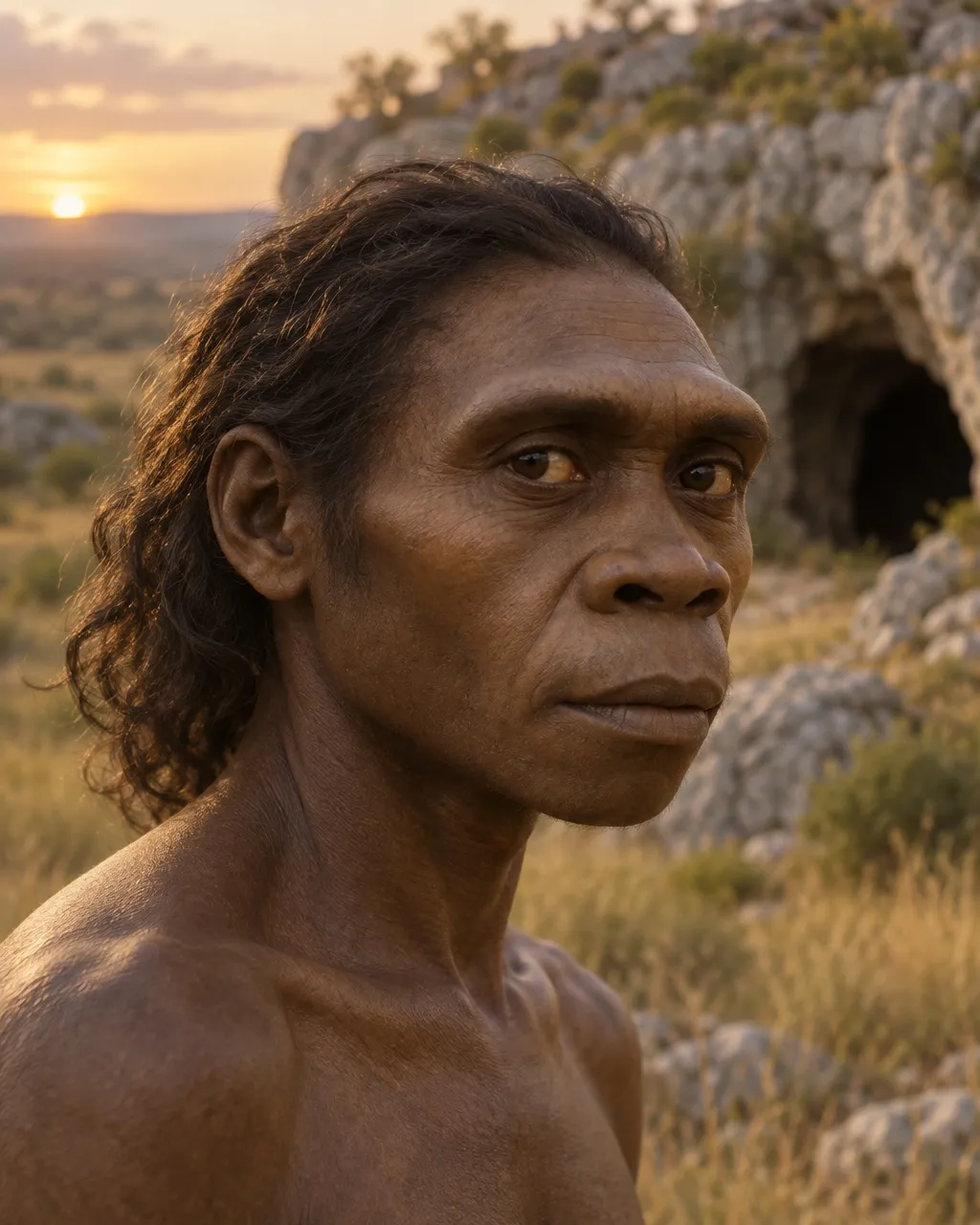
Homo naledi is one of the strangest finds in the study of human evolution. It had a brain no larger than some australopiths’, shoulders and fingers suited to climbing, and hands, feet and teeth that look like those of later humans. It would have looked unlike any living person. Yet it lived between about 335,000 and 236,000 years ago, when early Homo sapiens were already in Africa.
That surprised nearly everyone. The common expectation was that a fossil with such an old-fashioned body must itself be very old. Homo naledi showed that small-brained, primitive-looking relatives survived for a very long time alongside bigger-brained ones.
How it was found and named
According to the 2015 paper, fossils from the Dinaledi Chamber were first recognised in October 2013, and excavation followed in November 2013 and March 2014. Accounts of the discovery say that recreational cavers found the bones in a hard-to-reach part of the Rising Star Cave system; the paper does not name them. The paleoanthropologist Lee Berger put together a team, including six slim women scientists nicknamed the “underground astronauts”, to work in the chamber.
By 2015 they had recovered 1,550 specimens, from at least 15 individuals of all ages. Homo naledi was named in 2015. The specific name is the Sotho word for “star”, after the cave. In 2017 the team also reported a second chamber, Lesedi, with the bones of at least three more individuals.
Body and brain
- Size. About 1.45 metres (4 ft 9 in) tall, with body mass estimates of roughly 40 to 56 kilograms (88 to 123 lb).
- Brain. About 465 to 610 cubic centimetres. The shape of the brain, as seen in casts of the inside of the skull, resembles other Homo more than it does Australopithecus.
- Skull and teeth. A well-developed brow ridge, a bulge at the back of the skull, and smallish teeth. The teeth wore down in a pattern suggesting a gritty diet.
- Hands. The thumb and palm were suited to a precise grip, like ours, and a hand like this could have made and used tools. But the fingers were strongly curved, a trait seen in climbers.
- Shoulders and torso. The shoulders sat high and the chest was narrow, as in australopiths, which suggests climbing.
- Feet and legs. The feet were close to ours, made for walking on the ground, and its leg bones suggest a long stride. The pelvis was wide, and it probably was not a good long-distance runner.
How old, and why that matters
The Dinaledi bones could not be dated at first. In 2017 a team used several methods on teeth and on the surrounding sediments and found ages of about 335,000 to 236,000 years. That makes Homo naledi a contemporary of early Homo sapiens, whose oldest known fossils, from Jebel Irhoud in Morocco, are about 300,000 years old.
Its small brain, held for so long at a time when others had bigger brains, undermines the idea that human evolution was a steady climb toward larger brains.
Did it bury its dead?
The Dinaledi Chamber is deep in the cave, and almost no bones of other large animals were found with the naledi remains. Berger’s team argued that the bodies were carried or placed there on purpose. In 2023 they went further, reporting burial pits in the chamber and symbols engraved on cave walls, and suggested that this small-brained species buried its dead and made marks. Many researchers have said that the evidence is not strong enough: natural processes were not ruled out, and it is not clear that the engravings were made by people at all. A revised version of the burial paper has since been reviewed, and the reviewers were divided. The question has not been resolved.
Where it fits in the family tree
Homo naledi has a mix of features, and researchers disagree about its place. Features of the skull show some similarities to early Homo erectus, and an old split from the main line of Homo, possibly more than a million years ago, is likely. It could be a surviving cousin of the early members of our genus, such as Homo habilis. It is not thought to be an ancestor of ours. It might have lived alongside the small-bodied Homo floresiensis of Indonesia, the other well-known late survivor with a small brain, though the two are not closely related to each other.
It is not known whether naledi lived only in the Cradle of Humankind or across more of Africa.
Famous specimens
- The Dinaledi Chamber assemblage. The type specimen is DH1, a partial skull with a nearly complete lower jaw. The Dinaledi and Lesedi chambers have given the most complete record of a single early human species in Africa.
Sources
- Berger, L. R. and others (2015). Homo naledi, a new species of the genus Homo from the Dinaledi Chamber, South Africa. eLife 4: e09560.
- Dirks, P. H. G. M. and others (2017). The age of Homo naledi and associated sediments in the Rising Star Cave, South Africa. eLife 6: e24231.
- Hawks, J. and others (2017). New fossil remains of Homo naledi from the Lesedi Chamber, South Africa. eLife 6: e24232.
- Smithsonian National Museum of Natural History, Human Origins Program: Homo naledi.
Cite this page
Bonelore. "Homo naledi." https://bonelore.com/species/homo-naledi/