
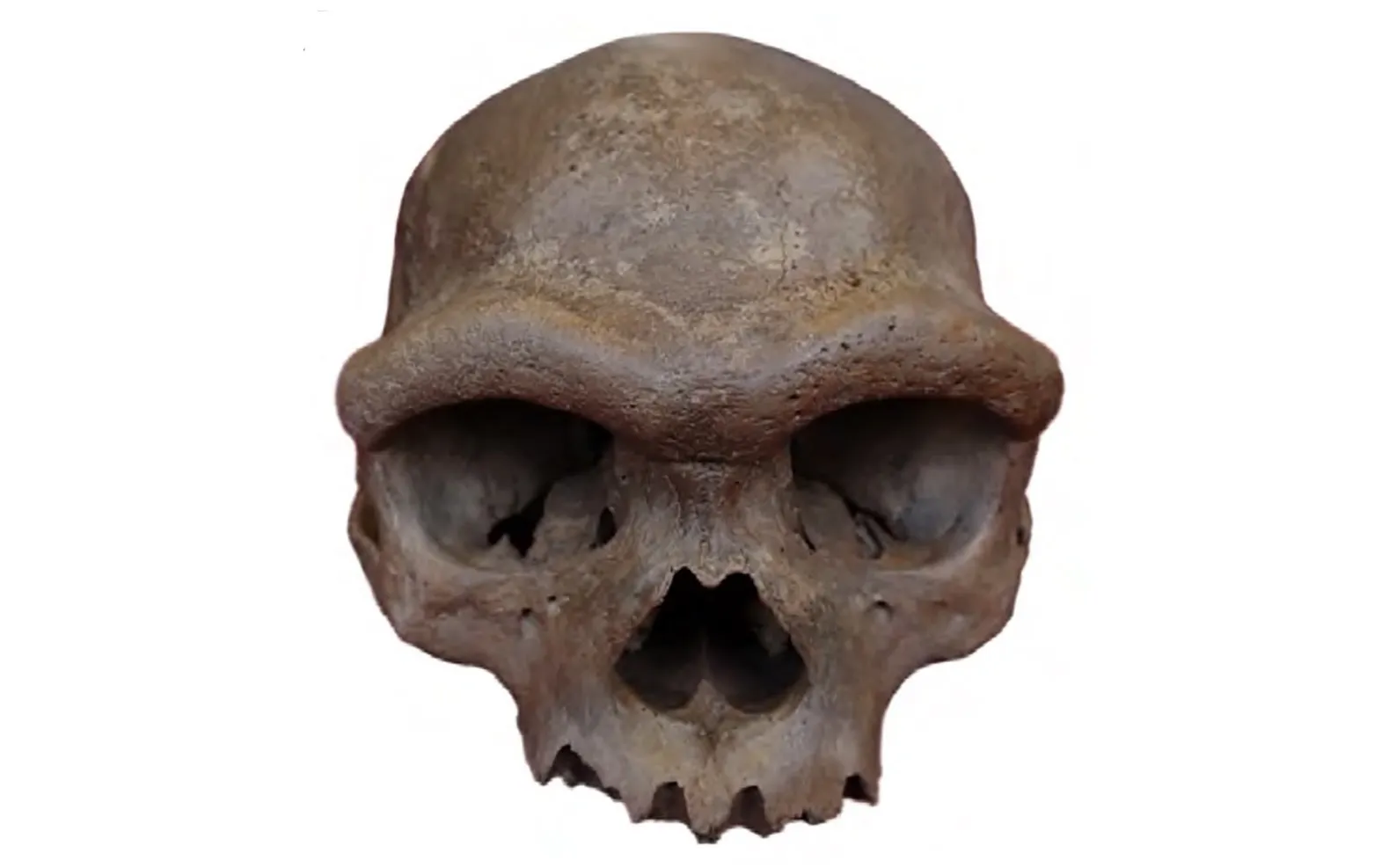
The skull in brief
The Harbin cranium is one of the best-preserved skulls of an archaic human ever found, and one of the largest. It is long, low and very wide, with a massive brow ridge, big square eye sockets and a brain of about 1,420 cubic centimetres, within the range of people today. Only one tooth survives, a huge molar. In 2021 it was named a new species, Homo longi, “Dragon Man”. In 2025 proteins and DNA from the skull matched the Denisovans, a group until then known almost only from DNA, scraps of bone and teeth. If that is right, this is what a Denisovan looked like.
The find
The story of the find comes from the family of the man who found it, and it can’t be checked. In 1933, during the Japanese occupation, a Chinese labourer helping to build a bridge over the Songhua River in Harbin dug the skull out of the riverbank. He wrapped it up and hid it at the bottom of an abandoned well, and he only told his family about it shortly before he died. In 2018 the family gave it to Hebei GEO University in Shijiazhuang, where it is kept today.
How old it is
Because the skull spent decades in a well, the exact layer it came from is unknown. In 2021 a team led by Qingfeng Shao compared the chemistry of the bone and of sediment stuck in its nose with layers along the river, and matched it to a formation laid down roughly 309,000 to 138,000 years ago. Uranium-series dating of the bone itself gave a minimum age of about 146,000 years. So the Harbin individual lived at least 146,000 years ago, and possibly much earlier.
The person
The skull is probably a man’s, and the team that described it estimated he was around 50 years old when he died. The face is wide but fairly flat and low, with cheekbones that sit low and a broad nose. The teeth were very large. He was probably big and strongly built.
Dragon Man becomes a Denisovan
In 2021 Qiang Ji, Xijun Ni and colleagues described the skull in three papers in the journal The Innovation. They named it Homo longi, from Long Jiang, the “Dragon River” that gives Heilongjiang province its name. Their family tree put Harbin with other Chinese skulls such as Dali and Jinniushan, in a group closer to our own species than to the Neanderthals.
In June 2025 two studies led by Qiaomei Fu, of the Institute of Vertebrate Paleontology and Paleoanthropology in Beijing, changed the picture. The first, in Science, recovered 95 ancient proteins from a tiny sample of the skull’s bone. Three of the protein variants are found only in Denisovans. The second, in Cell, recovered mitochondrial DNA from the hardened plaque on the molar, and it fell among known Denisovan DNA. Together they tie the skull to the Denisovans, whose first known bone came from Denisova Cave in Siberia, about 3,000 kilometres away.
The debate
- The DNA: Most of the DNA in the plaque came from modern contamination, and only a small share was ancient. Some researchers, including members of the team that named Homo longi, think that result needs to be repeated. The protein result is harder to explain away.
- The name: If Harbin is Denisovan, Homo longi is the oldest proper species name for the group, and some researchers now use it. Others would rather wait. In 2024 Christopher Bae and Xiujie Wu proposed another name, Homo juluensis, for the Xujiayao fossils and suggested the Denisovans belong there. In 2026 a protein study of fossils from Bianfu Cave in Yunnan, which also found Denisovan proteins in a Xujiayao sample, suggested that both names may be describing the same people.
- The family tree: The 2021 study placed Harbin closer to Homo sapiens, while the DNA says Denisovans were the sister group of the Neanderthals. Most researchers trust the DNA on this point, but how the Chinese skulls are related is still being argued.
Where it is
The original is at Hebei GEO University in Shijiazhuang, China. Casts and reconstructions are shown in museums elsewhere.
Sources
- Ji, Q. and others (2021). Late Middle Pleistocene Harbin cranium represents a new Homo species. The Innovation 2: 100132.
- Ni, X. and others (2021). Massive cranium from Harbin in northeastern China establishes a new Middle Pleistocene human lineage. The Innovation 2: 100130.
- Shao, Q. and others (2021). Geochemical provenancing and direct dating of the Harbin archaic human cranium. The Innovation 2: 100131.
- Fu, Q. and others (2025). The proteome of the late Middle Pleistocene Harbin individual. Science 389: 704 to 707.
- Fu, Q. and others (2025). Denisovan mitochondrial DNA from dental calculus of the >146,000-year-old Harbin cranium. Cell 188: 3919 to 3926.
- Bae, C. J. and Wu, X. (2024). Making sense of eastern Asian Late Quaternary hominin variability. Nature Communications 15: 9479.
- Rao, H. and others (2026). Ancient proteins identify various Denisovan remains from Southwest China. Nature 659: 705 to 711.
Last checked 27 November 2026. Spotted a mistake? Tell us.