The skull in brief
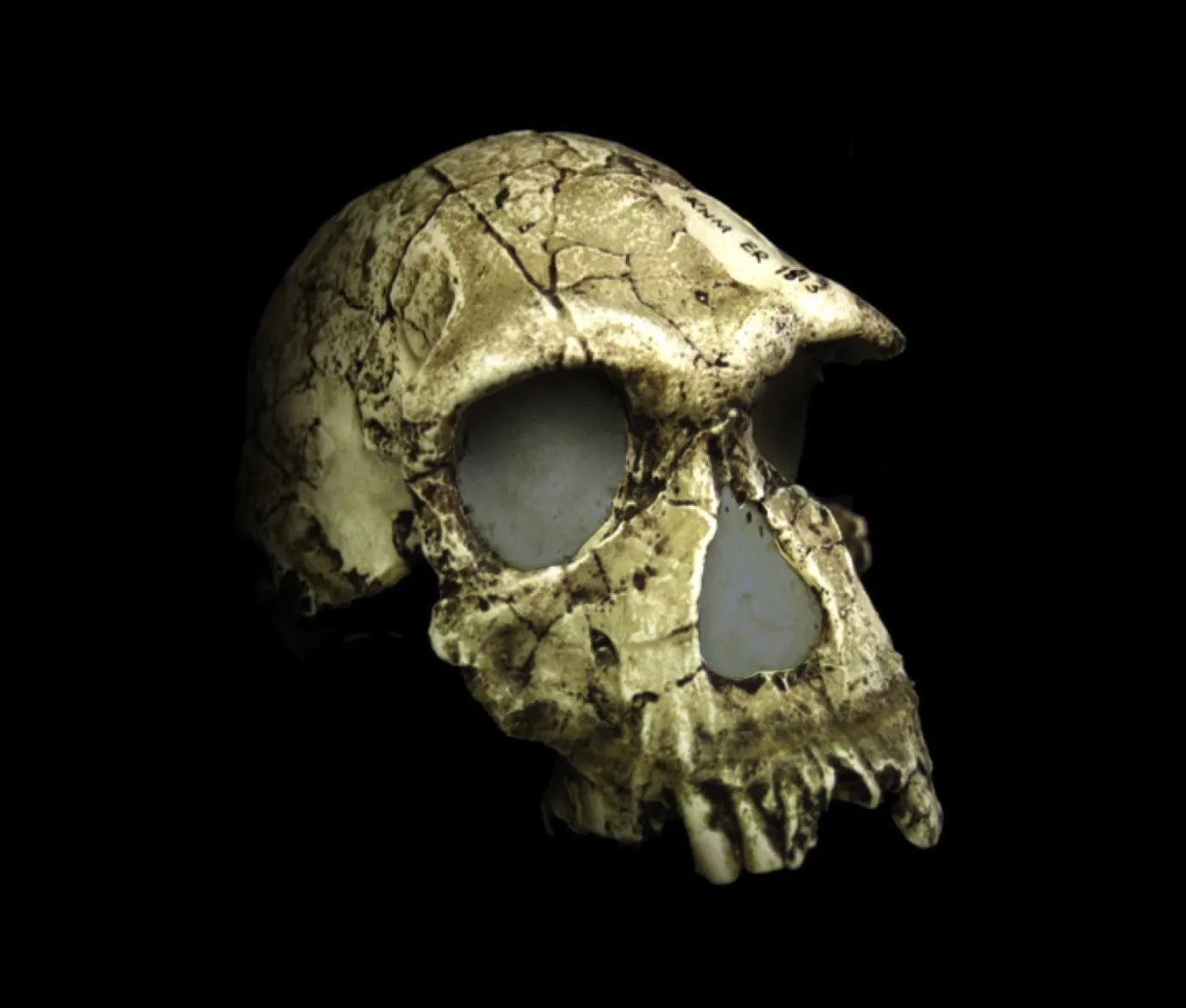
KNM-ER 1813 is one of the most complete skulls of an early member of our genus. Its brain was small, an estimated 510 cubic centimetres, little more than a third of a modern human brain. The face is small and slightly projecting, and the third molars have erupted and are worn, so this was a fully grown adult. The cast shown here has a number written on it, which is why this skull was easy to identify in the old photographs.
The find
The skull was found in 1973 at Koobi Fora in northern Kenya by Kamoya Kimeu, the leader of the “Hominid Gang”, the team of Kenyan fossil finders who worked with Richard Leakey. It is about 1.9 million years old. It was assigned to Homo habilis, and it is regarded as a typical example of that species.
A question about early Homo
When 1813 was found it brought up an uncomfortable fact. The big skull KNM-ER 1470 was from about the same time and place, but it was much larger, with a bigger brain and a broader face. Did the two belong to the same species, perhaps male and female or just varied individuals, or were there two kinds of early Homo living at once? Some researchers call the larger form Homo rudolfensis. Others argue for one varied species. The Dmanisi skulls from Georgia, which differ from each other almost as much, have added to the argument.
Where it is
The original belongs to the National Museum of Kenya, in Nairobi.
Sources
- Smithsonian National Museum of Natural History, Human Origins Program. Homo habilis.
- Wood, B. (1991). Koobi Fora Research Project, Volume 4: Hominid Cranial Remains. Clarendon Press.