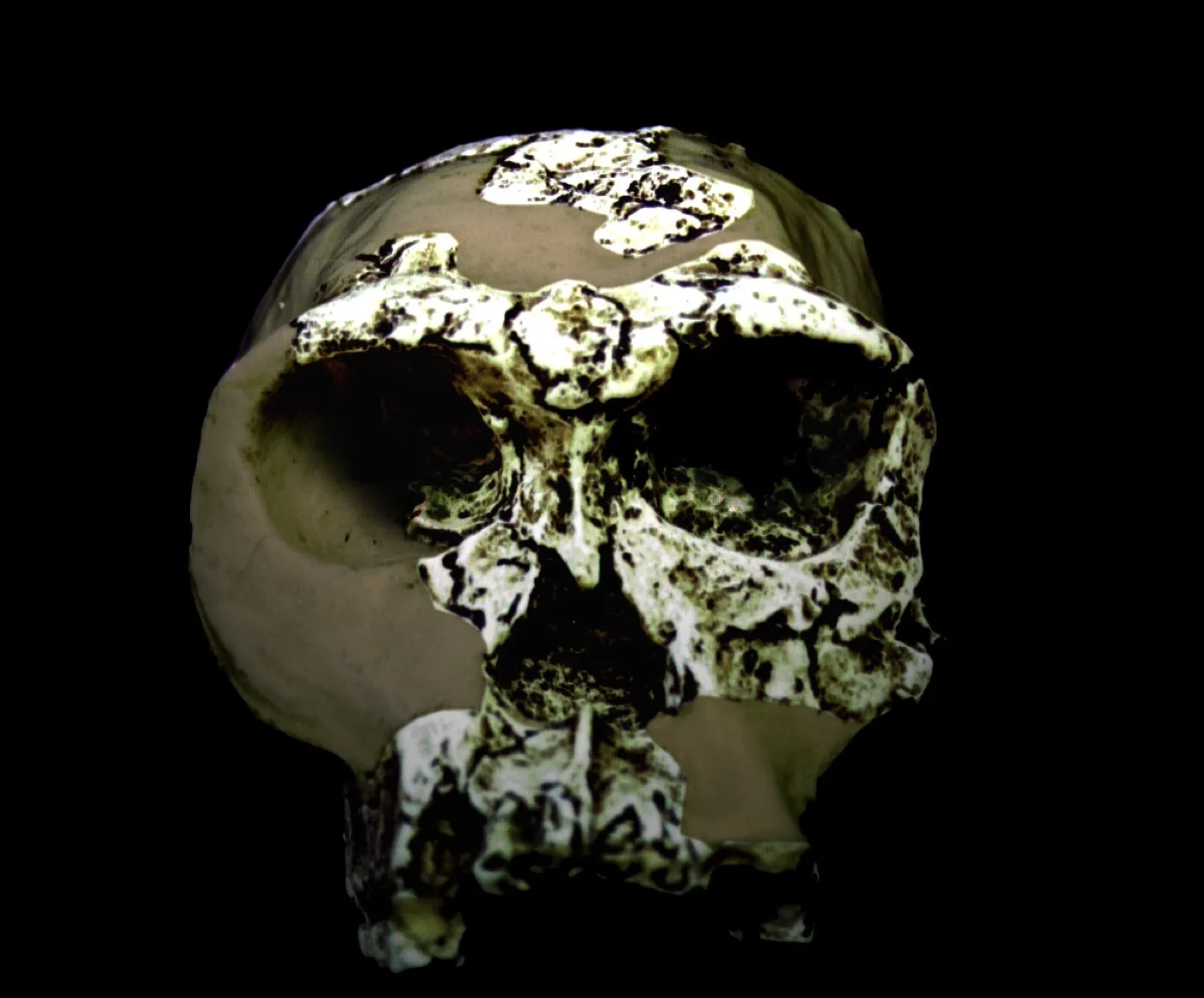

The skull in brief
OH 24, Olduvai Hominid 24, is a skull of an early Homo habilis from about 1.8 million years ago. It was found crushed almost flat, like the thin fashion model Twiggy, and so it was nicknamed after her. The cast shown here has the gaps between the surviving pieces of bone filled in, which gives an idea of how much had to be rebuilt.
The find
Peter Nzube, a member of the Leakeys’ team, found the fragments in 1968 at Olduvai Gorge in Tanzania, crushed flat and cemented together in a crust of limestone. Little was made of it at first. The pieces were reconstructed with great effort, and the anatomist Ron Clarke later did much of the work of rebuilding and studying it. Mary Leakey, Ron Clarke and Louis Leakey described it in Nature in 1971. The brain, estimated at just under 600 cubic centimetres, is uncertain because of the distortion that remains.
Why it matters
OH 24 is the oldest skull found at Olduvai Gorge, and after OH 5 the most complete. Its wisdom teeth had come through but show almost no wear, so this was a young adult who died soon after they erupted. Researchers compare it with other early Homo fossils, such as KNM-ER 1813 and KNM-ER 1470, when they try to decide how many species of early Homo there were.
Sources
- Smithsonian National Museum of Natural History, Human Origins Program. Homo habilis.
- Leakey, M. D., Clarke, R. J. and Leakey, L. S. B. (1971). New hominid skull from Bed I, Olduvai Gorge, Tanzania. Nature 232: 308 to 312.
- Leakey, L. S. B., Tobias, P. V. and Napier, J. R. (1964). A new species of the genus Homo from Olduvai Gorge. Nature 202: 7 to 9.