The skeleton in brief
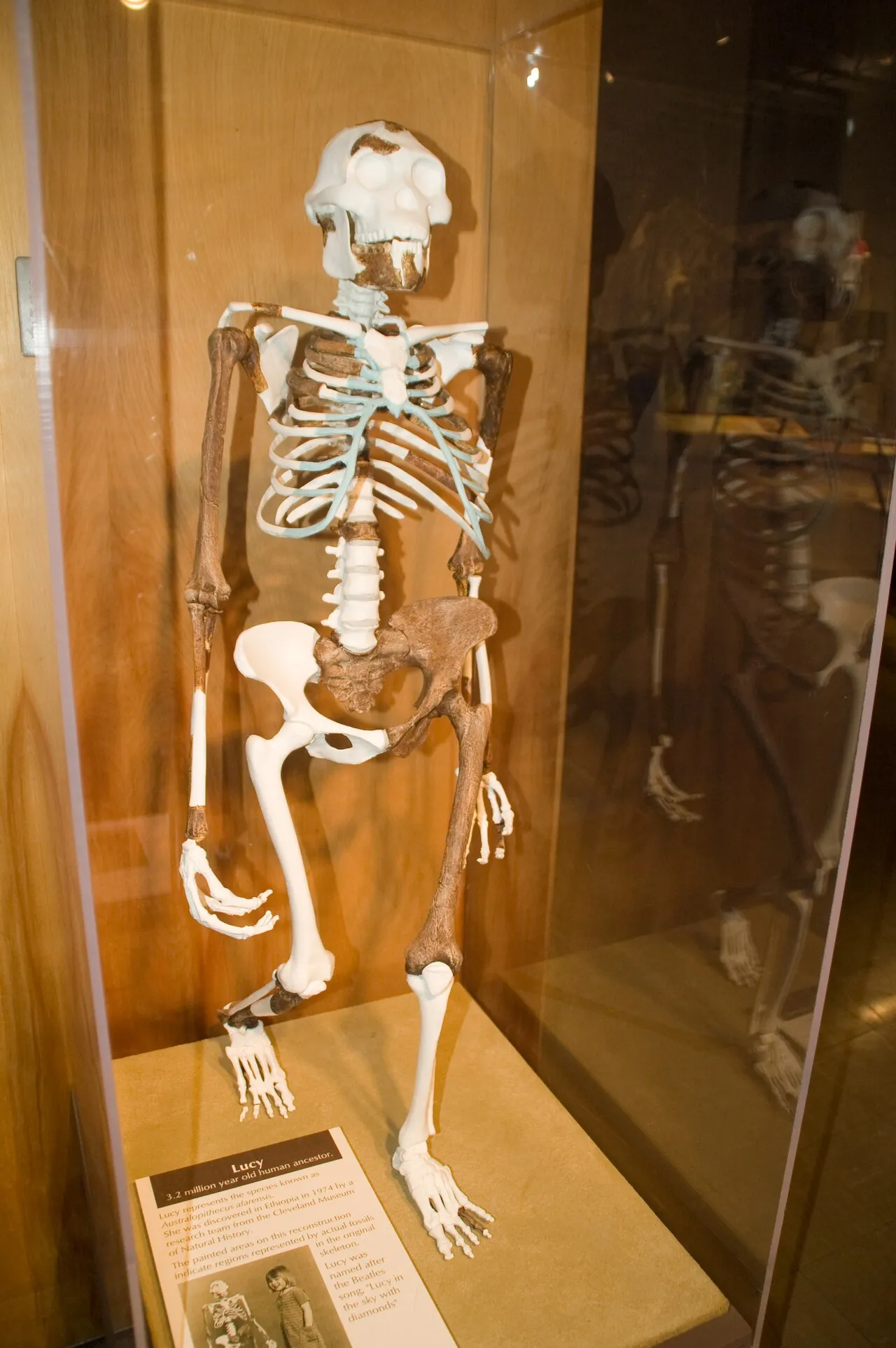
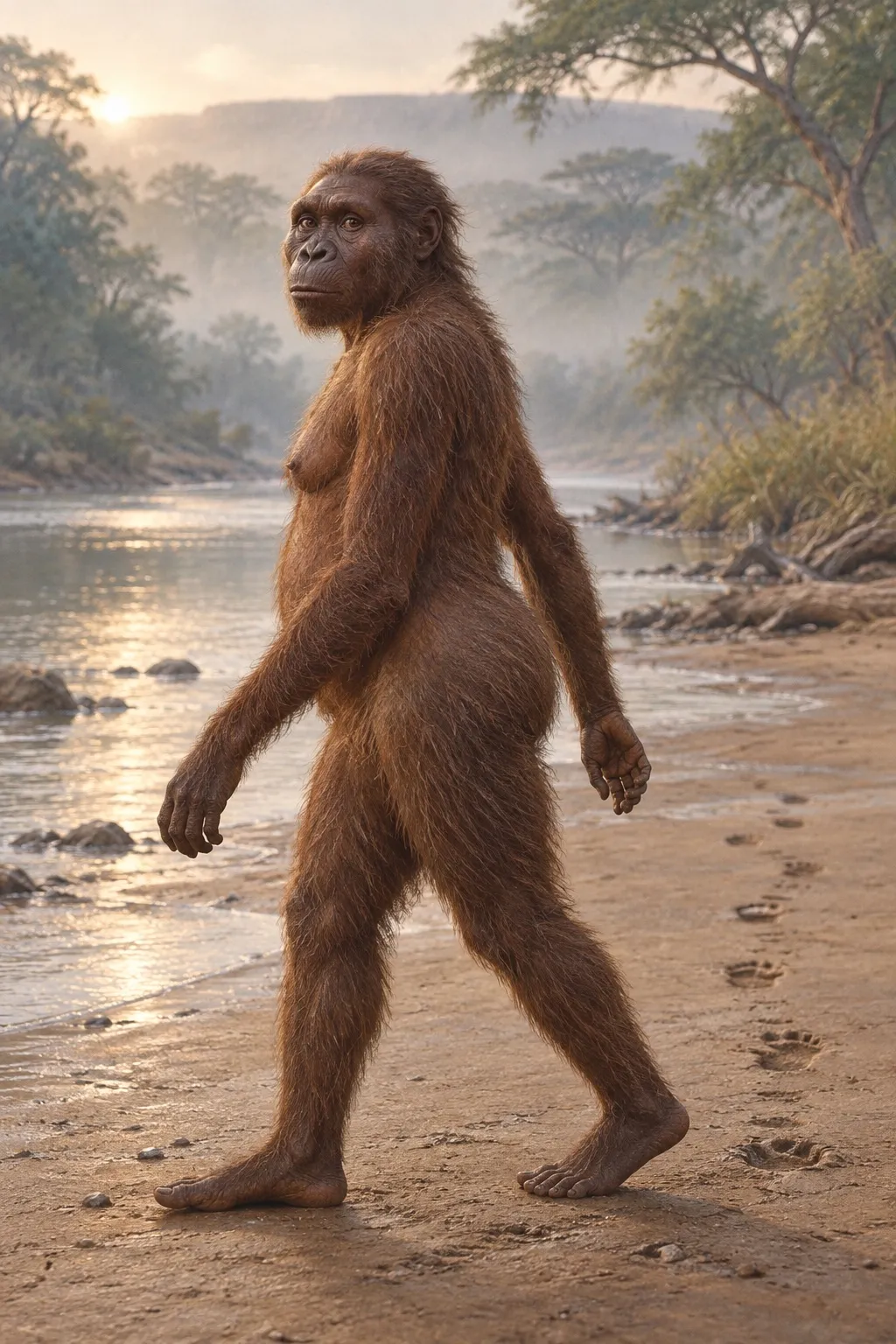
Lucy, catalogued AL 288-1 (Afar Locality 288, specimen 1), is the most famous fossil of early human relatives. About 40 percent of one adult female skeleton survives: parts of the skull and jaw, ribs, spine, pelvis, arms and legs. Published estimates put her at about 1.0 to 1.1 metres (3 ft 3 in to 3 ft 7 in) tall. The figure of 29 kilograms often quoted for her matches the female average for A. afarensis in McHenry’s 1992 study, but that study gives it as a species average, not a weight measured for Lucy herself. A 2018 study by Brassey and colleagues, which estimated body mass from a digital reconstruction of her skeleton, gave a best estimate of 20.4 kilograms, with a 95% prediction interval of 13.5 to 30.9 kg. The authors note that the result depends on how full her rebuilt trunk is: making it 10 or 20 percent larger raises the estimate to 23.5 or 27 kg. So her weight is uncertain. Her brain was small, about 390 cubic centimetres in a 2020 study that used virtual casts of the inside of her skull (range 365 to 417), but her pelvis and leg bones show that she walked upright. Her species is Australopithecus afarensis.
The find
On 24 November 1974 Donald Johanson and the graduate student Tom Gray were surveying a gully at Hadar in Ethiopia’s Afar region when Johanson spotted a piece of arm bone. Around it lay many more pieces of one small skeleton. That night the team played the Beatles song “Lucy in the Sky with Diamonds” in camp, and the name stuck. In Ethiopia she is called Dinkinesh, Amharic for “you are marvellous”. The fragments were reconstructed at the Cleveland Museum of Natural History.
What she showed
- Walking before big brains. Lucy proved in a single skeleton that upright walking came long before large brains. Many scientists had expected the opposite.
- Still a climber. Her long arms and curved fingers suggest she spent time in trees as well.
- How she died. It is unknown. A 2016 study argued that her bones show injuries from a fall from a tall tree, but Johanson and others disagreed.
Where she is
The original bones are kept in a secure vault in the National Museum of Ethiopia in Addis Ababa, which displays a cast. Lucy toured the United States from 2007 to 2013 and was shown in Prague in 2025. Casts are in many museums.
Sources
- Brassey, C. A. and others (2018). A volumetric technique for fossil body mass estimation applied to Australopithecus afarensis. Journal of Human Evolution 115: 47 to 64.
- McHenry, H. M. (1992). Body size and proportions in early hominids. American Journal of Physical Anthropology 87: 407 to 431. Source of the 29 kg female average.
- Gunz, P. and others (2020). Australopithecus afarensis endocasts suggest ape-like brain organization and prolonged brain growth. Science Advances 6: eaaz4729.
- Johanson, D. C. and Edey, M. (1981). Lucy: The Beginnings of Humankind. Simon and Schuster.
- Smithsonian National Museum of Natural History, Human Origins Program. Australopithecus afarensis.