
The skeleton in brief
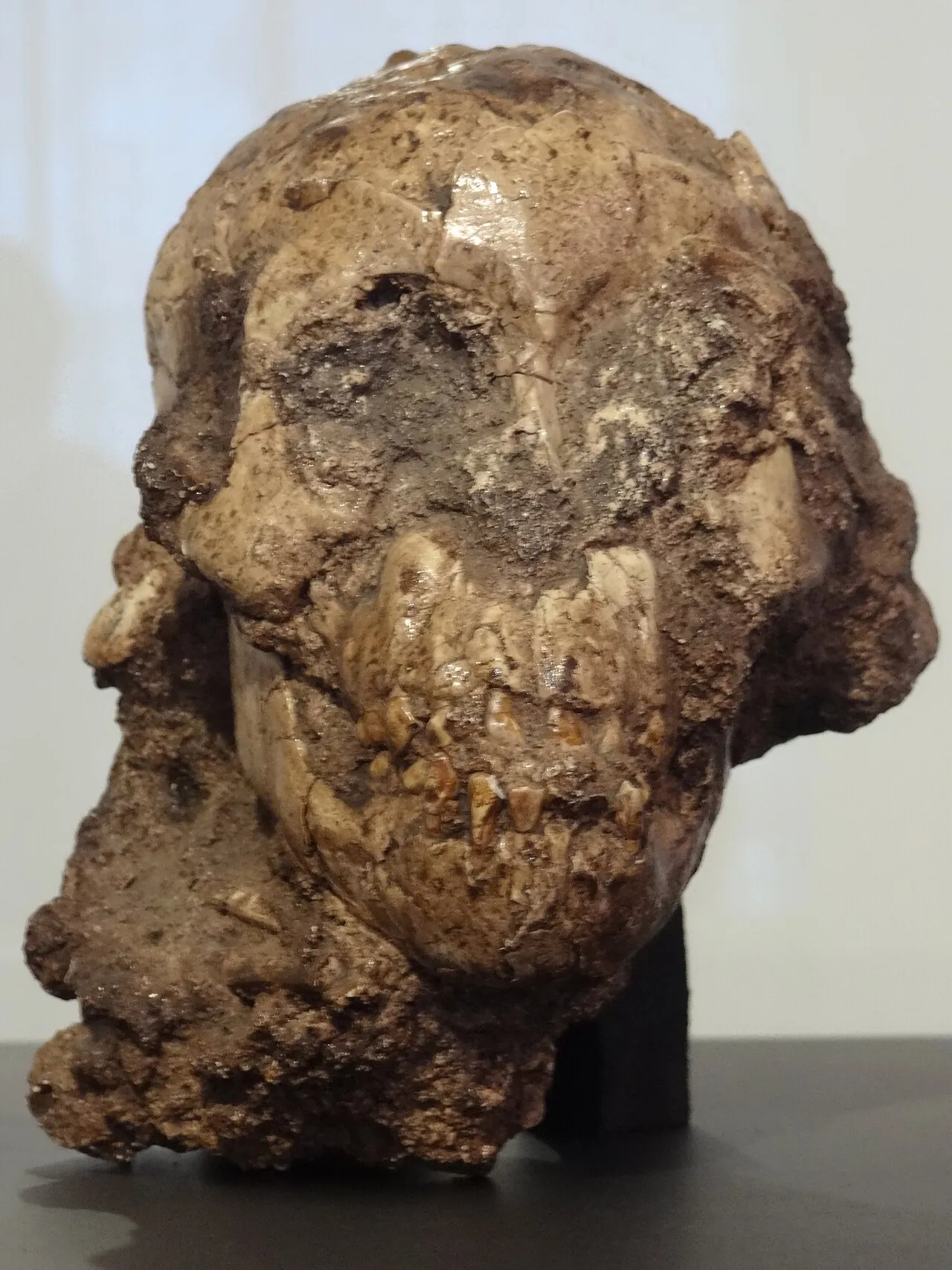
Selam, catalogued DIK-1/1, is the skeleton of a child of about three years old, from the species Australopithecus afarensis, the species of Lucy. It is about 3.3 million years old, roughly 100,000 years older than Lucy. Nearly the whole skull and torso survive, with many limb bones, a tiny hyoid bone from the throat, a shoulder blade and foot bones. Selam means “peace” in Amharic. CT scans of the unerupted canine teeth suggest that it was a girl.
The find
In 2000 the Ethiopian paleoanthropologist Zeresenay Alemseged found the skeleton at Dikika, in the Afar region of Ethiopia, not far from Hadar, where Lucy was found. It lay in a block of hard sandstone, and Alemseged spent about five years cleaning the bones from the rock with a dental tool and needle. The find was published in Nature in 2006.
What it shows
- Walking and climbing. The legs and feet show that Selam walked upright, while the shoulder blade resembles a gorilla’s and suggests that young afarensis still climbed well.
- A child’s brain. The brain was small, and it seems to have grown slowly, more like an ape’s than a modern child’s.
- Preservation. It is rare to find so complete a child, including delicate throat bones, so Selam gives a unique glimpse of how these early people grew up.
Where it is
The skeleton belongs to Ethiopia and is kept in the National Museum of Ethiopia in Addis Ababa.
Sources
- Alemseged, Z. and others (2006). A juvenile early hominin skeleton from Dikika, Ethiopia. Nature 443: 296 to 301.
- Smithsonian National Museum of Natural History, Human Origins Program. Australopithecus afarensis.