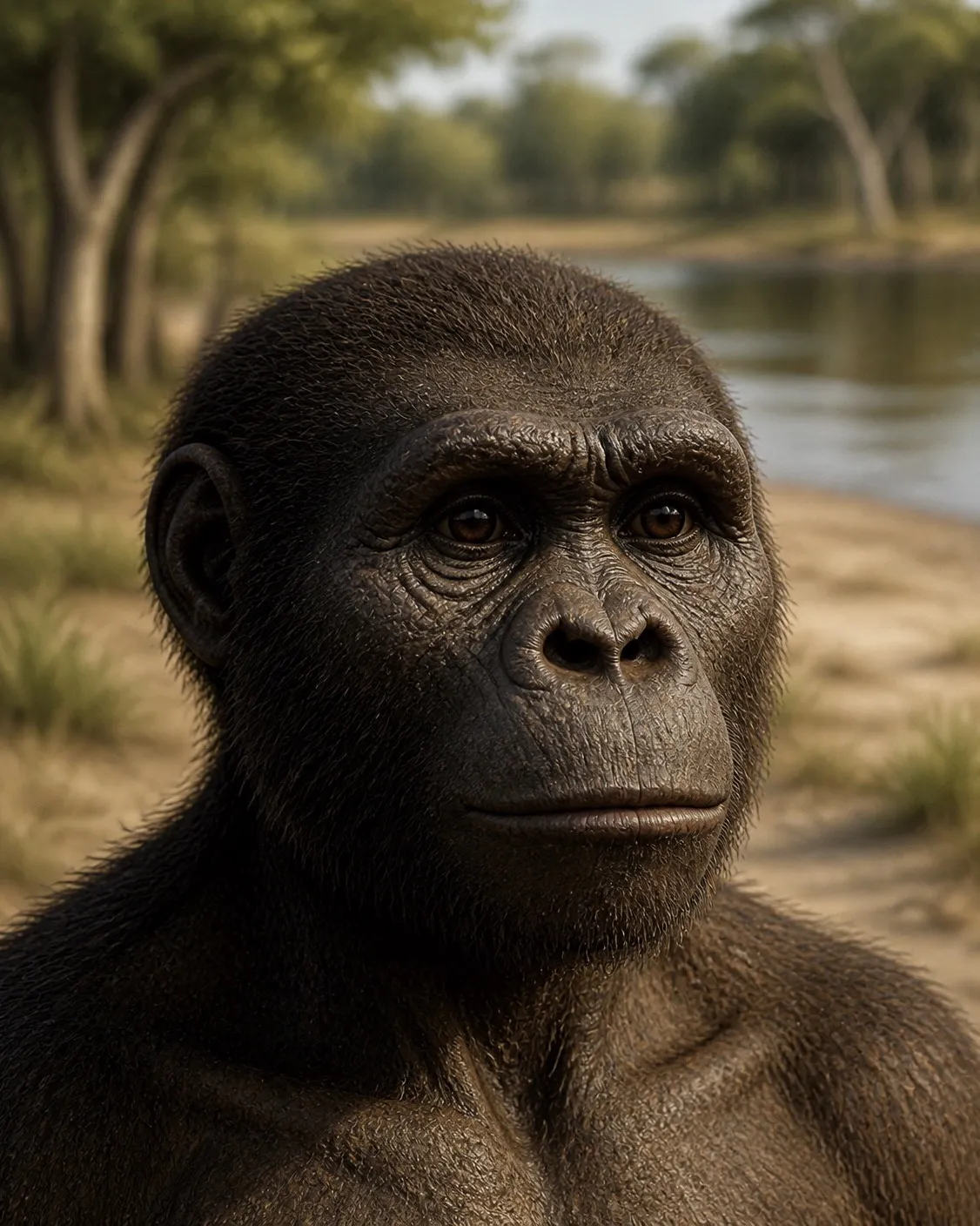
Ahounta Djimdoumalbaye is a Chadian fossil hunter credited with spotting Toumai, the skull of Sahelanthropus tchadensis, in the Djurab Desert on 19 July 2001. About 7 million years old, it is one of the oldest possible human relatives known. Ahounta was a young member of a Chadian and French mission led by Michel Brunet and is a co-author of the 2002 Nature paper.
The last day of the trip
On 19 July 2001, the last day of an expedition, a small field team was working at Toros-Menalla, in the Djurab Desert of northern Chad. It included Ahounta Djimdoumalbaye, then a student, the Chadian Fanoné Gongdibé and the French researcher Alain Beauvilain, and it was part of the Franco-Chadian mission led by Michel Brunet of the University of Poitiers. At a spot catalogued as TM 266, Ahounta saw a skull lying in the sand.
It was badly crushed, but mostly complete. It became known as Toumai, a name given by the president of Chad at the time, Idriss Déby. In 2002 Brunet’s team named a new species from it in Nature, Sahelanthropus tchadensis, and listed Ahounta among the paper’s authors, under the name order “Djimdoumalbaye Ahounta”. That matters, because local finders have often gone unnamed in the record.
What the record does not say
Very little has been published about Ahounta’s own life. We could not find a reliable birth date, a full account of Ahounta’s schooling or a later career, so this page gives only what the sources support. If you can add to it, we would like to hear from you through the contact page.
The arguments that followed
The find has been argued over ever since, in two ways. The first is whether Sahelanthropus walked upright and belongs on the human side of the family tree at all. A 2022 paper on a thigh bone and arm bones from the same site says it did, and other studies disagree.
The second is how the skull was found. Beauvilain, who was there, later wrote that it was collected from the surface and was not dug out of a layer of rock, which affects how securely it can be dated. He and Brunet’s team disagreed in public over this and over the thigh bone. None of this changes who is credited with seeing the skull first.
Sources
- Brunet, M. and others, including Ahounta, D. (2002). A new hominid from the Upper Miocene of Chad, Central Africa. Nature 418: 145 to 151.
- Beauvilain, A. (2008). The contexts of discovery of Australopithecus bahrelghazali (Abel) and of Sahelanthropus tchadensis (Toumaï): unearthed, embedded in sandstone or surface collected? South African Journal of Science 104: 165 to 168.
- Daver, G. and others (2022). Postcranial evidence of late Miocene hominin bipedalism in Chad. Nature 609: 94 to 100.
- Wikipedia: Michel Brunet (checked for the team and the find, 2026-11-03)
Last checked 3 November 2026. Spotted a mistake? Tell us.