Lomekwi 3 in brief
Lomekwi 3 is a low hill cut by a small ravine in the dry country west of Lake Turkana, in the far north of Kenya. The layers there belong to the Lomekwi Member of the Nachukui Formation, lake and river deposits laid down between about 3.44 and 2.53 million years ago. In 2011 a team found stone tools weathering out of the hill, and digging showed more of them buried in the layers. They are about 3.3 million years old, the oldest stone tools known anywhere.
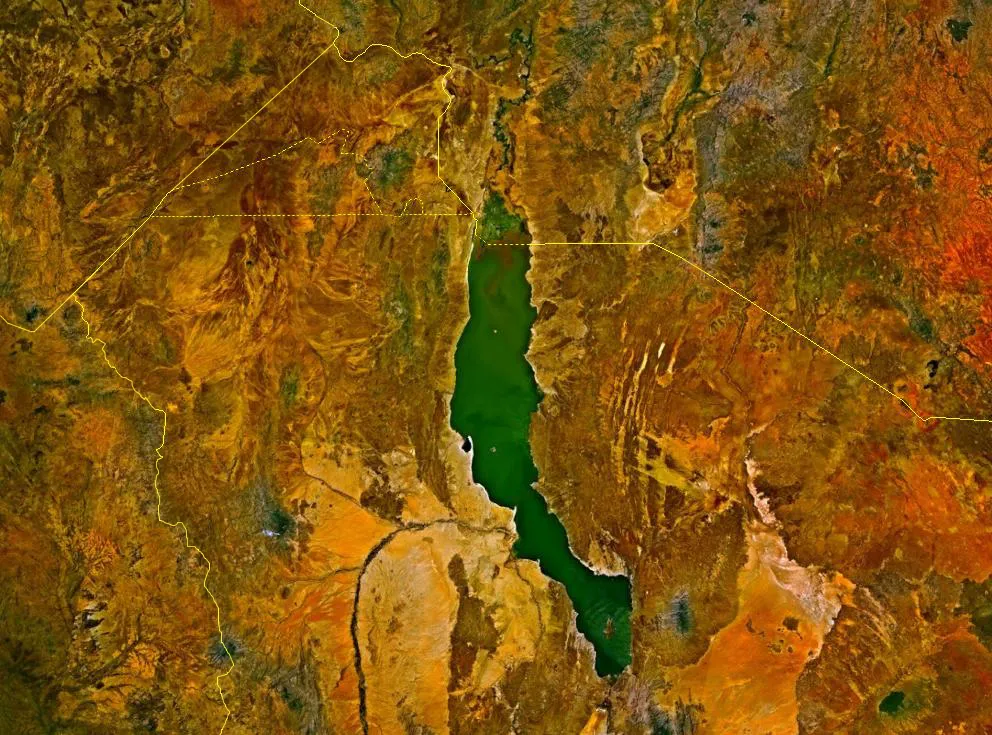
The wider Lomekwi area had already given up two famous skulls: the Black Skull, KNM-WT 17000, found by Alan Walker’s team in 1985, and the flat-faced skull of Kenyanthropus platyops, KNM-WT 40000, found by Justus Erus of Meave Leakey’s team in 1999. The photo above is a satellite view of the lake; Lomekwi lies near its western shore.
Discovery
The West Turkana Archaeological Project, led by Sonia Harmand and Jason Lewis and working with the National Museums of Kenya, started looking for old tool sites in the area in 2011. In July that year the team took a wrong branch of a dry riverbed, the Lomekwi laga, and stopped where it ran out. Sammy Lokorodi, a local surveyor on the team, walked up the slope and found the site, with stone tools lying on the surface.
The team dug a small trench there in 2011 and 2012. They reported the tools in Nature in May 2015 and named this new, older kind of toolmaking the Lomekwian.
How it was dated
The tools were not dated directly. Their age comes from the layers around them:
- A volcanic ash about 10 metres below the buried tools matches the Toroto Tuff, dated to 3.31 million years ago. So the tools are younger than that.
- The sediments holding the tools record a time when Earth’s magnetic field was reversed. That fits the Mammoth reversal, between 3.33 and 3.21 million years ago.
- Working out how fast the layers built up between dated ashes puts the tools at about 3.3 million years.
Until then, the oldest known tools were Oldowan tools from Gona in Ethiopia, about 2.6 million years old, named after Olduvai Gorge. Lomekwi 3 is about 700,000 years older than those.
The tools
The 2015 paper describes 149 pieces from the first two seasons: 19 dug from the buried layer and 130 found on the surface or in the slope above it. One core fits back together with a flake found on the surface, which helps show that the surface pieces came out of the same layer.
- 83 cores (the stones flakes were struck from), 35 flakes, 7 possible anvils, 7 hammerstones, and a few worked or split cobbles.
- They are big. The average core weighs about 3.1 kilograms, and the heaviest pieces, used as anvils, weigh up to 15 kilograms. Later Oldowan tools are mostly small enough to hold in one hand.
- They were made from local lava rocks: basalt, phonolite and trachy-phonolite.
- The makers seem to have rested a stone on an anvil and hit it, or swung it against the anvil, rather than holding the core in one hand and striking it with the other. Many flakes stop short with a step or hinge, the mark of a knapper who was still working out how stone breaks.
Who made them?
Nobody knows. No fossils were found with the tools, and the earliest known Homo, a jaw from Ethiopia about 2.8 million years old, is about 500,000 years younger. The only hominin known from West Turkana at this time is Kenyanthropus platyops, found within a few kilometres of the site and in layers of the same age, so it is the leading candidate. Australopithecus afarensis, the species of Lucy, lived in Ethiopia then too, and cut marks on animal bones from Dikika, Ethiopia, about 3.4 million years old, may have been made with stone tools.
Either way, Lomekwi 3 shows that making stone tools did not start with Homo and its bigger brain, as was long thought.
The debate
Not everyone is convinced. Manuel Domínguez-Rodrigo and Luis Alcalá have argued, in 2016 and 2019, that most of the tools were found on the surface and that the site might mix material of different ages. The Lomekwi team answered in 2019, pointing to the tools dug from the buried layer and the refit between a buried core and a surface flake. Some researchers also find the tools’ large size puzzling. The 19 excavated pieces are the core of the case, and most archaeologists now accept Lomekwi 3 as the oldest known toolmaking site, though it is still argued over.
Newer finds have since filled in the gap after it. Oldowan tools at Nyayanga in western Kenya are about 2.9 million years old, and at Namorotukunan, across the lake near Koobi Fora, Oldowan toolmaking went on for about 300,000 years, from 2.75 to 2.44 million years ago.
Visiting
Lomekwi 3 is a remote research site in the dry hills of Turkana County, with no visitor facilities. In 2021 and 2022 the National Museums of Kenya in Nairobi marked ten years since the discovery with an exhibition of the tools, and in 2022 the exhibition, with replicas, moved to Lodwar, the main town of Turkana County. See also the Black Skull, found in the Lomekwi area.
Sources
- Harmand, S. and others (2015). 3.3-million-year-old stone tools from Lomekwi 3, West Turkana, Kenya. Nature 521: 310 to 315.
- Lewis, J. E. and Harmand, S. (2016). An earlier origin for stone tool making: implications for cognitive evolution and the transition to Homo. Philosophical Transactions of the Royal Society B 371: 20150233.
- Domínguez-Rodrigo, M. and Alcalá, L. (2016). 3.3-million-year-old stone tools and butchery traces? More evidence needed. PaleoAnthropology 2016: 46 to 53.
- Domínguez-Rodrigo, M. and Alcalá, L. (2019). Pliocene archaeology at Lomekwi 3? New evidence fuels more skepticism. Journal of African Archaeology 17: 173 to 176.
- Harmand, S. and others (2019). Reply to Domínguez-Rodrigo and Alcalá: Interpretation without accurate evidence is fantasy. Journal of African Archaeology 17: 177 to 181.
- McPherron, S. P. and others (2010). Evidence for stone-tool-assisted consumption of animal tissues before 3.39 million years ago at Dikika, Ethiopia. Nature 466: 857 to 860.
- Semaw, S. and others (2003). 2.6-million-year-old stone tools and associated bones from OGS-6 and OGS-7, Gona, Afar, Ethiopia. Journal of Human Evolution 45: 169 to 177.
- Plummer, T. W. and others (2023). Expanded geographic distribution and dietary strategies of the earliest Oldowan hominins and Paranthropus. Science 379: 561 to 566.
- Braun, D. R. and others (2025). Early Oldowan technology thrived during Pliocene environmental change in the Turkana Basin, Kenya. Nature Communications 16: 9401.
Last checked 27 November 2026. Spotted a mistake? Tell us.