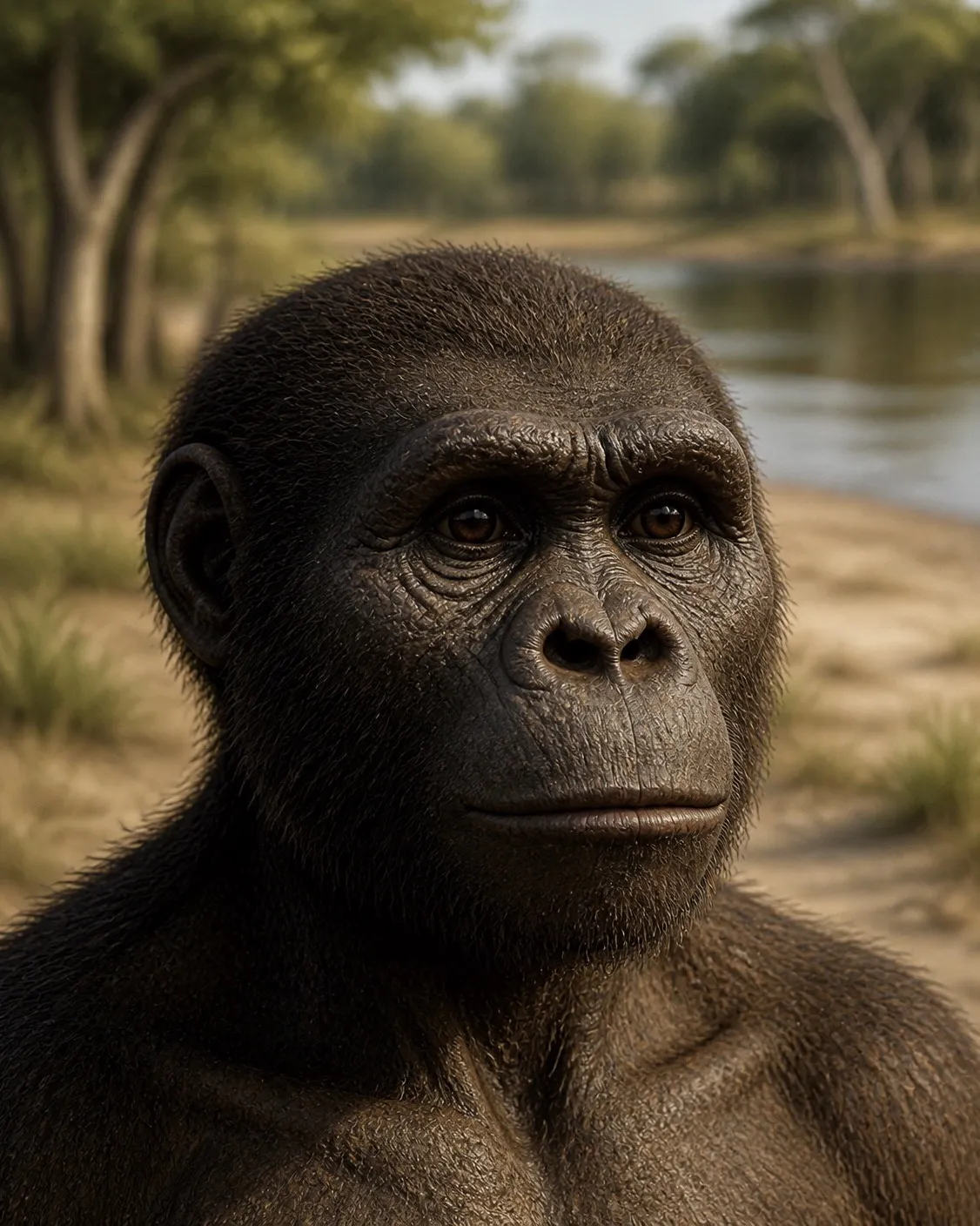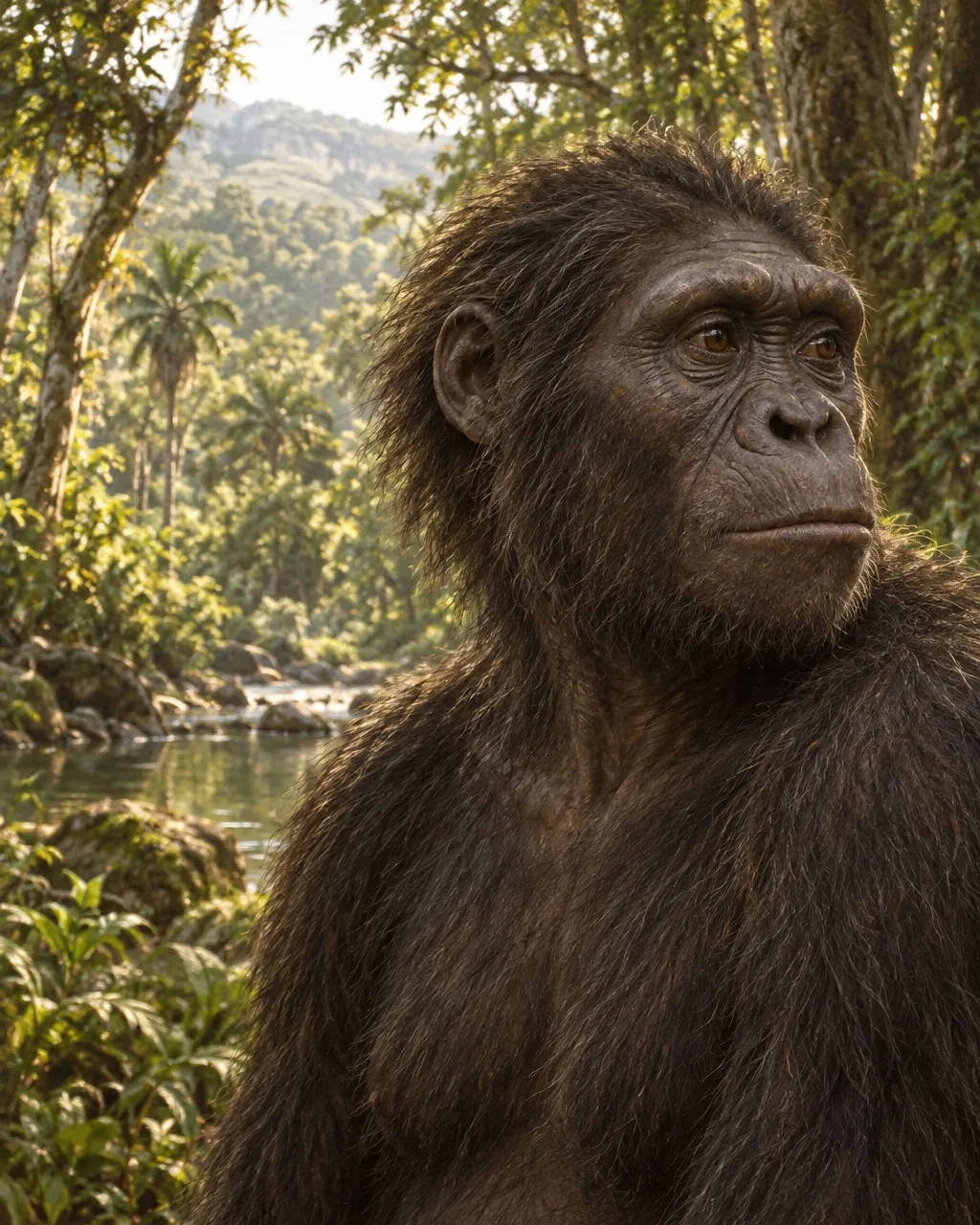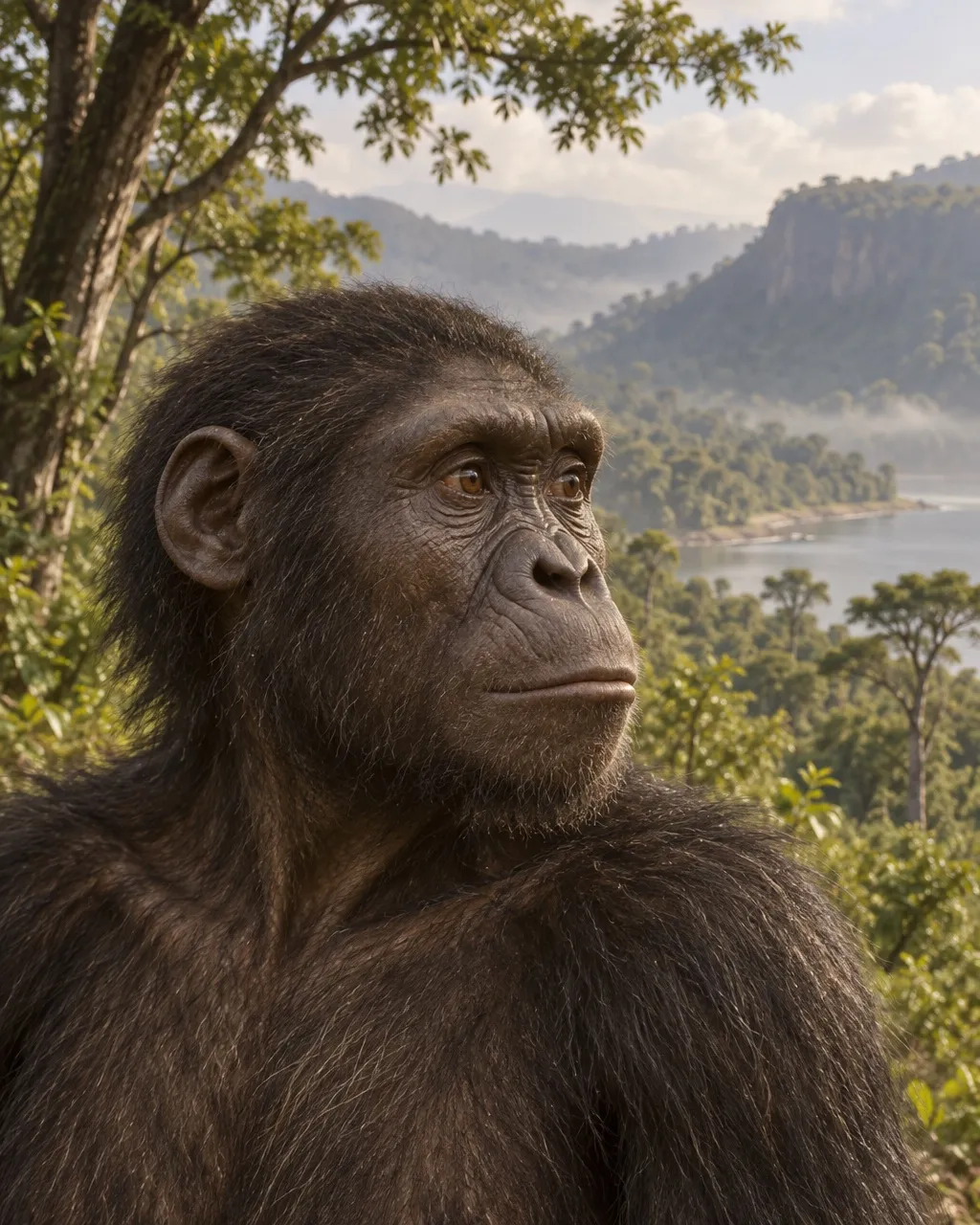
Orrorin tugenensis is one of the oldest possible members of the human family, known from about 20 fossils found in the Tugen Hills of Kenya and dated to about 6 million years ago. Its thigh bones suggest it walked upright on the ground, while its arm and finger bones show it still climbed trees.
The species in brief
Orrorin tugenensis lived about 6 million years ago in the wooded hills of central Kenya, close to the time when the human line and the chimpanzee line went their separate ways. It is known from only about 20 fossils (the Smithsonian counts 13), and not a single skull. But among those fossils are three pieces of thigh bone, and those have made Orrorin one of the most argued-over species in the story of how our ancestors came to walk on two legs.
Discovery
The Tugen Hills rise west of Lake Baringo in Kenya’s Rift Valley. Their layers of rock hold fossils from many periods. A single hominin-like molar was found there in 1974. In 2000 the Kenya Palaeontology Expedition, led by Brigitte Senut of the National Museum of Natural History in Paris and Martin Pickford, found more pieces at four sites in the Lukeino Formation. The finds included parts of lower jaws, teeth, thigh bones, an upper arm bone and a finger bone, from at least five individuals.
Senut, Pickford and colleagues named the species in early 2001. Because the first finds were announced around the turn of the millennium, newspapers called it Millennium Man.
How old it is
The Lukeino Formation lies between dated volcanic layers, and the fossils are about 6 million years old. The range is usually given as about 6.1 to 5.7 or 5.8 million years. A 2002 study using potassium-argon dating and magnetic records put the formation at about 6.0 to 5.7 million years, and argon-argon dates on the upper part of the formation at Kapcheberek give 5.88 to 5.72 million years. That makes Orrorin a little younger than Sahelanthropus tchadensis from Chad, at about 7 million years, and a little older than Ardipithecus kadabba from Ethiopia.
The thigh bones
The best fossil is BAR 1002’00, the top end of a left femur. It has a long neck joining the ball of the hip to the shaft. In 2004 Karen Galik and colleagues published CT scans showing that the outer bone of the neck is thin on top and much thicker underneath. In apes it is about equally thick all round. In humans and other bipeds, the thick lower edge carries the weight of the body while walking upright. The team concluded that Orrorin was bipedal.
Other researchers took a closer look. In 2008 Brian Richmond and William Jungers compared the femur with those of apes and many hominins and found that it most resembles the femurs of Australopithecus and Paranthropus, millions of years younger. Their conclusion was that Orrorin walked upright with hip mechanics like the australopiths’, not like ours. A 2013 study by Sergio Almécija and colleagues found that the femur sits between those of Miocene apes and the australopiths. Each study supports some form of upright walking, but they disagree about how human-like it was.
Climbing and teeth
The upper arm bone and the curved finger bone are built for climbing, so Orrorin probably spent part of its time in trees. Its cheek teeth are small for its size and have thick enamel, closer to later hominins than to chimpanzees, while its canine is fairly pointed and ape-like. It probably ate a mix of fruit, leaves, seeds, nuts and other plant foods, and perhaps insects.
From the size of its bones it was roughly the size of a female chimpanzee, perhaps 30 to 50 kilograms.
The argument
Senut and Pickford argued that Orrorin was a direct ancestor of humans, more so than Lucy’s species, which they would put on a side branch. Few other researchers accept that. Most agree that Orrorin is a good candidate for an early member of the human line, but the fossils are too few and broken to say exactly where it fits, or even, for some sceptics, whether it is a hominin at all rather than an ape that lived near the split.
Where it fits in the family tree
Orrorin belongs with Sahelanthropus and Ardipithecus among the earliest possible hominins, between about 7 and 4.4 million years ago. Its environment, with forest and woodland, supports the idea that upright walking began among apes that still lived among trees, not out on open grassland.
Where to see it
The Orrorin fossils belong to Kenya and are kept there. Casts of the thigh bone and jaw are shown in some museums.
Sources
- Smithsonian National Museum of Natural History, Human Origins Program. Orrorin tugenensis.
- Australian Museum. Orrorin tugenensis.
- Senut, B., Pickford, M., Gommery, D., Mein, P., Cheboi, K. and Coppens, Y. (2001). First hominid from the Miocene (Lukeino Formation, Kenya). Comptes Rendus de l’Académie des Sciences, Earth and Planetary Science 332: 137 to 144.
- Pickford, M. and Senut, B. (2001). ‘Millennium Ancestor’, a 6-million-year-old bipedal hominid from Kenya. South African Journal of Science 97: 22.
- Deino, A. L., Tauxe, L., Monaghan, M. and Hill, A. (2002). 40Ar/39Ar geochronology and paleomagnetic stratigraphy of the Lukeino and lower Chemeron Formations at Tabarin and Kapcheberek, Tugen Hills, Kenya. Journal of Human Evolution 42: 117 to 140.
- Sawada, Y. and others (2002). The age of Orrorin tugenensis, an early hominid from the Tugen Hills, Kenya. Comptes Rendus Palevol 1: 293 to 303.
- Galik, K. and others (2004). External and internal morphology of the BAR 1002’00 Orrorin tugenensis femur. Science 305: 1450 to 1453.
- Richmond, B. G. and Jungers, W. L. (2008). Orrorin tugenensis femoral morphology and the evolution of hominin bipedalism. Science 319: 1662 to 1665.
- Almécija, S. and others (2013). The femur of Orrorin tugenensis exhibits morphometric affinities with both Miocene apes and later hominins. Nature Communications 4: 2888.
Cite this page
Bonelore. "Orrorin tugenensis." https://bonelore.com/species/orrorin-tugenensis/
Last checked 27 November 2026. Spotted a mistake? Tell us.