The skull in brief
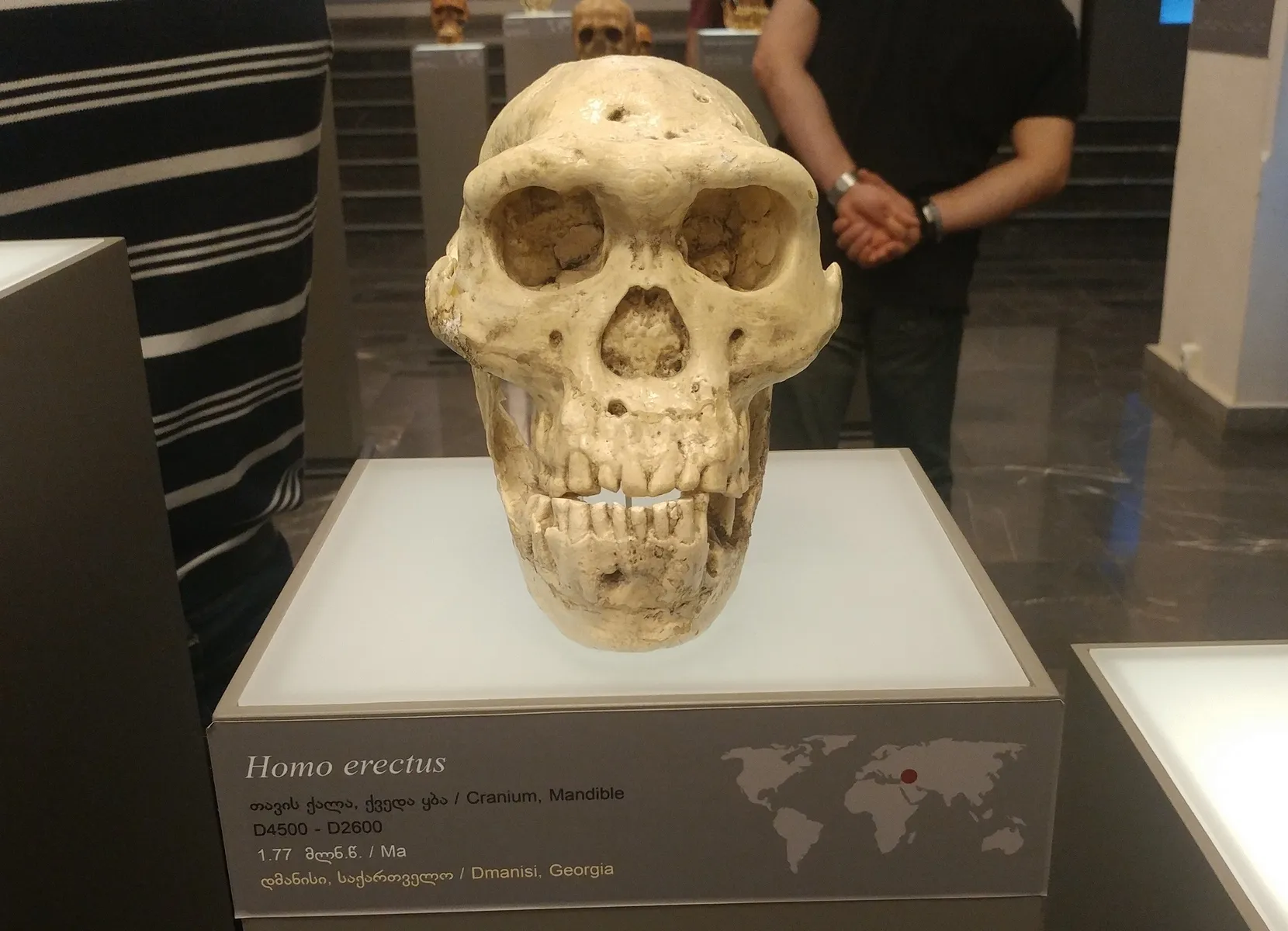
Skull 5 is the fifth skull found at Dmanisi in Georgia, and the most complete of them. Its catalogue number is D4500, and it fits with a lower jaw, D2600. It is about 1.8 million years old, which makes it the most complete skull of its age and the first complete adult skull of an early human relative of that antiquity. Its brain was only about 546 cubic centimetres, comparable to a large Australopithecus, but the features of the face, brow and teeth are those of early Homo erectus.
The find
Dmanisi is a medieval hilltop town site about 90 kilometres south-west of Tbilisi. In 1991 David Lordkipanidze and colleagues found traces of very early human occupation beneath it, and since then excavations have produced five skulls and many bones. The jaw D2600 was found in 2000, and the skull D4500 in 2005. The team later matched them as parts of the same individual. The pair was described in the journal Science in October 2013.
What it shows
- Large face, small brain. The brow, cheekbones and face are massive, among the largest of any early human relative, and the skull probably belonged to a male. The braincase is much smaller than those of the other Dmanisi skulls, which hold between about 600 and 780 cubic centimetres.
- Body. Limb bones from Dmanisi, described in 2007, show that these people were small, about 1.5 metres tall, with body proportions close to ours and at the low end of modern variation.
- One population. All five skulls come from the same place and about the same time. Differences among them are about as large as those among modern people, or among chimpanzees.
The argument
Lordkipanidze’s team concluded that the range of variation at Dmanisi is no larger than in a single living species. If that is right, early African fossils that look very different from each other, such as those called Homo habilis and Homo rudolfensis, could belong to one variable lineage, along with early Homo erectus. Many researchers disagree and think that the African fossils represent more than one species. The debate continues.
Where it is
The Dmanisi fossils are kept at the Georgian National Museum in Tbilisi, where the skull is on display. The photograph on this page is of that display.
Sources
- Lordkipanidze, D. and others (2013). A complete skull from Dmanisi, Georgia, and the evolutionary biology of early Homo. Science 342: 326 to 331.
- Lordkipanidze, D. and others (2007). Postcranial evidence from early Homo from Dmanisi, Georgia. Nature 449: 305 to 310.
- Smithsonian National Museum of Natural History, Human Origins Program: Dmanisi.