The skeleton in brief
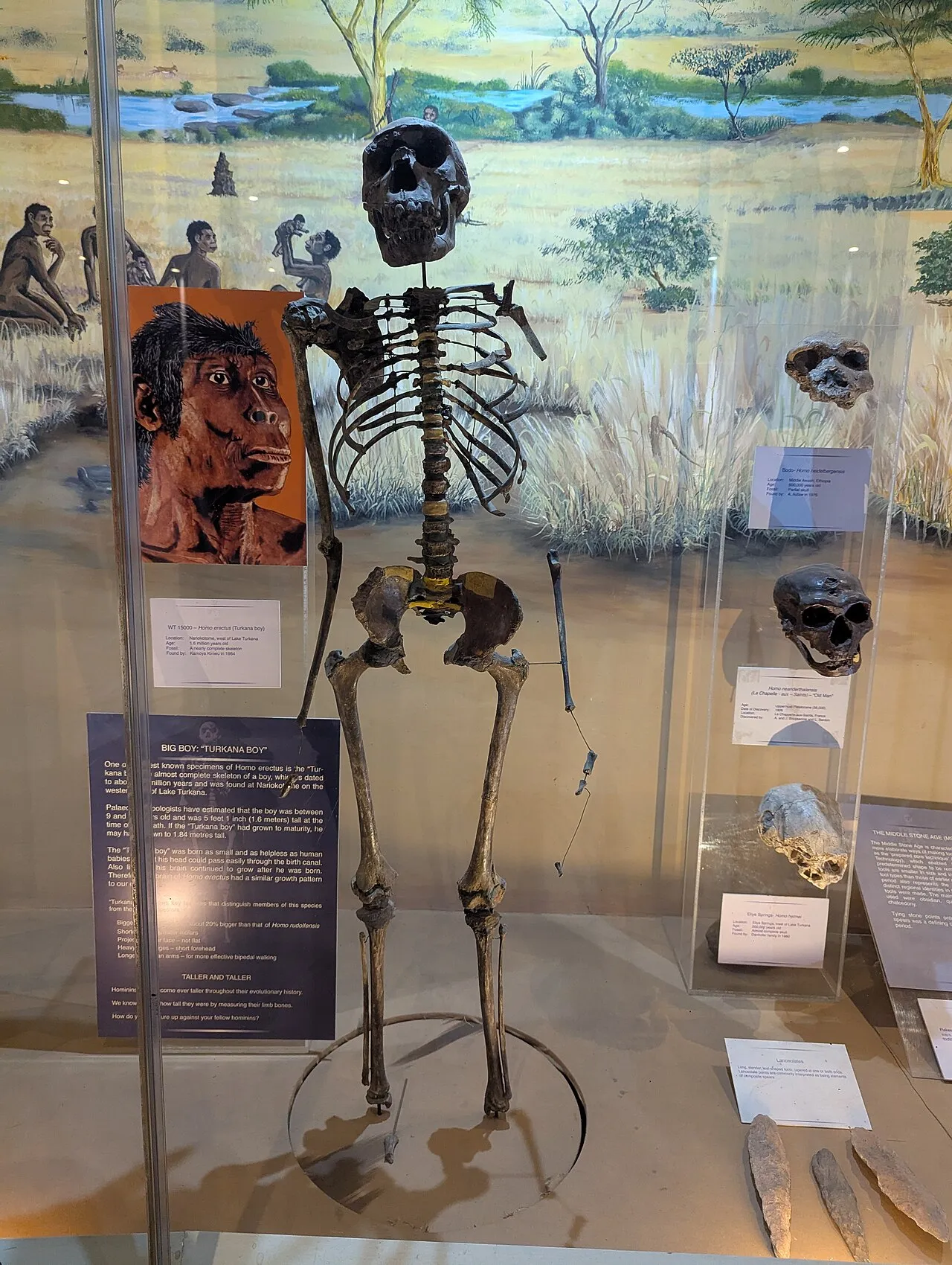
Turkana Boy, catalogued KNM-WT 15000, is a skeleton of a young Homo erectus (sometimes called Homo ergaster) from about 1.5 to 1.6 million years ago. About 108 bones survive, making it the most complete early human skeleton known. The original 1985 description gave him as about 12 years old and already 1.68 metres tall. A later stature-at-death study puts his height when he died lower, at about 1.47 metres, and his adult height is a projection rather than a measurement. His brain was about 880 cubic centimetres.
The find
In 1984 Kamoya Kimeu, the leader of Richard Leakey’s team of fossil finders, spotted a piece of skull on the bank of the Nariokotome River, west of Lake Turkana in Kenya. Excavation over the following seasons uncovered much of a skeleton lying in the sand of an old river bed.
What he shows
- A modern body. Long legs, a narrow pelvis and short arms, a body built for walking and running long distances. It is much closer to ours than to the australopiths.
- How old he was. Estimates range from about 7 to 15 years, with many put at 9 to 12. Studies of his teeth point to the younger end, which suggests that erectus children grew up faster than ours.
- Illness. Early reports saw signs of a disorder, but a later study found no skeletal disease. He had a damaged lower back and a diseased jaw, and an infection may have killed him.
Where he is
The skeleton belongs to the National Museums of Kenya in Nairobi, where it is studied. Casts are shown in many museums.
Sources
- Walker, A. and Leakey, R. (eds.) (1993). The Nariokotome Homo erectus Skeleton. Harvard University Press.
- Smithsonian National Museum of Natural History, Human Origins Program. Homo erectus.