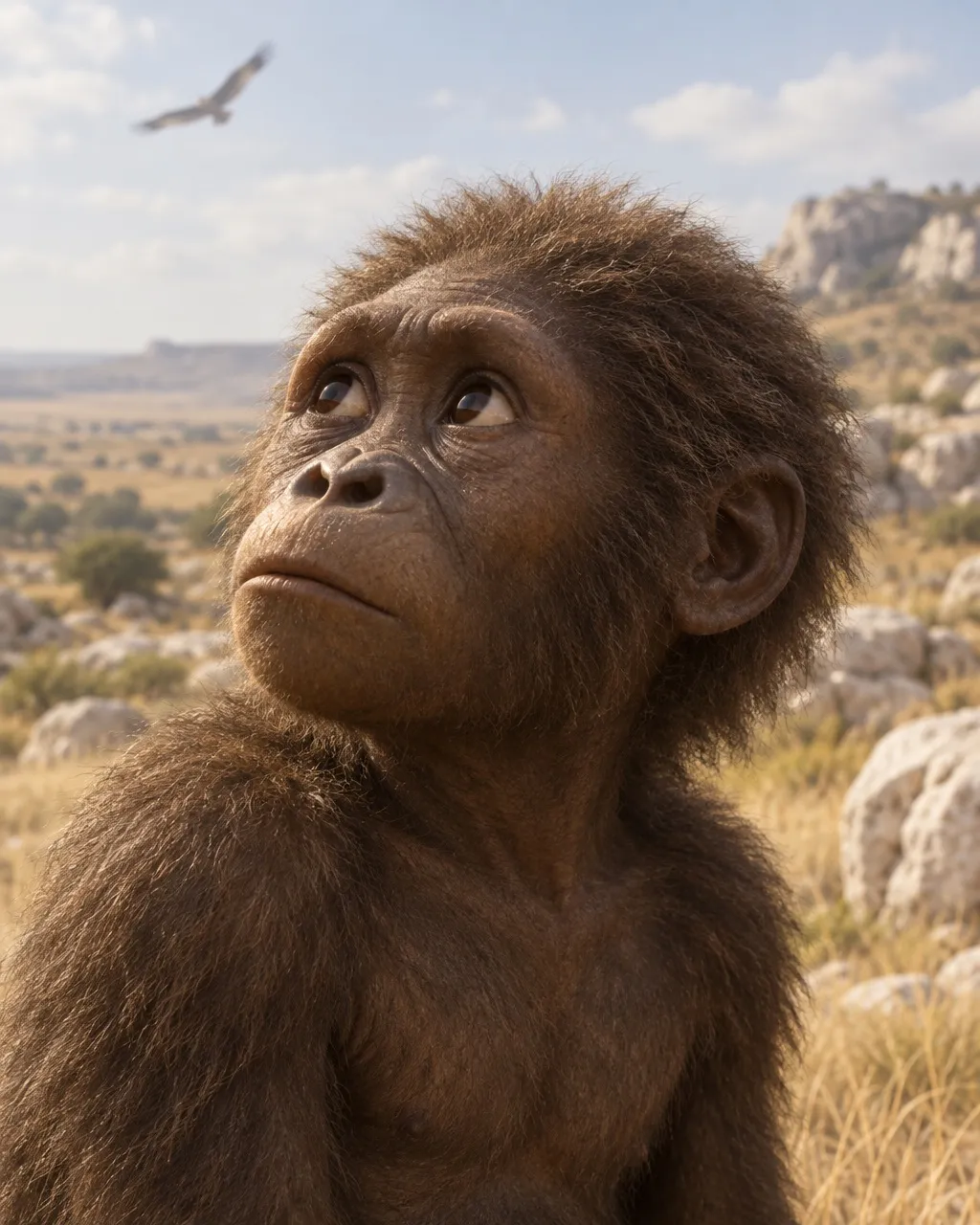
Raymond Dart (1893 to 1988) was an Australian-born anatomist at the University of the Witwatersrand in Johannesburg. In 1925 he described the Taung Child, a fossil skull from a South African quarry, as an early human relative and named the genus Australopithecus. Most experts rejected him for more than 20 years, but he was proved right.
The crate on the doorstep
Raymond Dart was born near Brisbane in 1893, trained in medicine in Sydney and in 1922 became professor of anatomy at the new medical school of the University of the Witwatersrand in Johannesburg. He asked his students to bring him fossils.
One of them, Josephine Salmons, showed him a fossil baboon skull from a lime quarry at Buxton, near Taung. Dart asked for more, and in late 1924 crates of rock from the quarry arrived at his house. In one he found a natural stone cast of the inside of a skull, a brain that was too big for a baboon’s, and the rock that fitted it held a face.
He spent weeks chipping the face free with fine tools, including sharpened knitting needles. What emerged was the skull of a child, with milk teeth and a face that looked ape-like but not quite. The opening where the spinal cord meets the skull sat further forward than in an ape, which suggested to Dart that it had held its head upright.
Dart was right
In February 1925 he described the Taung Child in Nature and gave it a new name, Australopithecus africanus, “southern ape of Africa”. He called it a link between apes and humans.
The experts in London mostly dismissed it. They expected the first humans to have big brains and to come from Asia or Europe, and a child’s skull from Africa, described by a young anatomist far from the big museums, did not fit. Only after Robert Broom found adult skulls of the same kind at Sterkfontein and other caves did opinion turn. In 1947 Sir Arthur Keith, one of the leading doubters, wrote that Dart had been right and he had been wrong.
Not all of Dart’s later ideas lasted. His claim that australopiths made tools from bones and were violent hunters, the “killer ape” idea, has been rejected. He ran the Wits anatomy school until 1958 and died in Johannesburg in 1988, aged 95.
Worked with
- Robert Broom Scottish doctor and fossil hunter who found Mrs Ples
Where to see the finds
- University of the Witwatersrand, Johannesburg: the Taung Child (casts are shown in many museums)
Sources
- Dart, R. A. (1925). Australopithecus africanus: the man-ape of South Africa. Nature 115: 195 to 199.
- Smithsonian National Museum of Natural History, Human Origins Program: Taung Child
- Dart, R. A. with Craig, D. (1959). Adventures with the Missing Link. Harper.
- Wikipedia: Raymond Dart (checked for dates, 2026-10-30)
Last checked 30 October 2026. Spotted a mistake? Tell us.