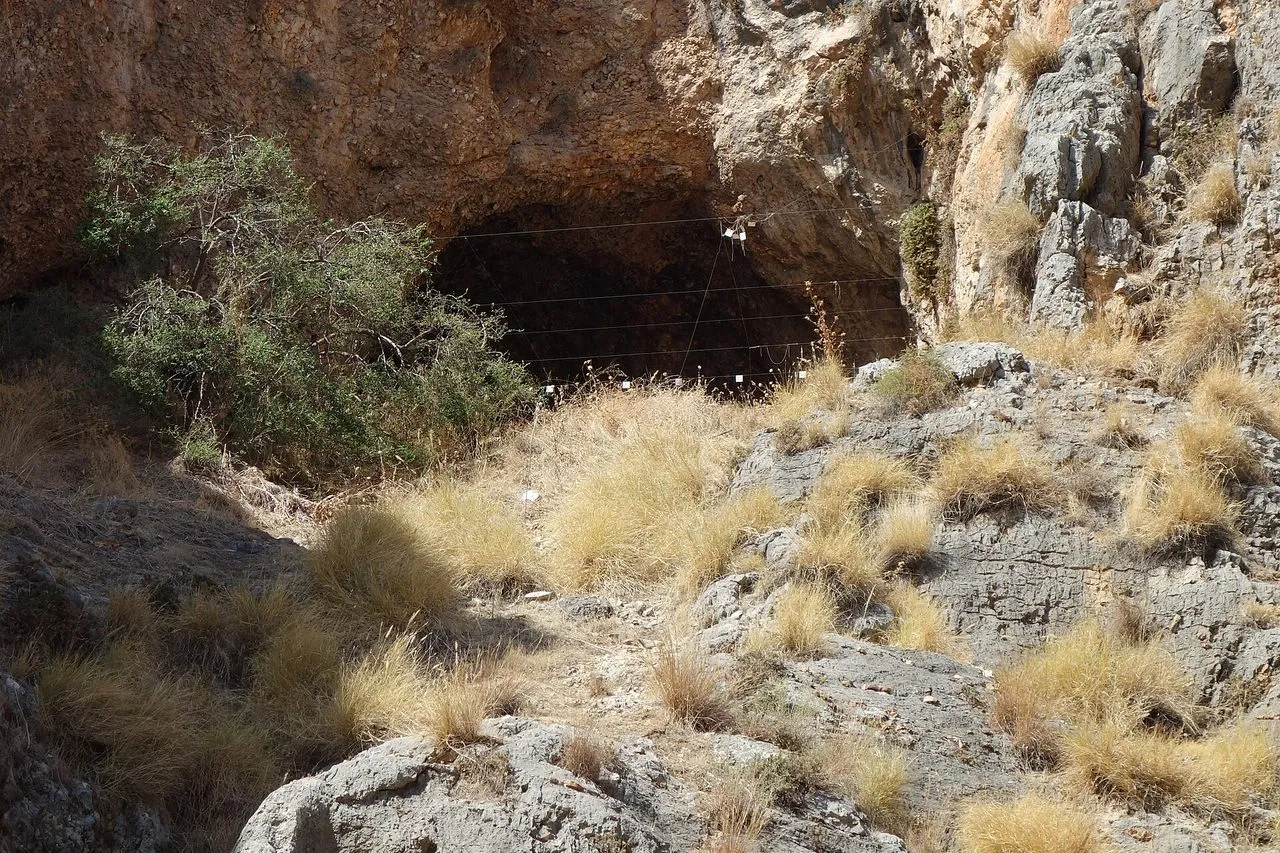
Amud Cave in brief
Amud Cave sits in a limestone cliff above Nahal Amud, a dry gorge that runs down to the Sea of Galilee in northern Israel. Its floor holds layers of ash, stone tools and animal bones left by people who used the cave over many thousands of years, and it is one of the Neanderthal cave sites of the Galilee.
Discovery
A University of Tokyo expedition led by Hisashi Suzuki dug at Amud between 1961 and 1964. In July 1961 the team uncovered a nearly complete skeleton of a young man, now called Amud 1. It lay near the top of the deposits, where older and younger material had been mixed, and the first radiocarbon dates of 20,000 to 28,000 years were far too young for a Neanderthal. Later dating by other methods gave an age of about 50,000 to 60,000 years.
Israeli and American teams returned to the cave in the 1990s, led by Erella Hovers, and found the remains of more Neanderthals, many of them children.
What the fossils show
- Amud 1: A man of about 25 with the largest brain measured in a fossil human, about 1,740 cubic centimetres. At around 1.72 to 1.78 metres he is the tallest Neanderthal known.
- Amud 7: A baby of about ten months, found in a small hollow against the cave wall. The upper jaw of a red deer lay on its hip, and the excavators read this as a deliberate burial.
- Stone tools: Flakes and points of the Levantine Mousterian, the same tool tradition as the early modern humans of Skhul and Qafzeh, found in the same region tens of thousands of years earlier.
Why it matters
The Levant is a crossroads where Neanderthals and our own species both lived, at different times. Skhul and Qafzeh hold early Homo sapiens of 100,000 years ago or more, while Amud and Kebara, another Neanderthal cave, are from some 50,000 to 60,000 years ago. One view is that Neanderthals moved south into the region when the climate turned cooler, after the first modern people had gone. See Neanderthals.
Amud 1 looks a little different from the Neanderthals of Europe, with slender brow ridges and long legs, but studies place him firmly among them.
Visiting
Amud is a research cave and is not set up for visitors. The finds are kept in Israel. The Mount Carmel caves, which are in a nature reserve with paths and a visitor centre, are a better place to see Stone Age cave sites in the region (see Mount Carmel).
Sources
- Suzuki, H. and Takai, F., editors (1970). The Amud Man and His Cave Site. University of Tokyo.
- Rak, Y., Kimbel, W. H. and Hovers, E. (1994). A Neandertal infant from Amud Cave, Israel. Journal of Human Evolution 26: 313 to 324.
- Hovers, E. and others (1995). Hominid remains from Amud Cave in the context of the Levantine Middle Paleolithic. Paléorient 21: 47 to 61.
- Valladas, H. and others (1999). TL dates for the Neanderthal site of the Amud Cave, Israel. Journal of Archaeological Science 26: 259 to 268.
- Rink, W. J. and others (2001). Electron spin resonance (ESR) and thermal ionization mass spectrometric (TIMS) 230Th/234U dating of teeth in Middle Paleolithic layers at Amud Cave, Israel. Geoarchaeology 16: 701 to 717.
Last checked 27 November 2026. Spotted a mistake? Tell us.