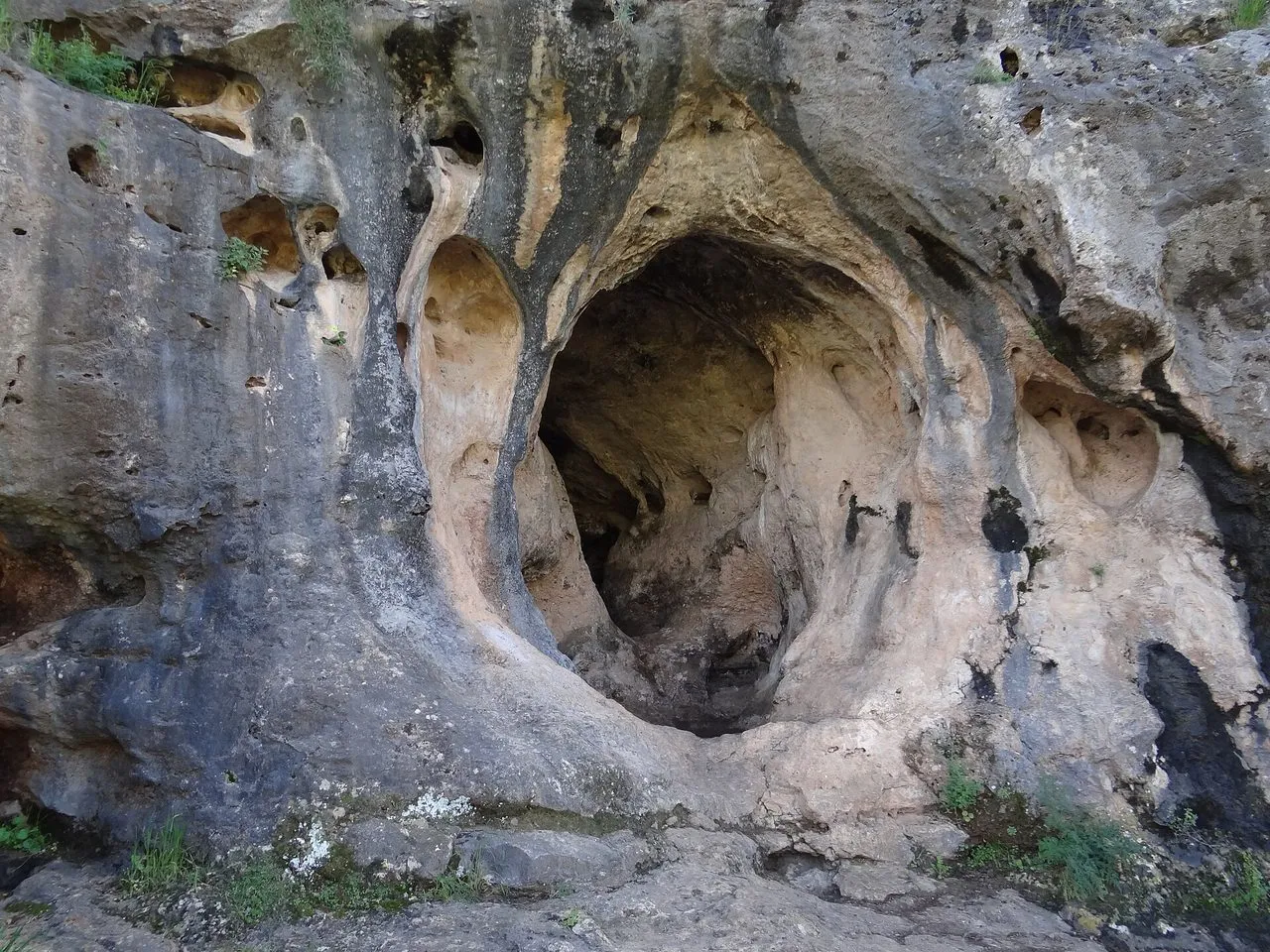
The Mount Carmel caves in brief
On the western side of Mount Carmel, a ridge that rises above the coast south of Haifa, a dry valley called Nahal Me’arot (in Arabic, Wadi el-Mughara) cuts through the limestone. Four caves open on its sides: Tabun, Jamal, el-Wad and Skhul. People lived in them over a very long time, and the layers on their floors hold stone tools, hearths, animal bones and the burials of both Neanderthals and early modern humans. Skhul is the cave that gave the world a group of early Homo sapiens, including Skhul V.
Discovery
Dorothy Garrod, a British archaeologist, led a joint British and American expedition that dug in the caves from 1929 to 1934. In 1932 her team found the skeleton of a Neanderthal woman at Tabun. At Skhul, a young American, Theodore McCown, uncovered the remains of ten people, adults and children, some of them in graves. Garrod became the first woman to hold a professorship at the University of Cambridge in 1939. McCown and the anatomist Arthur Keith published the human fossils from the caves in 1939.
What was found
- Skhul: Ten early Homo sapiens, buried in the cave. Skhul V lay with the jaw of a wild boar in his arms, one of the oldest known burials with an offering. Two pierced sea shells from the site are among the oldest beads known. See Homo sapiens.
- Tabun: A very long sequence of layers, with Neanderthal remains including the woman found in 1932. See Neanderthals.
- el-Wad: A cemetery of the Natufians, who lived here between about 15,000 and 11,500 years ago, with skeletons of more than 100 people, from the time when people in the Near East began to settle in villages.
- Jamal: A smaller cave that Garrod’s team also dug, with layers of Stone Age tools and animal bones.
Why Skhul changed the story
The Skhul people were first thought to be about 40,000 years old, younger than the Neanderthals of Tabun, which made it look as if one could have become the other. Better dating overturned this. A study in 2005 gave the Skhul fossils an age of 100,000 to 135,000 years. People who looked much like us were living in the region before the Neanderthals of Amud Cave and Kebara, and the Neanderthals could not have been their ancestors. Most researchers see the Skhul and Qafzeh people as an early move of our species out of Africa that did not last.
World Heritage
In 2012 UNESCO listed the four caves as “Sites of Human Evolution at Mount Carmel: The Nahal Me’arot / Wadi el-Mughara Caves”. It said that they show one of the longest sequences of prehistoric life anywhere in the world, and that they are a main site of the Natufian culture.
Visiting
The caves lie in the Nahal Me’arot Nature Reserve, which has paths, a visitor centre and access to some of the caves. The Skhul V skeleton is held at Harvard University’s Peabody Museum.
Sources
- McCown, T. D. and Keith, A. (1939). The Stone Age of Mount Carmel, Volume 2: The Fossil Human Remains from the Levalloiso-Mousterian. Oxford: Clarendon Press.
- Garrod, D. A. E. and Bate, D. M. A. (1937). The Stone Age of Mount Carmel, Volume 1: Excavations at the Wady el-Mughara. Oxford: Clarendon Press.
- Stringer, C. B. and others (1989). ESR dates for the hominid burial site of Es Skhul in Israel. Nature 338: 756 to 758.
- Grün, R. and others (2005). U-series and ESR analyses of bones and teeth relating to the human burials from Skhul. Journal of Human Evolution 49: 316 to 334.
- Vanhaeren, M. and others (2006). Middle Paleolithic shell beads in Israel and Algeria. Science 312: 1785 to 1788.
- UNESCO World Heritage Centre. Sites of Human Evolution at Mount Carmel: The Nahal Me’arot / Wadi el-Mughara Caves.
- Smithsonian National Museum of Natural History, Human Origins Program. Skhūl V.
Last checked 27 November 2026. Spotted a mistake? Tell us.