La Chapelle-aux-Saints in brief
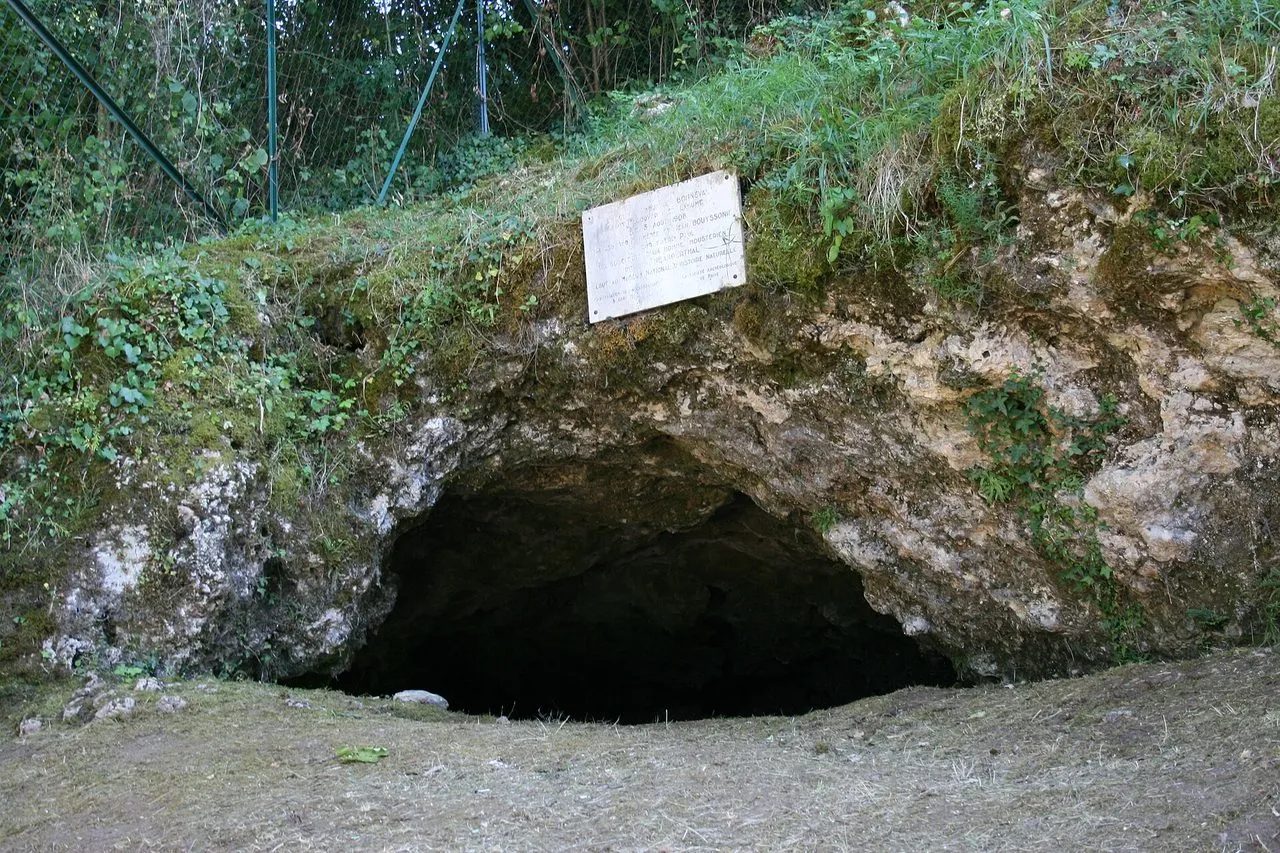
La Chapelle-aux-Saints is a small village in the Corrèze department of central France, south-east of the city of Brive-la-Gaillarde. Beside the village, in a limestone outcrop, is a low cave called the Bouffia Bonneval. (Bouffia is a local word for a small cave.) In 1908 three priests found a Neanderthal skeleton there, the first fairly complete one ever discovered. It is now known as La Chapelle-aux-Saints 1, or the Old Man of La Chapelle.
Discovery
The brothers Amédée and Jean Bouyssonie and their colleague Louis Bardon were priests who studied prehistory in their spare time. In August 1908 they dug in the cave and, on 3 August, found a skeleton lying in a shallow pit in the floor. They reported it as a man of the Mousterian, the stone tool culture of the Neanderthals, and sent the bones to Marcellin Boule at the natural history museum in Paris.
The stooped caveman
Boule’s long study, published from 1911, rebuilt the Old Man with a curved spine, bent knees and a head pushed forward. For decades that stooping picture was the image of the Neanderthals in books and museums. In 1957 two anatomists, William Straus and A. J. E. Cave, showed that the skeleton had severe arthritis, and that a healthy Neanderthal walked upright much as we do. See Neanderthals.
Was he buried?
The finders believed that the body lay in a grave dug on purpose, and the cave became one of the main cases for Neanderthal burial. Doubts followed, because the original dig was done quickly and recorded in little detail. A team led by William Rendu went back to the cave for years of new fieldwork. In 2014 they reported that the pit was made by people and that the body was covered soon after death, which fits a deliberate burial. They also found more Neanderthal bones in the cave. Other researchers think that the evidence is not enough to prove a burial, and the question is still open.
Visiting
The cave is beside the village and can be seen from outside, with a plaque that marks the 1908 find. It is small and low, and it is not set up for visits inside. The skeleton is in the Musée de l’Homme in Paris. Other Neanderthal sites that are close in time include La Ferrassie in the Dordogne and the Neander Valley in Germany.
Sources
- Bouyssonie, A., Bouyssonie, J. and Bardon, L. (1908). Découverte d’un squelette humain moustérien à la bouffia de la Chapelle-aux-Saints (Corrèze). L’Anthropologie 19: 513 to 518.
- Boule, M. (1911 to 1913). L’homme fossile de La Chapelle-aux-Saints. Annales de Paléontologie 6 to 8.
- Straus, W. L. and Cave, A. J. E. (1957). Pathology and the posture of Neanderthal man. The Quarterly Review of Biology 32: 348 to 363.
- Rendu, W. and others (2014). Evidence supporting an intentional Neandertal burial at La Chapelle-aux-Saints. Proceedings of the National Academy of Sciences 111: 81 to 86.
- Dibble, H. L. and others (2015). A critical look at evidence from La Chapelle-aux-Saints supporting an intentional Neandertal burial. Journal of Archaeological Science 53: 649 to 657.
- Smithsonian National Museum of Natural History, Human Origins Program. La Chapelle-aux-Saints.
Last checked 27 November 2026. Spotted a mistake? Tell us.