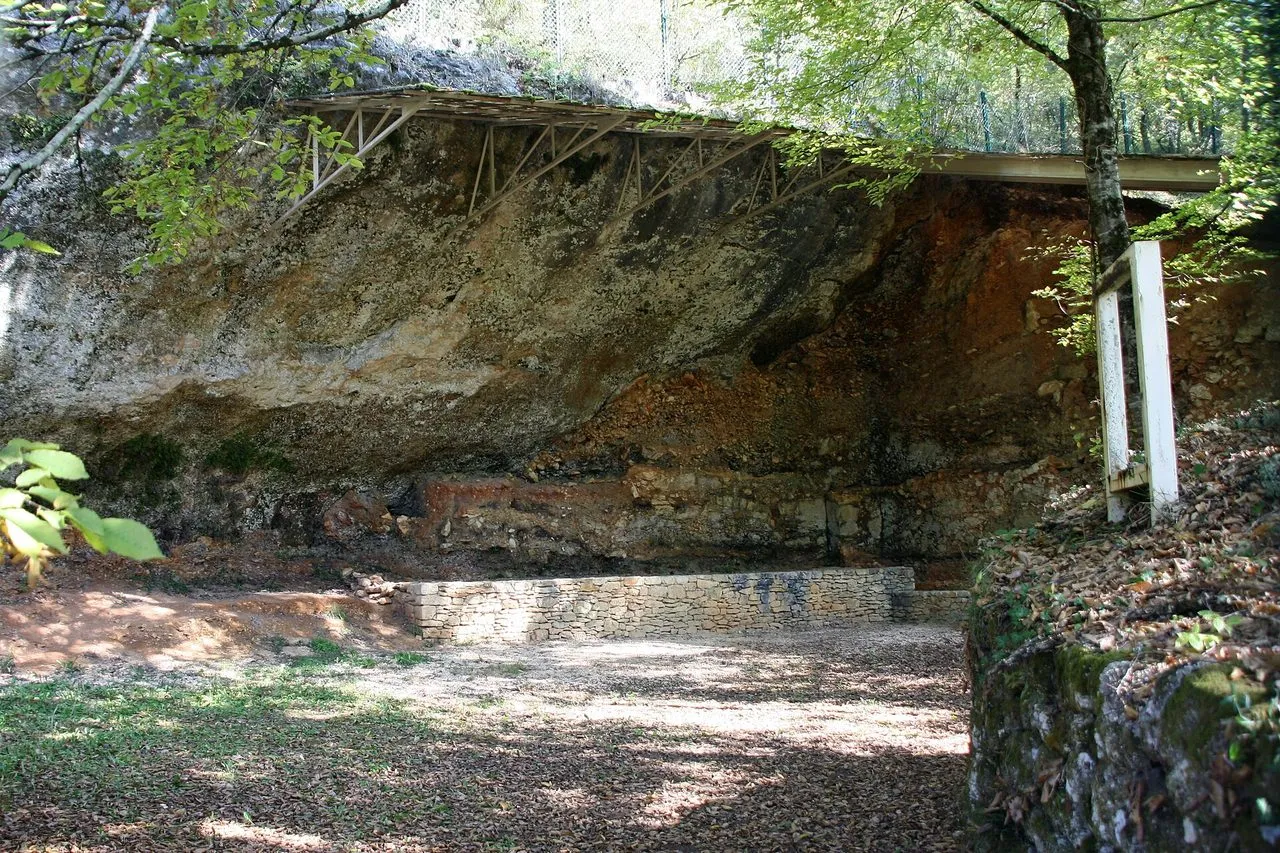
La Ferrassie in brief
La Ferrassie is a limestone rock shelter at Savignac-de-Miremont in the Dordogne, about 6 kilometres west of Les Eyzies. A wide overhang shelters a deep deposit that built up over tens of thousands of years, with a smaller shelter, the Petit Abri, nearby. People used it again and again, and Neanderthals left more than stone tools: they were buried there.
Discovery
In 1909 the prehistorian Louis Capitan and the schoolteacher Denis Peyrony, who lived at Les Eyzies, uncovered the skeleton of a man, La Ferrassie 1, and then a woman, La Ferrassie 2, nearby. Peyrony went on digging at the site for decades, and later teams dug there again in the 1960s and 1970s. In all, the shelter has given up the bones of eight Neanderthals: two adults, children and infants, and two unborn babies.
What the site shows
- Burials: The bodies of several of the Neanderthals were placed in shallow pits in the floor of the shelter. The clearest case is La Ferrassie 8, a child of about two, whose grave was studied again in 2020 and dated to about 41,000 years ago.
- Skeletons: The man, La Ferrassie 1, has the largest and most complete Neanderthal skull known, with a brain of about 1,640 cubic centimetres. He and the woman gave scientists a first clear look at how male and female Neanderthals differed.
- Stone tools: Peyrony used the layers to build a sequence of Stone Age tool types, from Neanderthal Mousterian tools at the bottom to tools of modern humans higher up. This became a reference for the Stone Age in western Europe.
- Marked stone: A limestone slab with rows of small hollows, called cupules, lay over the grave of a child, La Ferrassie 6. Some researchers think that Neanderthals made the marks, and others doubt it.
How old it is
The Neanderthal layers were long given ages of 50,000 to 70,000 years. In 2015 a dating study of the layers beside the skeletons showed that La Ferrassie 1 and 2 are no older than about 54,000 years, and probably about 43,000 to 45,000. The Neanderthals of La Ferrassie lived late in the story of their species. See Neanderthals.
Visiting
La Ferrassie is a research site, and opening times for visits change from year to year, so check before you go. The skeletons are held by the Musée de l’Homme in Paris. The nearby town of Les Eyzies has the National Museum of Prehistory, and La Chapelle-aux-Saints is another famous Neanderthal burial site in France.
Sources
- Capitan, L. and Peyrony, D. (1909). Deux squelettes humains au milieu de foyers de l’époque moustérienne. Revue de l’École d’Anthropologie de Paris 19: 402 to 409.
- Guérin, G. and others (2015). A multi-method luminescence dating of the Palaeolithic sequence of La Ferrassie based on new excavations adjacent to the La Ferrassie 1 and 2 skeletons. Journal of Archaeological Science 58: 147 to 166.
- Gómez-Olivencia, A. and others (2018). La Ferrassie 1: new perspectives on a “classic” Neandertal. Journal of Human Evolution 117: 13 to 32.
- Balzeau, A. and others (2020). Pluridisciplinary evidence for burial for the La Ferrassie 8 Neandertal child. Scientific Reports 10: 21230.
- Smithsonian National Museum of Natural History, Human Origins Program. La Ferrassie.
Last checked 27 November 2026. Spotted a mistake? Tell us.