Les Eyzies in brief
Les Eyzies, in full Les Eyzies-de-Tayac-Sireuil, is a small town in the Dordogne where the Vézère river and the little river Beune meet, under tall limestone cliffs. The cliffs are pitted with shelters and caves that people used for tens of thousands of years, and the valley has about 150 known Stone Age sites and 25 decorated caves. The town calls itself the world capital of prehistory, and with its museum and its neighbours it is one of the best places in Europe to learn about the Ice Age.
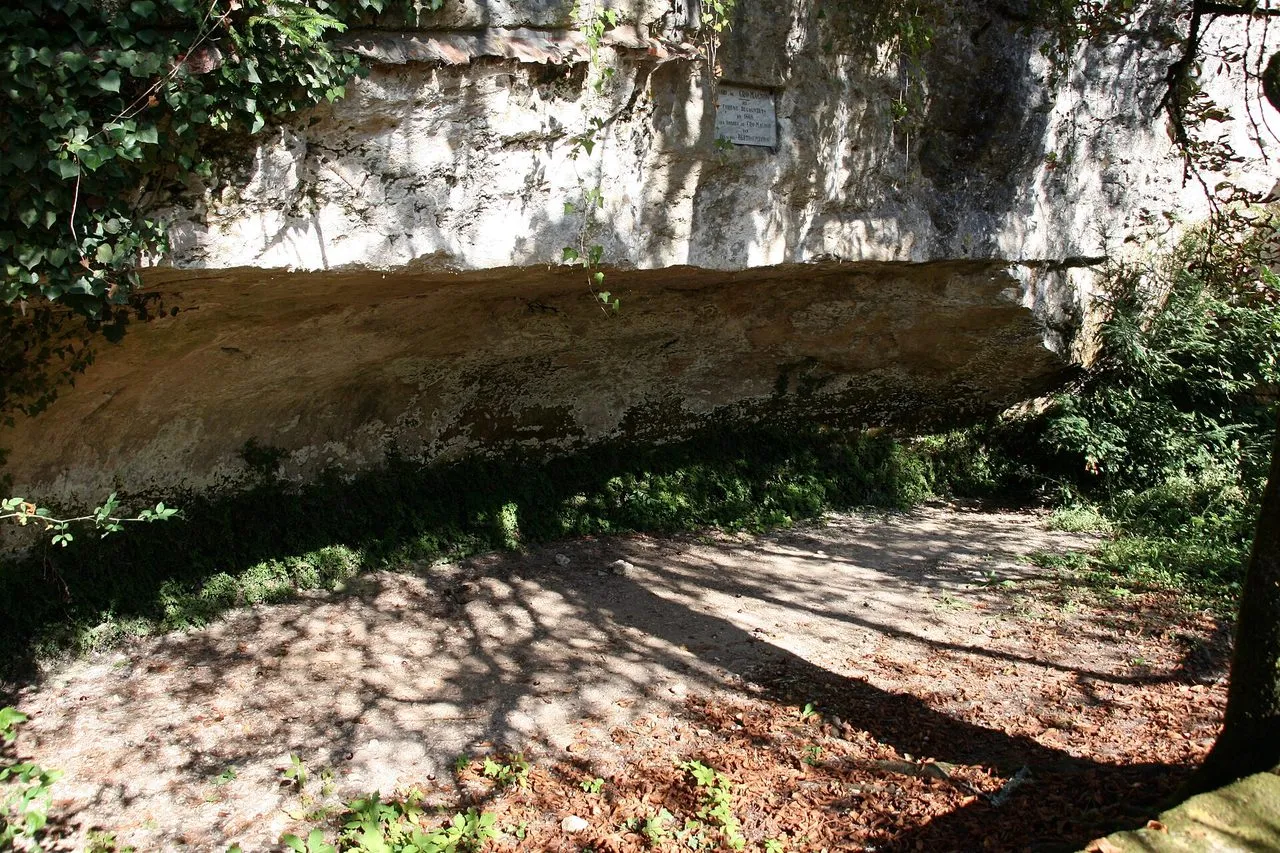
The Cro-Magnon rock shelter
In March 1868 workmen cutting a road at the foot of the cliff uncovered a rock shelter with bones and flint tools in it. The geologist Louis Lartet was sent to excavate it. He found the remains of five people, four adults and an infant, together with pierced sea shells and animal teeth that had been worn as ornaments, worked antler and flint tools. The bones were of people of our own species. One of them is Cro-Magnon 1, an adult man whose skull is fully modern, with a high rounded braincase and a short broad face.
The find came only four years after the Neanderthals were named, and showed that people like us had lived in Europe in the Ice Age, among extinct animals. For a long time “Cro-Magnon” was the usual name for the first modern people of Europe. Researchers now more often say “early modern humans”, since they were not a separate species or group. The burials are given as about 30,000 years old. See Homo sapiens.
A valley of Stone Age sites
In 1979 UNESCO listed the Vézère Valley as “Prehistoric Sites and Decorated Caves of the Vézère Valley”. A few of the places near Les Eyzies:
- Font-de-Gaume and Les Combarelles: Caves with Ice Age paintings and engravings, and among the few painted caves in France that can still be visited, with small groups.
- Abri Pataud: A rock shelter with deep layers of Ice Age life that can be visited with its museum.
- Laugerie, La Madeleine and Le Moustier: Shelters that gave their names to Stone Age cultures. La Madeleine is the origin of the name Magdalenian and Le Moustier of Mousterian.
- La Ferrassie: A shelter about 6 kilometres west, where Neanderthals were buried.
- Lascaux: The famous painted cave, about 20 kilometres to the north-east, which has its own page.
Visiting
The National Museum of Prehistory stands in Les Eyzies, partly in and beside the old Château de Tayac, with tools, art and casts of fossils from across the valley. The Cro-Magnon shelter is in the town and can be seen from outside. The original bones are in the Musée de l’Homme in Paris. Some caves need advance booking, and opening times change, so check before you go.
Sources
- Lartet, L. (1868). Une sépulture des troglodytes du Périgord (crânes des Eyzies). Bulletins de la Société d’Anthropologie de Paris 3: 335 to 349.
- Henry-Gambier, D. (2002). Les fossiles de Cro-Magnon (Les Eyzies-de-Tayac, Dordogne): nouvelles données sur leur position chronologique et leur attribution culturelle. Bulletins et Mémoires de la Société d’Anthropologie de Paris 14: 89 to 112.
- UNESCO World Heritage Centre. Prehistoric Sites and Decorated Caves of the Vézère Valley.
- Smithsonian National Museum of Natural History, Human Origins Program. Cro-Magnon 1.
Last checked 27 November 2026. Spotted a mistake? Tell us.