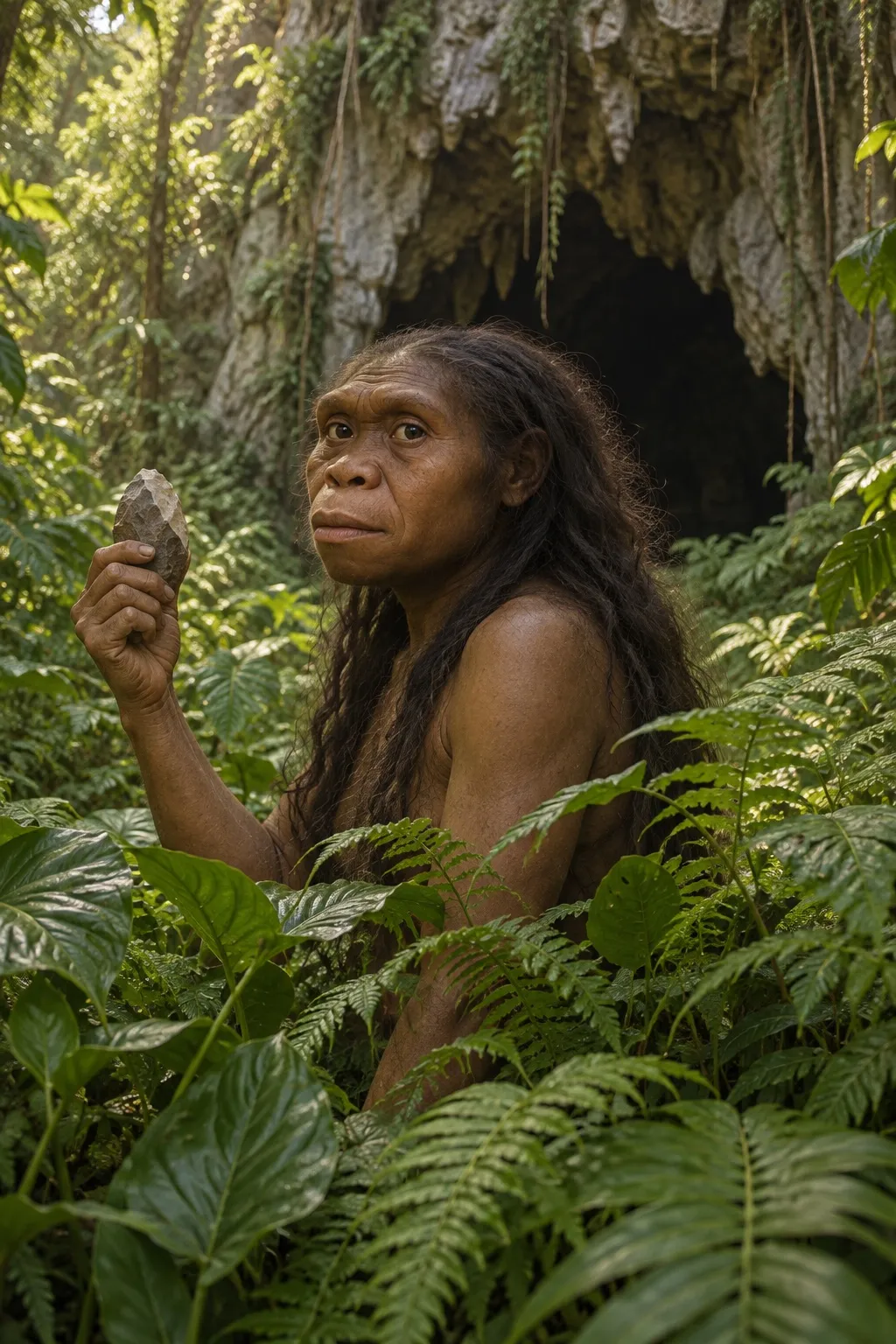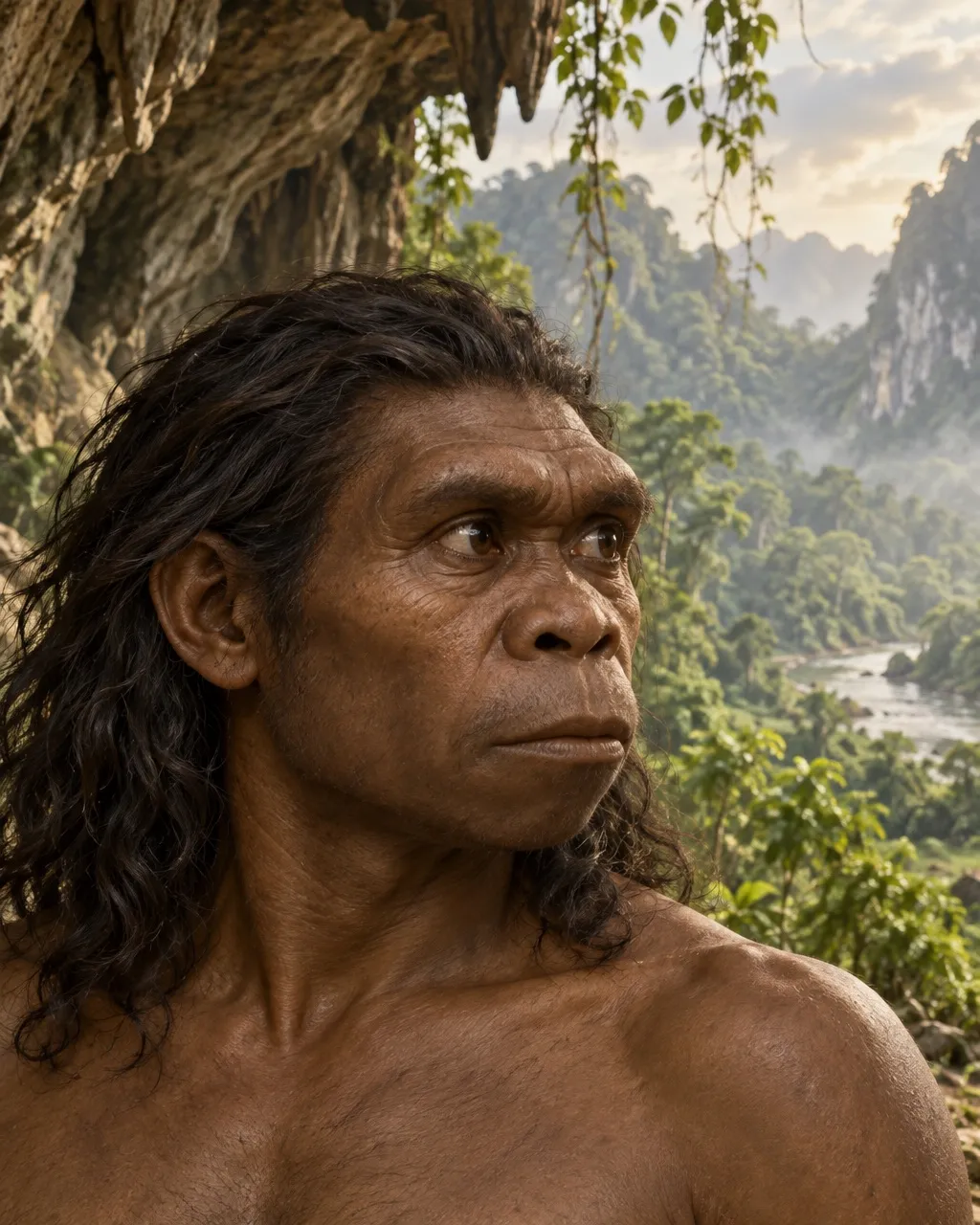
Homo luzonensis is a small human species named in 2019 from teeth and bones found in Callao Cave on the island of Luzon in the Philippines, at least 50,000 to 67,000 years old. Its tiny teeth and curved finger and toe bones are unlike those of any other species of Homo.
The species in brief
In 2019 a French and Filipino team announced a new human species from a cave on Luzon, the largest island of the Philippines. It is known from just 13 small fossils: teeth, finger and toe bones and part of a thigh bone. But those few bones have a combination of features never seen together before. Like Homo floresiensis on Flores, Homo luzonensis shows that, not long before modern humans arrived, the islands of Southeast Asia were home to their own kinds of humans.
Discovery
Callao Cave is a large limestone cave near Peñablanca in Cagayan province, northern Luzon. In 2007 Armand Salvador Mijares of the University of the Philippines, digging with Philip Piper, found a single human foot bone, a third metatarsal, in a layer well below the more recent deposits. In 2010 the team reported that the bone was at least 67,000 years old, which made it the oldest human fossil from the Philippines. They could not tell which species it came from.
Excavations in 2011 and 2015, led by Mijares and Florent Détroit of the National Museum of Natural History in Paris, found twelve more bones and teeth in the same layer. In April 2019 Détroit, Mijares and colleagues described them in Nature as a new species, Homo luzonensis.
The fossils
- Teeth: Seven teeth, including five upper teeth (two premolars and three molars) from one individual, catalogued CCH6.
- Hands: Two finger bones.
- Feet: Two toe bones and the 2007 metatarsal.
- Leg: Part of the shaft of a thigh bone from a child.
They come from at least two adults and one child.
What makes it different
- Teeth: The molars are very small, as small as or smaller than those of Homo floresiensis and modern humans, and simple in shape. The premolars, by contrast, are relatively large and have two or three roots, a primitive feature seen in australopiths and early Homo.
- Fingers and toes: The finger and toe bones are curved and have strong ridges for the muscles that flex them, much like those of Australopithecus. A toe bone also has a shape that resembles australopiths more than later humans.
Curved fingers and toes are often linked to climbing. Whether Homo luzonensis climbed often, or simply kept an old shape from its ancestors, is not known.
How old it is
Uranium-series dating directly on the bones gives minimum ages: at least 67,000 years for the 2007 metatarsal and at least 50,000 years for one of the teeth. The true ages could be older. In 2023 Rainer Grün and Chris Stringer reassessed the uranium-series results, allowing for uranium the bones took up after burial, and concluded that the fossils could be at least 130,000 years old.
Who got there first
Luzon has always been an island, separated from the mainland by deep water even in the Ice Ages. So whoever reached it had to cross the sea. In 2018 a team led by Thomas Ingicco reported 57 stone tools and the butchered skeleton of a rhinoceros at Kalinga, also in northern Luzon, dated to about 709,000 years ago. No human bones were found there, but someone was butchering animals on Luzon hundreds of thousands of years before Homo luzonensis. They may have been its ancestors.
The argument
Some researchers think it is too early to call these fossils a new species. With so few bones, the unusual mix of features could fall within the range of another species, perhaps a small form of Homo erectus, or the result of mixing between different groups. No DNA has been recovered from the bones. The team that named it argues that the combination of tiny molars, primitive premolars and australopith-like fingers and toes does not match any known species.
Where it fits in the family tree
If it is a separate species, Homo luzonensis is probably descended from an early human population that crossed to the island long ago and then evolved in isolation, much as the Flores hominins did. It lived at about the same time as Neanderthals, Denisovans, Homo floresiensis and modern humans.
Where to see it
The Callao Cave fossils are kept in the Philippines. Callao Cave itself is open to visitors.
Sources
- Mijares, A. S. and others (2010). New evidence for a 67,000-year-old human presence at Callao Cave, Luzon, Philippines. Journal of Human Evolution 59: 123 to 132.
- Ingicco, T. and others (2018). Earliest known hominin activity in the Philippines by 709 thousand years ago. Nature 557: 233 to 237.
- Détroit, F. and others (2019). A new species of Homo from the Late Pleistocene of the Philippines. Nature 568: 181 to 186.
- Grün, R. and Stringer, C. (2023). Direct dating of human fossils and the ever-changing story of human evolution. Quaternary Science Reviews 322: 108379.
Cite this page
Bonelore. "Homo luzonensis." https://bonelore.com/species/homo-luzonensis/
Last checked 27 November 2026. Spotted a mistake? Tell us.