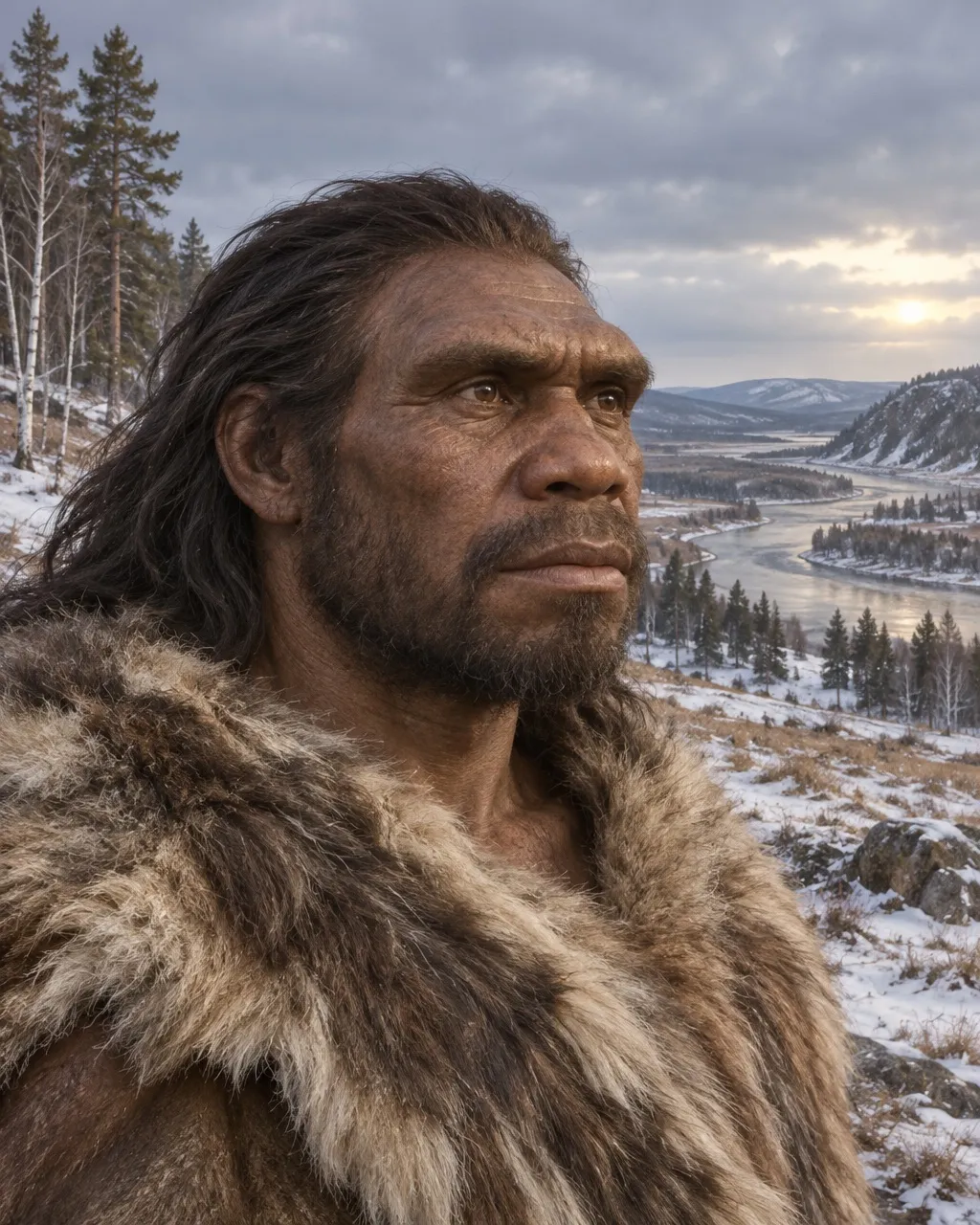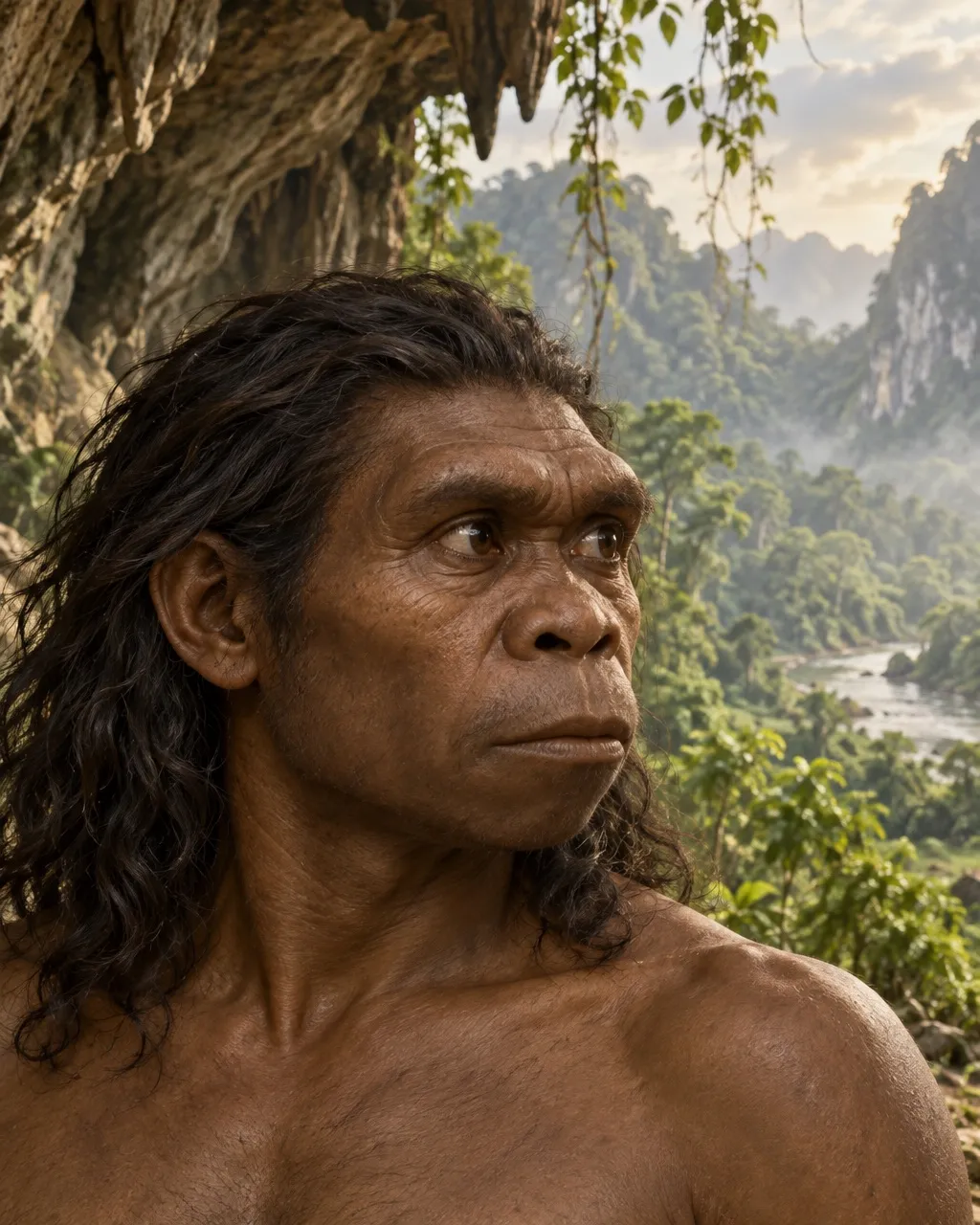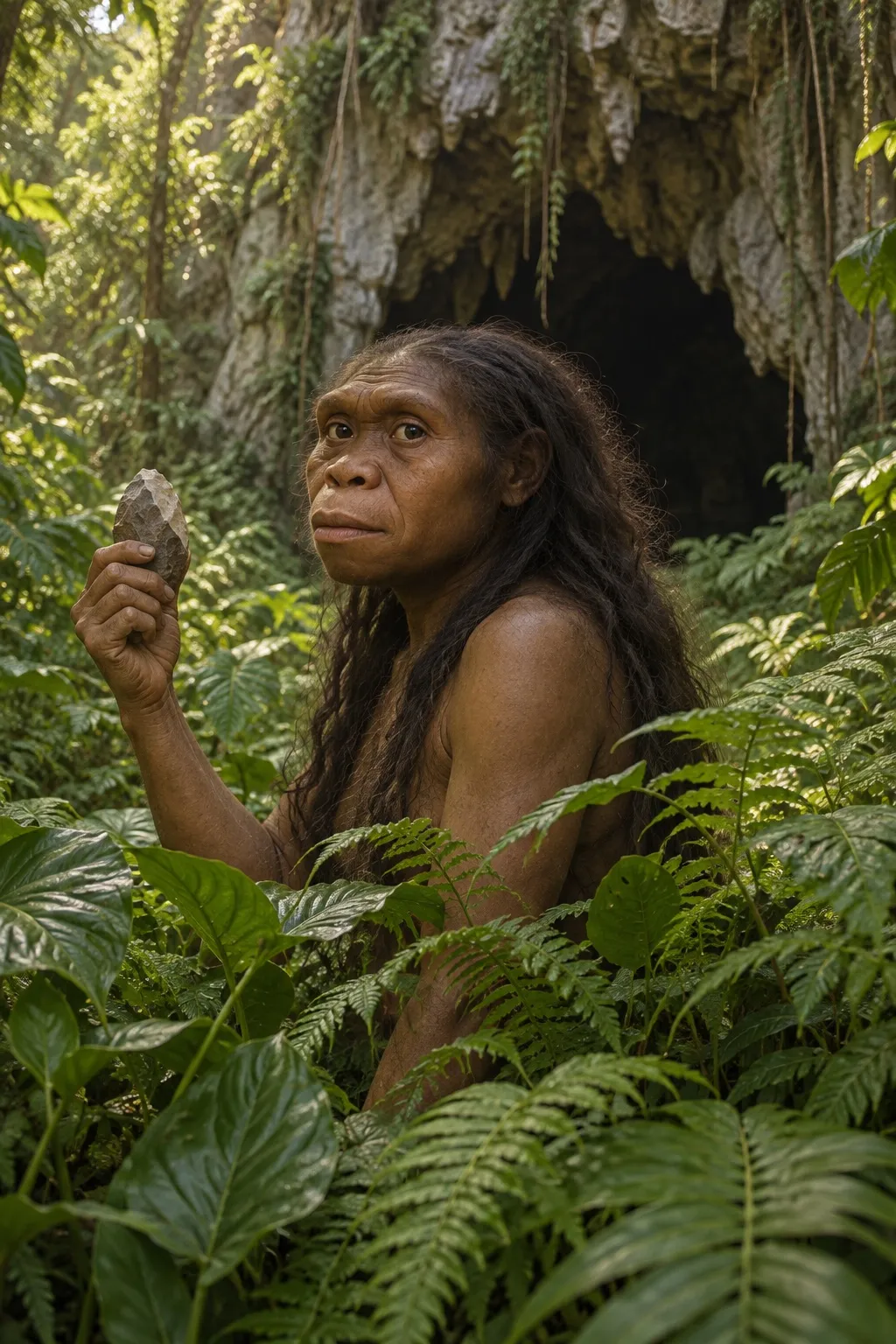
Homo floresiensis, nicknamed the Hobbit, was a human species about a metre tall with a brain the size of a chimpanzee's. It lived on the island of Flores in Indonesia, where its bones are about 100,000 to 60,000 years old and its stone tools as recent as about 50,000 years.
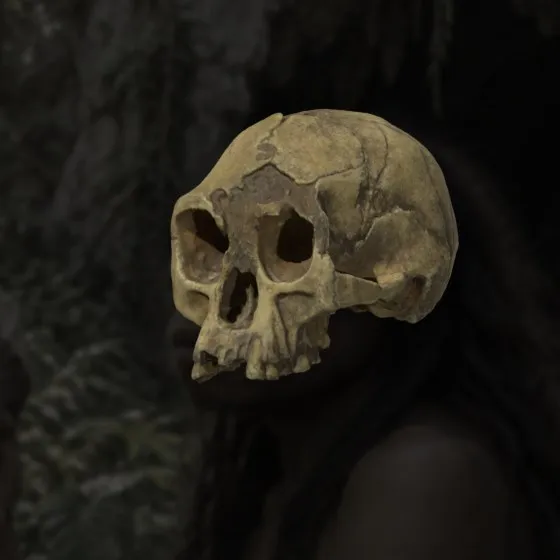
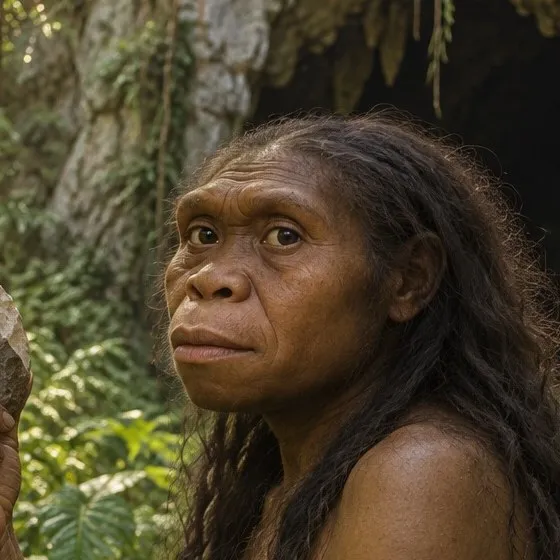
The species in brief
Homo floresiensis is one of the great surprises of human evolution. In 2003, in a limestone cave on the Indonesian island of Flores, a team found the skeleton of an adult human relative about a metre tall, with a brain about the size of a chimpanzee’s. She had lived not millions of years ago, like the small-brained australopiths of Africa, but within the last 100,000 years. Her species made stone tools, hunted or scavenged dwarf elephants, and survived on its island until about 50,000 years ago.
Discovery
A joint Indonesian and Australian team led by Mike Morwood and Radien Soejono began digging at Liang Bua cave in 2001. They were looking for traces of the first modern humans who passed through the islands on their way to Australia. In September 2003, about six metres down, they found a small skeleton instead. The bones were not fossilised and were so soft that they had to dry before they could be lifted.
Peter Brown and colleagues named the new species in the journal Nature in October 2004, with the skeleton, LB1, as its type specimen. Bones and teeth from more individuals turned up in later digs, so LB1 is no longer alone.
Body and brain
- Height: About 1.06 metres (3 ft 6 in) for LB1, probably a woman of about 30.
- Weight: Roughly 25 to 30 kilograms.
- Brain: About 380 to 430 cubic centimetres (about 426 in a 2013 CT study), about a third of ours and similar to a chimpanzee’s or an early australopith’s.
- Skull: Long and low, with a sloping forehead, a brow ridge and no chin.
- Shoulders and arms: Short, curved collarbones that set the shoulders forward, giving a hunched look.
- Wrists: The small wrist bones keep the primitive shape seen in African apes and australopiths, not the shape shared by Neanderthals and modern humans.
- Feet: Very long compared with the legs, with a big toe in line with the others but other ape-like proportions. The species walked upright, but probably with a different gait from ours.
How old it is
When it was first described, the species looked astonishingly young: the layers around LB1 were dated to about 18,000 years. In 2016 the team published a new study of the cave. Its layers turned out to be more complicated than they first seemed, and the skeletal remains are now dated to about 100,000 to 60,000 years ago. Stone tools that the species made range from about 190,000 to 50,000 years ago.
The family is older still. At Mata Menge, about 70 kilometres east of Liang Bua, excavations in 2014 found part of a lower jaw and teeth about 700,000 years old. They look like floresiensis and are even smaller. An arm bone from the same layer, reported in 2024, is the smallest adult hominin upper arm bone ever found.
Island dwarfs
Animals on islands often change size over many generations. Big animals tend to shrink when food is limited and there are few predators, and small ones can grow. Flores had both: a dwarf elephant relative called Stegodon, Komodo dragons, a giant marabou stork and giant rats. Most researchers think the ancestors of Homo floresiensis were early Homo erectus who somehow reached Flores, where stone tools in the So’a Basin are older than 700,000 years, and shrank there. The Mata Menge fossils, small and with teeth that resemble early Javanese erectus, support that view.
Some researchers argue instead for a more primitive ancestor, an early and already small member of Homo that left Africa before erectus, because LB1’s wrists, feet and shoulders look so primitive. The question is still open.
The disease argument
Soon after the find, a few researchers argued that LB1 was a modern human with microcephaly, a condition that makes the head small, or with another growth disorder. Studies of her wrists, her feet, the shape of her braincase and the other individuals from the cave all point the other way, and most researchers now accept Homo floresiensis as a real species.
The end of the Hobbit
The species, along with the dwarf Stegodon, the giant stork and a vulture, disappears from Liang Bua by about 50,000 years ago. A change in the stone used for tools in the cave about 46,000 years ago may mark the arrival of modern humans on Flores. Whether the two species met, and whether that had anything to do with the end of the Hobbit, is not known.
Homo luzonensis, found in the Philippines in 2019, shows that Flores was not the only island with its own kind of small human.
Where it fits in the family tree
Homo floresiensis is a side branch, not an ancestor of ours. It lived at the same time as Neanderthals, Denisovans, Homo luzonensis and our own species, at a time when several kinds of humans shared the planet.
Where to see it
The Flores fossils belong to Indonesia and are kept there. Casts of the LB1 skull are on show in many natural history museums.
Sources
- Smithsonian National Museum of Natural History, Human Origins Program. Homo floresiensis.
- Australian Museum. Homo floresiensis.
- Brown, P. and others (2004). A new small-bodied hominin from the Late Pleistocene of Flores, Indonesia. Nature 431: 1055 to 1061.
- Morwood, M. J. and others (2004). Archaeology and age of a new hominin from Flores in eastern Indonesia. Nature 431: 1087 to 1091.
- Tocheri, M. W. and others (2007). The primitive wrist of Homo floresiensis and its implications for hominin evolution. Science 317: 1743 to 1745.
- Jungers, W. L. and others (2009). The foot of Homo floresiensis. Nature 459: 81 to 84.
- Sutikna, T. and others (2016). Revised stratigraphy and chronology for Homo floresiensis at Liang Bua in Indonesia. Nature 532: 366 to 369.
- van den Bergh, G. D. and others (2016). Homo floresiensis-like fossils from the early Middle Pleistocene of Flores. Nature 534: 245 to 248.
- Brumm, A. and others (2016). Age and context of the oldest known hominin fossils from Flores. Nature 534: 249 to 253.
- Sutikna, T. and others (2018). The spatio-temporal distribution of archaeological and faunal finds at Liang Bua (Flores, Indonesia) in light of the revised chronology for Homo floresiensis. Journal of Human Evolution 124: 52 to 74.
- Kaifu, Y. and others (2024). Early evolution of small body size in Homo floresiensis. Nature Communications 15: 6381.
Cite this page
Bonelore. "Homo floresiensis." https://bonelore.com/species/homo-floresiensis/
Last checked 27 November 2026. Spotted a mistake? Tell us.