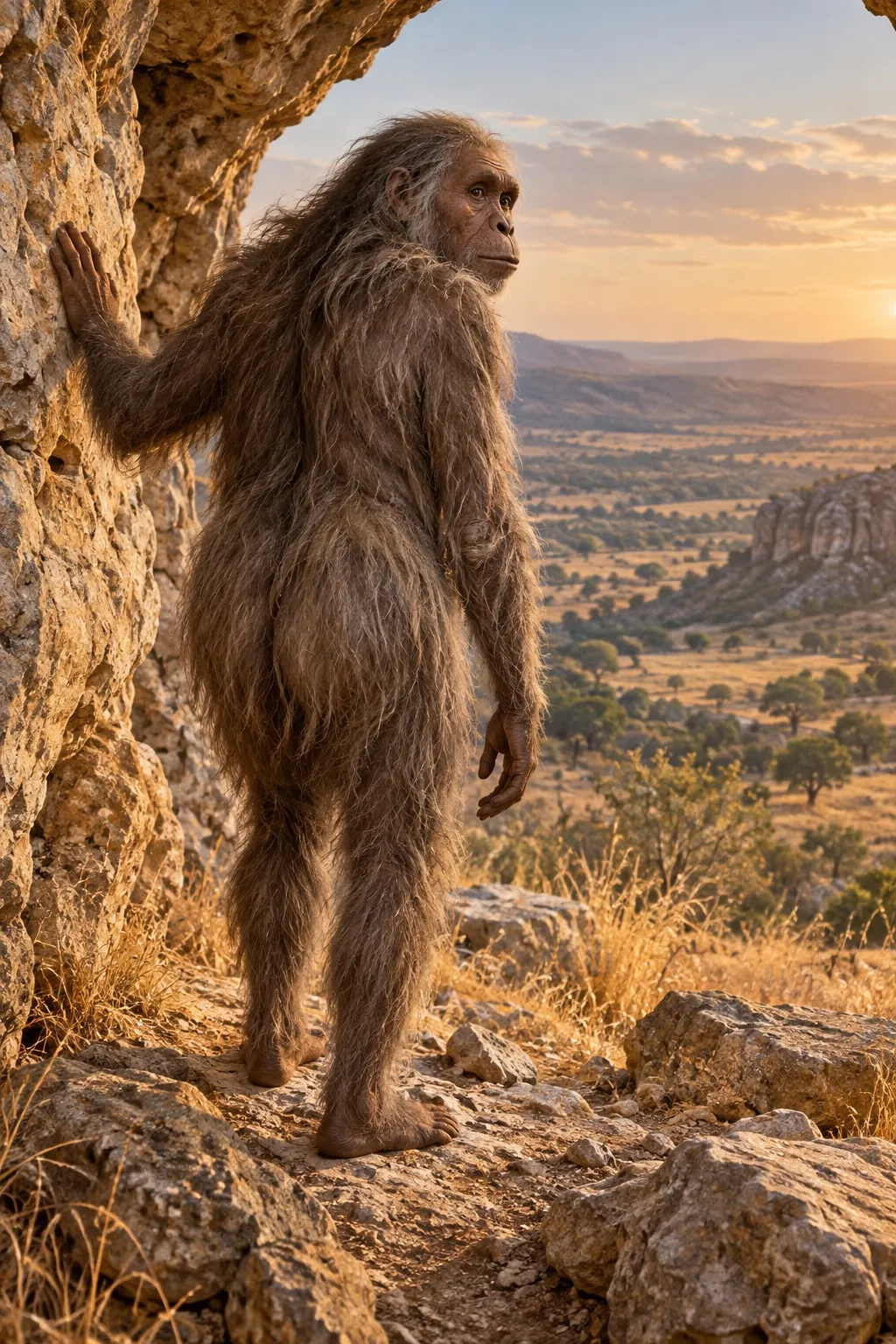
Ron Clarke (born 1944) is a British-born paleoanthropologist at the University of the Witwatersrand in South Africa. In 1994 he spotted four Australopithecus foot bones in a box of fossils labelled as monkey bones, and that led his team to Little Foot, the most complete Australopithecus skeleton ever found, which took some twenty years to free from the rock.
Four bones in a box
In 1994 Ron Clarke was going through boxes of fossils from Sterkfontein that had been blasted out of the cave years before and labelled as monkey bones. Four small bones caught his eye. Fitted together, they made part of a left foot, with a big toe that could still grasp a little, like an ape’s, from a creature that also walked upright. The bones got the nickname “Little Foot”.
In 1997 Clarke found more pieces of the same individual’s feet and leg in other boxes. One was a shin bone broken off clean. He gave a cast of it to two of his preparators, Stephen Motsumi and Nkwane Molefe, and sent them into the dark Silberberg Grotto to look for the matching break in the cave wall. They found it in about two days.
Twenty years of digging
The rest of the skeleton lay in hard breccia, a natural concrete of cave rubble. Clarke, Motsumi and Molefe spent the next two decades freeing it with small tools, a millimetre at a time: arm, skull and jaw, ribs, spine, pelvis, legs and hands. It was shown to the public in December 2017 as the most complete Australopithecus skeleton ever found.
Its age is still argued. A 2015 study gave about 3.67 million years, older than Lucy, while other methods give much younger dates. Clarke argues that Little Foot belongs to a species other than Australopithecus africanus, which he calls Australopithecus prometheus. Many researchers disagree.
Trained by the Leakeys
Clarke was born in Wokingham, England, in 1944, and qualified in the conservation of antiquities in London. In the 1960s he went to work for Louis Leakey in Nairobi, where he learned to handle and rebuild fossils. He did much of the painstaking work of reconstructing OH 24, a crushed skull from Olduvai Gorge, and published it in 1971 with Mary and Louis Leakey.
He later moved to South Africa and earned his PhD at Wits in 1977, and he has worked at Sterkfontein since 1991, when he took charge of the excavations there. He is an honorary professor at the university’s Evolutionary Studies Institute.
Worked with
- Louis Leakey Kenyan-born scientist who put East Africa at the centre of human origins
- Mary Leakey British archaeologist who found Zinj and the Laetoli footprints
- Lee Berger American-South African paleoanthropologist who led the Homo naledi and sediba work
Where to see the finds
- University of the Witwatersrand, Johannesburg: Little Foot (StW 573), shown to the public in December 2017
- National Museum of Tanzania, Dar es Salaam: OH 24, the Olduvai skull he rebuilt
Sources
- Clarke, R. J. and Tobias, P. V. (1995). Sterkfontein Member 2 foot bones of the oldest South African hominid. Science 269: 521 to 524.
- Clarke, R. J. and Kuman, K. (2019). The skull of StW 573, a 3.67 Ma Australopithecus prometheus skeleton from Sterkfontein Caves, South Africa. Journal of Human Evolution 134: 102634.
- Leakey, M. D., Clarke, R. J. and Leakey, L. S. B. (1971). New hominid skull from Bed I, Olduvai Gorge, Tanzania. Nature 232: 308 to 312.
- Sterkfontein Caves, University of the Witwatersrand: Ronald Clarke
- Wikipedia: Little Foot (timeline, checked 2026-10-30)
Last checked 30 October 2026. Spotted a mistake? Tell us.