Shanidar Cave in brief
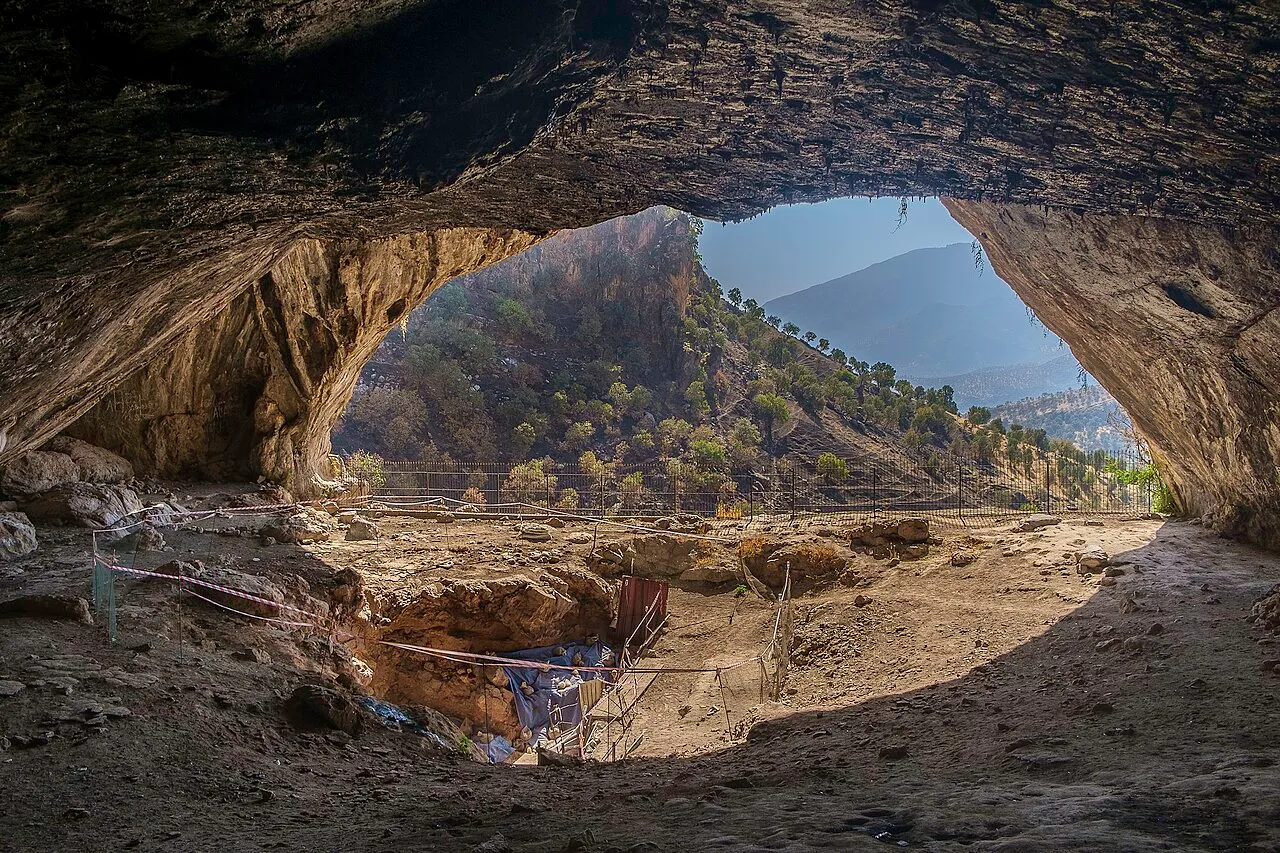
Shanidar Cave opens high on Bradost Mountain, in the Zagros Mountains of north-eastern Iraq, near the village of Barzan and above the valley of the Great Zab river. Its mouth is about 25 metres wide and 8 metres high, and inside is a single big chamber about 53 metres across. People have sheltered here for tens of thousands of years, and Kurdish shepherds were still wintering in it with their flocks when archaeologists first arrived.
The floor holds about 14 metres of layers. The deepest, Layer D, belongs to the Middle Paleolithic and holds the Neanderthals and their Mousterian stone tools, roughly 75,000 to 45,000 years old. Above it come the tools of early modern humans, then a cemetery from the very beginning of farming, then recent times.
Discovery
The American archaeologist Ralph Solecki first tested the cave floor in 1951. He came back in 1953, 1956 to 1957 and 1960, working with Iraq’s Directorate General of Antiquities and the Smithsonian Institution, and later Columbia University. The first Neanderthal, a baby, came out in 1953. In 1957 the team found three adults, Shanidar 1, 2 and 3, and in 1960 a tight group of bodies lying behind a large boulder that had fallen from the roof, among them Shanidar 4, the “flower burial”. A tenth Neanderthal, a child’s leg and foot bones, turned up in 2006 among the animal bones from the cave stored at the Smithsonian.
Solecki thought some of these people had been killed by rocks falling from the roof. That idea is now doubted.
In the 2010s a team led by Graeme Barker of the University of Cambridge, working with the Kurdistan Region’s antiquities service, reopened the dig beside Solecki’s 1960 trench. In 2018 they found Shanidar Z, the upper body of an adult whose flattened skull has since been pieced back together, and in 2019 and 2022 they found Shanidar A, an older adult with a spear wound (see the Shanidar A story).
What the fossils show
- Shanidar 1: A man who lived into middle age, old for a Neanderthal, with a body full of healed injuries. A blow crushed the bone around his left eye, which probably left him blind on that side. His right arm was withered and its lower part missing, his legs had been hurt and he walked with a limp, and bony growths in his ear canals made him nearly deaf. He lived with all this for years.
- Shanidar 3: A man of about 40 to 50 with a cut in a left rib that had started to heal, so he lived for some weeks after it. It was made by a sharp weapon, and one study argues it was a thrown spear.
- Shanidar 4: The “flower burial”. Clumps of pollen in the soil around the body were read in the 1970s as flowers laid on the grave. Most researchers now think burrowing animals or other natural causes brought the pollen in.
- Shanidar Z and A: Found in the same small patch as Shanidar 4. They show that Neanderthals laid their dead in this one spot again and again.
- Stone tools: Points, scrapers and flakes of the Mousterian, with the bones of wild goats and tortoises the Neanderthals ate.
- A later cemetery: Graves of about 35 people from roughly 10,600 years ago, at the start of the move to farming in the region.
Why it matters
Shanidar is one of the richest Neanderthal sites outside Europe, and it has shaped how we picture them. Shanidar 1 is one of the strongest cases that Neanderthals looked after the sick and injured: a man who could barely hear, see on one side or use one arm probably needed help from others to survive. The “flower burial” made Neanderthals famous as people who mourned their dead. The flowers are doubted now, but the new digs show the cave really was a place where bodies were laid down with care, over and over.
Two of its Neanderthals died from or lived with weapon wounds, which makes Shanidar a key site for the question of how much Neanderthals fought, and whom. See Neanderthals, and Amud Cave for another Neanderthal cave in the Near East.
Visiting
Visitors can walk up to the cave from the road below, and the dig inside is fenced off. The cave is in the Kurdistan Region of Iraq, in Erbil Governorate, so check your government’s travel advice before planning a trip. The original Shanidar 3 skeleton is at the Smithsonian in Washington. The other fossils from Solecki’s digs went to the Iraq Museum in Baghdad, and casts of them are kept at the Smithsonian.
Sources
- Solecki, R. S. (1971). Shanidar: The First Flower People. Knopf.
- Leroi-Gourhan, A. (1975). The flowers found with Shanidar IV, a Neanderthal burial in Iraq. Science 190: 562 to 564.
- Trinkaus, E. (1983). The Shanidar Neandertals. Academic Press.
- Sommer, J. D. (1999). The Shanidar IV ‘flower burial’: a re-evaluation of Neanderthal burial ritual. Cambridge Archaeological Journal 9: 127 to 129.
- Solecki, R. S., Solecki, R. L. and Agelarakis, A. P. (2004). The Proto-Neolithic Cemetery in Shanidar Cave. Texas A&M University Press.
- Cowgill, L. W., Trinkaus, E. and Zeder, M. A. (2007). Shanidar 10: a Middle Paleolithic immature distal lower limb from Shanidar Cave, Iraqi Kurdistan. Journal of Human Evolution 53: 213 to 223.
- Churchill, S. E. and others (2009). Shanidar 3 Neandertal rib puncture wound and Paleolithic weaponry. Journal of Human Evolution 57: 163 to 178.
- Trinkaus, E. and Villotte, S. (2017). External auditory exostoses and hearing loss in the Shanidar 1 Neandertal. PLoS ONE 12: e0186684.
- Pomeroy, E. and others (2020). New Neanderthal remains associated with the ‘flower burial’ at Shanidar Cave. Antiquity 94: 11 to 26.
- Pomeroy, E. and others (2026). Evidence for funerary behaviour and lethal trauma in a new Neanderthal individual from Shanidar Cave. Scientific Reports 16: 30042.
Last checked 27 November 2026. Spotted a mistake? Tell us.