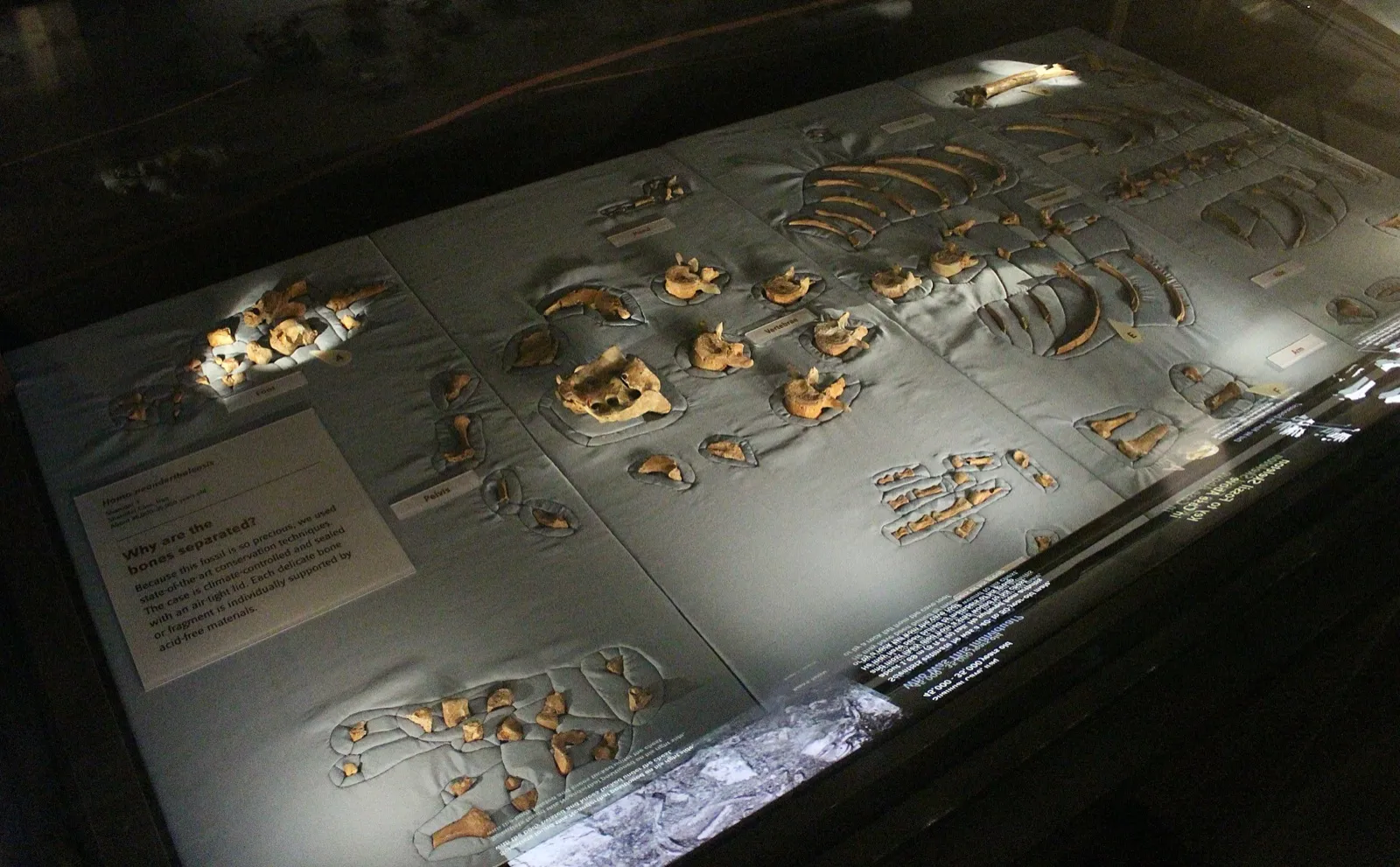
Shanidar 3 in brief
Shanidar 3 is the partial skeleton of a Neanderthal man from Shanidar Cave, in the Zagros Mountains of Iraqi Kurdistan. He was about 40 to 50 years old when he died and stood about 1.69 metres tall. One of his left ribs carries a deep cut from a sharp weapon that had started to heal. The Smithsonian calls it possibly the oldest known killing, or attempted killing, of one human by another, and a 2009 study argued the weapon was a thrown spear.
The find
Ralph Solecki’s team found the skeleton in the cave in 1957, during the third season of digging, after a local workman noticed bone in the trench. The team came back in 1960 and recovered more of it. He lay near the top of Layer D, the deepest layer, which holds the Neanderthals and their Mousterian stone tools. Shanidar 1, a man who survived crippling injuries, and Shanidar 5 lay nearby in the same upper part of the layer, and rocks fallen from the cave roof lay over Shanidar 3’s body. Solecki thought a rock fall may have killed him, but whether the roof came down before or after his death cannot be told.
More than 130 bones and many small fragments survive. The skull was never recovered, but some teeth were, worn almost down to the roots.
How old it is
No date has been taken from the skeleton itself. Radiocarbon dates on charcoal found near Shanidar 1, at the same level, came out at about 46,000 to 50,000 years. Newer work by the Cambridge team at the cave puts the upper Neanderthals, Shanidar 1, 3 and 5, at roughly 45,000 to 55,000 years ago, and the Smithsonian gives a younger estimate of 35,000 to 45,000. Roughly 45,000 to 50,000 years is the usual figure.
The rib wound
The wound is a deep, narrow cut in the left ninth rib, on the side of the chest. A sharp edge went in between the ribs and probably collapsed his lung. New bone had started to grow around the cut, so he lived for at least several weeks after the injury. The Smithsonian suggests he still most likely died of it, perhaps from the lung damage or an infection.
The thrown spear idea
In 2009 Steven Churchill of Duke University and his colleagues tried to work out what kind of weapon made the cut. They fired stone points into pig carcasses with a crossbow set to match different weapons. Thrusting spears, held and pushed in, carry more force and did more damage than Shanidar 3 shows. Points moving at the lower speed of a thrown spear left a cut much like his. The angle of the wound, about 45 degrees downward, also fits a weapon arriving from the air if he was standing.
The team pointed out that throwing weapons are usually thought of as a modern human invention, and they saw no clear evidence that Neanderthals used them. So they raised the possibility that a modern human threw the weapon. They also said they could not rule out a knife, an accident or a hand-held Neanderthal spear, and other researchers have argued that a Neanderthal weapon is just as possible. Who wounded Shanidar 3, and why, is still unknown.
His other injuries
He had arthritis in his right ankle and wear in other joints. Degenerative changes like these are common in the adult Shanidar Neanderthals and point to hard, active lives.
In 2026 the Cambridge team described Shanidar A, an older adult from the same cave with a round hole through the shoulder blade that looks like a wooden spear thrust. That person lived about 25,000 years before Shanidar 3, so the two wounds show that weapon injuries turn up again and again among the Shanidar Neanderthals. See the Shanidar A story.
Where it is
The original is at the Smithsonian’s National Museum of Natural History in Washington, D.C., where it is shown in the Hall of Human Origins. It came to the Smithsonian for study and conservation, as Iraq’s antiquities law then allowed, because the digs were run jointly by Iraq’s Directorate General of Antiquities and the Smithsonian. The other Neanderthal skeletons from Solecki’s digs went to the Iraq Museum in Baghdad.
Sources
- Solecki, R. S. (1971). Shanidar: The First Flower People. Knopf.
- Trinkaus, E. and Zimmerman, M. R. (1982). Trauma among the Shanidar Neandertals. American Journal of Physical Anthropology 57: 61 to 76.
- Trinkaus, E. (1983). The Shanidar Neandertals. Academic Press.
- Churchill, S. E., Franciscus, R. G., McKean-Peraza, H. A., Daniel, J. A. and Warren, B. R. (2009). Shanidar 3 Neandertal rib puncture wound and Paleolithic weaponry. Journal of Human Evolution 57: 163 to 178.
- Pomeroy, E. and others (2017). Newly discovered Neanderthal remains from Shanidar Cave, Iraqi Kurdistan, and their attribution to Shanidar 5. Journal of Human Evolution 111: 102 to 118.
- Pomeroy, E. and others (2026). Evidence for funerary behaviour and lethal trauma in a new Neanderthal individual from Shanidar Cave. Scientific Reports 16: 30042.
- Smithsonian Human Origins Program: Shanidar 3, Neanderthal skeleton.
Last checked 27 November 2026. Spotted a mistake? Tell us.