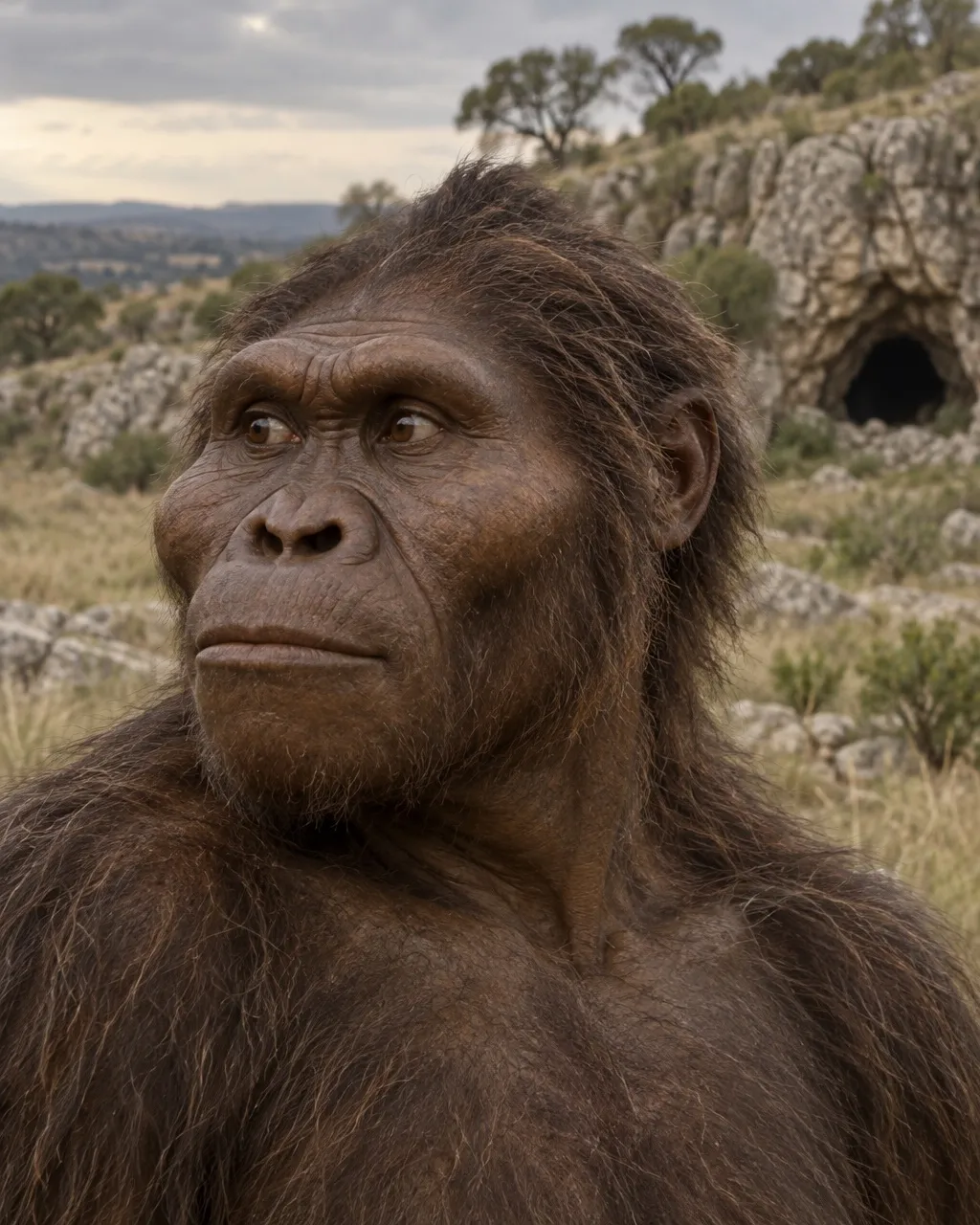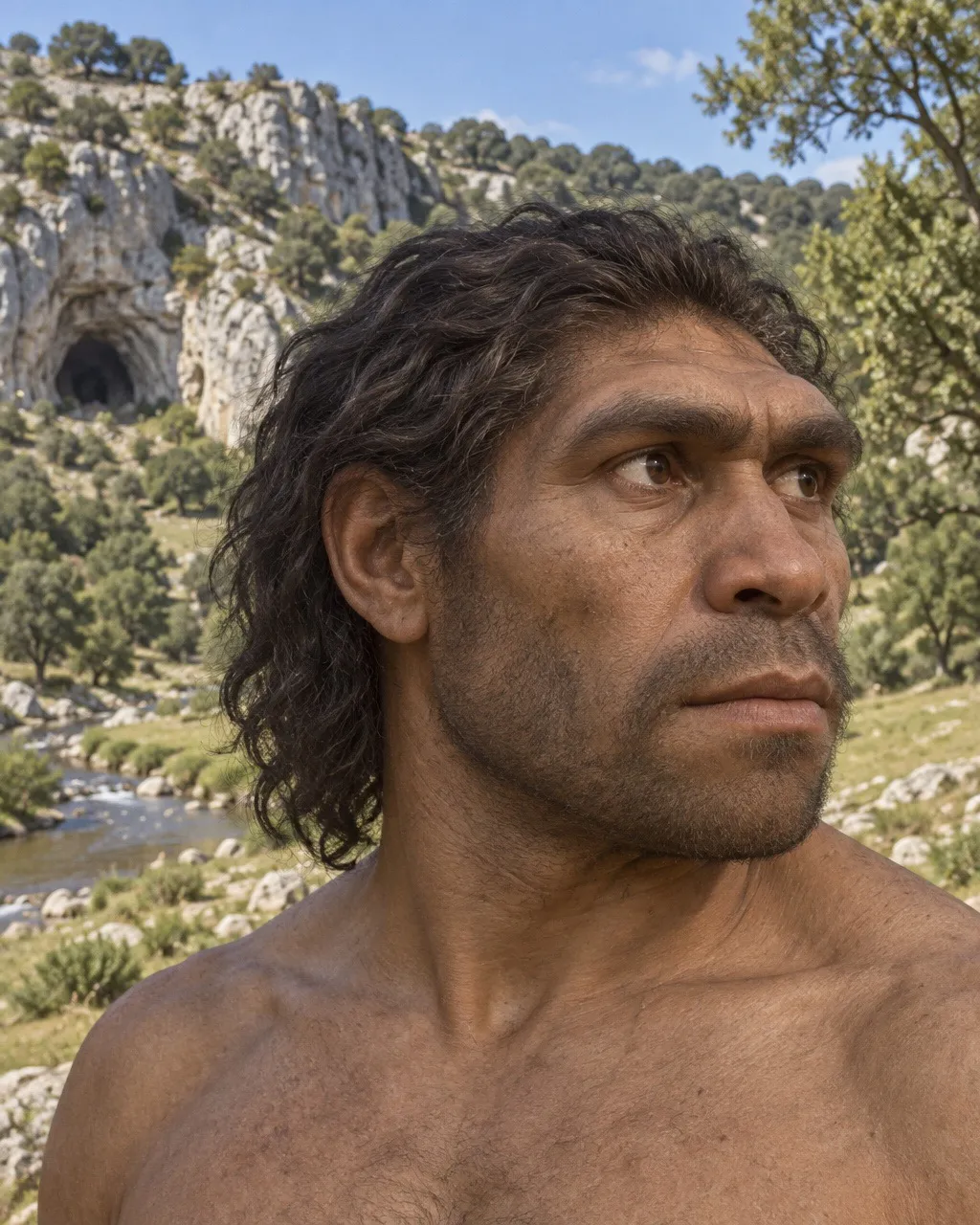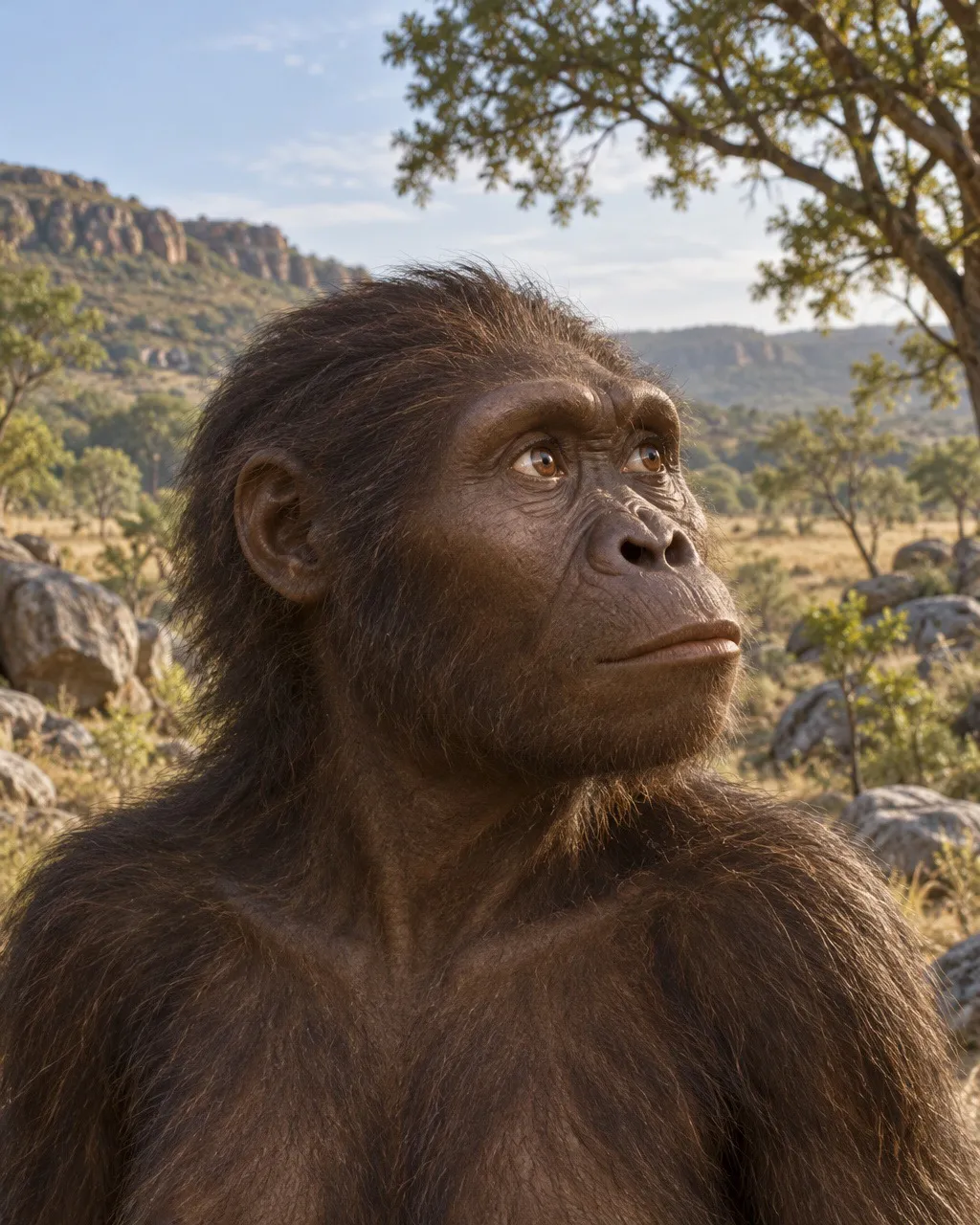
Australopithecus sediba is a small, small-brained species from Malapa cave in South Africa, dated to about 1.98 million years ago. Found in 2008 by a nine-year-old boy, it mixes ape-like and human-like features, with a long thumb and short fingers but long arms for climbing.
The species in brief
About 1.98 million years ago, at least two individuals of a small human relative died in a cave in the dolomite hills north of today’s Johannesburg, probably after falling down a deep shaft. Their bodies were buried quickly, which is why so much of their skeletons survives. When they were found in 2008, they turned out to be a new species, Australopithecus sediba. It has a small brain and long arms like other australopiths, but a hand, pelvis and teeth with surprisingly human-like features.
Discovery
In 2008 Lee Berger of the University of the Witwatersrand was mapping caves in the Cradle of Humankind, near Sterkfontein, using satellite images. On 15 August he visited a site called Malapa with his nine-year-old son Matthew and his dog. Matthew ran off after the dog and soon called his father over to a rock with a bone sticking out of it. It was the collarbone of a young hominin.
The team soon found two partial skeletons:
- MH1 (Malapa Hominin 1), nicknamed Karabo: A young male of about 12 or 13, with a partial skull, jaw and skeleton. He is the type specimen.
- MH2: An adult female with much of her skeleton, including a hand and wrist that are nearly complete and a foot and ankle.
Berger and his colleagues named the species in the journal Science in April 2010. More bones from these and other individuals have come out of the rock since.
How old it is
The fossils lie under a layer of flowstone, a sheet of rock laid down by dripping water. In 2011 Robyn Pickering and colleagues dated that flowstone with uranium-lead, and combined it with a record of Earth’s magnetic field in the layers, which flipped briefly at this time. The result was about 1.977 million years, with a margin of only a couple of thousand years. Few hominin fossils anywhere are dated so precisely.
A mosaic body
- Brain: About 420 cubic centimetres in Karabo, who had reached most of his adult brain size. That is no bigger than other australopiths.
- Size: Small. Karabo would have stood about 1.3 metres at most as an adult, and the species was probably around 1.2 to 1.3 metres tall.
- Face and teeth: A smaller face that juts forward less than in most australopiths, with small cheek teeth.
- Hand: MH2’s hand has a strong grip for climbing, like other australopiths, but also a long thumb and short fingers, the proportions needed for a precise grip between thumb and fingertips. Some researchers think a hand like this could have made stone tools.
- Arms: Long, with large joints, good for climbing trees.
- Pelvis: The upper part is shaped more like that of Homo than of other australopiths.
- Foot and ankle: A human-like ankle joint and possibly an arch, but an ape-like heel. The team suggested it walked upright in its own unusual way, rolling onto the outer edge of the foot, and still climbed.
What it ate
In 2012 a team led by Amanda Henry extracted tiny plant particles, called phytoliths, from the hardened plaque on the teeth of the two skeletons. Together with chemical and wear studies of the teeth, they showed that these individuals ate leaves, fruit, bark and wood from trees and shrubs, and some grasses or sedges. Unlike other hominins of the region at that time, they largely ignored the open grassland plants. It is the first time plant remains were recovered from the teeth of such an early hominin.
The argument
The discoverers argued that Australopithecus sediba is probably descended from Australopithecus africanus, and that it shares more features with early Homo than any other australopith does. They suggested it might be close to the ancestor of our genus.
The dates make that difficult. In 2015 a team working at Ledi-Geraru in Ethiopia reported a jaw from the genus Homo about 2.8 million years old, and other early Homo fossils, such as KNM-ER 1470, are about as old as Malapa or older. A species that lived 1.98 million years ago cannot be the ancestor of humans who already existed 800,000 years earlier, although it could be a late survivor of a population that was. Most researchers now see it as a cousin of early Homo that shows how many of our features evolved more than once, or in a patchwork, among different hominins.
Where to see it
The Malapa fossils are kept at the University of the Witwatersrand in Johannesburg. The team made 3D scans of the bones freely available online for researchers and teachers.
Sources
- Smithsonian National Museum of Natural History, Human Origins Program. Australopithecus sediba.
- Australian Museum. Australopithecus sediba.
- Berger, L. R. and others (2010). Australopithecus sediba: a new species of Homo-like australopith from South Africa. Science 328: 195 to 204.
- Pickering, R. and others (2011). Australopithecus sediba at 1.977 Ma and implications for the origins of the genus Homo. Science 333: 1421 to 1423.
- Kivell, T. L. and others (2011). Australopithecus sediba hand demonstrates mosaic evolution of locomotor and manipulative abilities. Science 333: 1411 to 1417.
- Zipfel, B. and others (2011). The foot and ankle of Australopithecus sediba. Science 333: 1417 to 1420.
- Henry, A. G. and others (2012). The diet of Australopithecus sediba. Nature 487: 90 to 93.
- Villmoare, B. and others (2015). Early Homo at 2.8 Ma from Ledi-Geraru, Afar, Ethiopia. Science 347: 1352 to 1355.
Cite this page
Bonelore. "Australopithecus sediba." https://bonelore.com/species/australopithecus-sediba/
Last checked 27 November 2026. Spotted a mistake? Tell us.