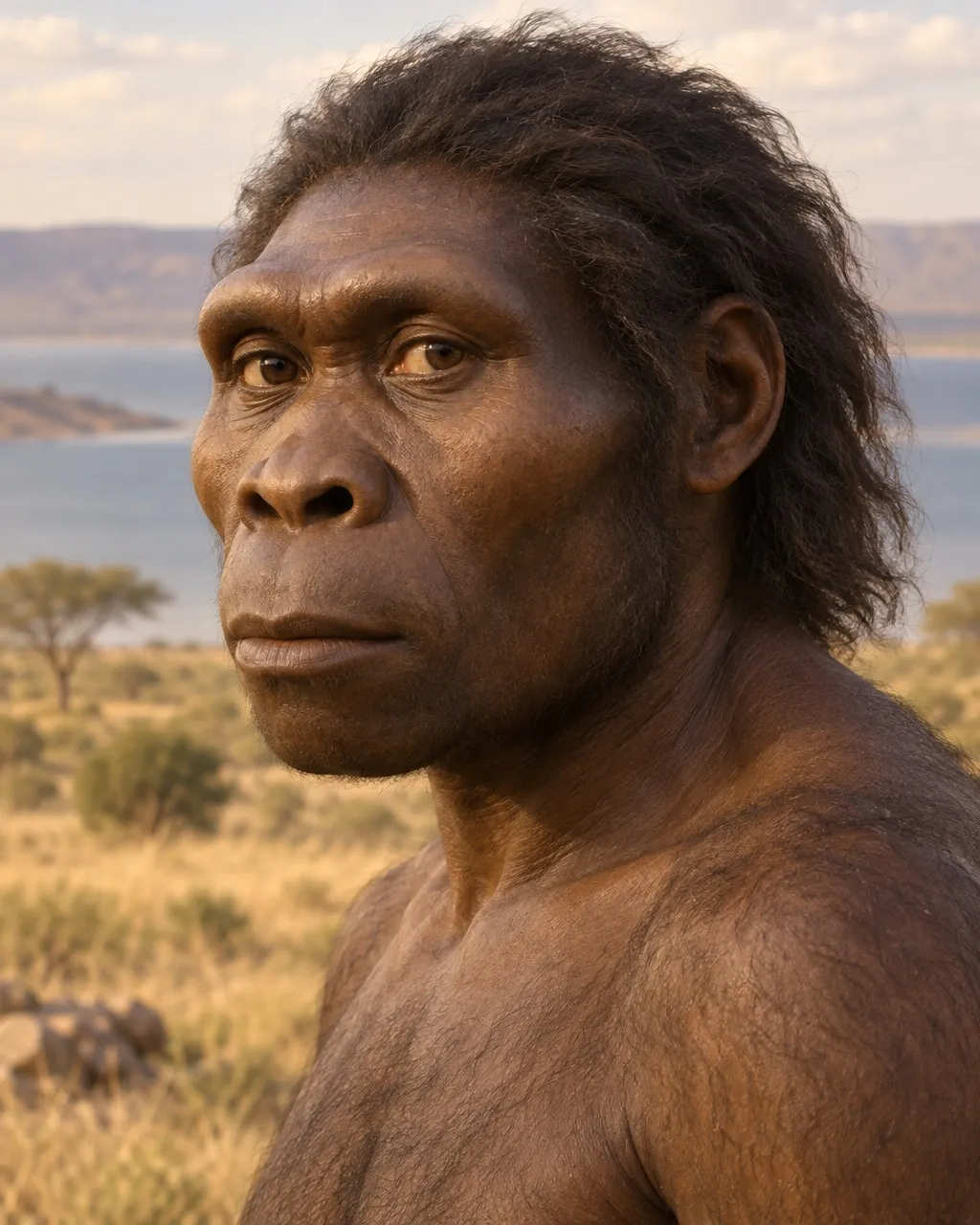
Meave Leakey (born 1942) is a British-born Kenyan paleontologist who has worked around Lake Turkana since 1969. Her teams found and named Australopithecus anamensis in 1995 and Kenyanthropus platyops in 2001, and her later work showed that several kinds of early Homo lived side by side in East Africa.
From monkeys to hominins
Meave Epps was born in London in 1942 and trained as a zoologist at the University of North Wales in Bangor, earning her doctorate in 1968. While working on it she spent time at a primate research centre near Nairobi run by Louis Leakey. In 1969 she was invited to join Richard Leakey’s new expedition at Koobi Fora on Lake Turkana. They married in 1970.
From 1982 to 2001 she headed the National Museums of Kenya’s Division of Palaeontology. Her early specialty was fossil monkeys. She also did much of the slow work of putting fossils back together: after Bernard Ngeneo found the skull KNM-ER 1470 in more than 150 pieces in 1972, she and colleagues rebuilt it over the following weeks.
Two new names
In 1989, when Richard turned to wildlife and politics, Meave became coordinator of the museum’s fossil field research in the Turkana Basin. Her team went back to Kanapoi, south-west of the lake, and to Allia Bay on the east shore. In 1994 and 1995 they found jaws, teeth and a shin bone about 4 million years old, and in 1995 they named a new species, Australopithecus anamensis, from the Turkana word for lake. The shin showed it walked upright.
In 1999 Justus Erus, a member of her team, found a crushed skull at Lomekwi, west of the lake. It had a flat face unlike Australopithecus afarensis, which lived at the same time. In 2001 she and her colleagues gave it a new genus, Kenyanthropus platyops, the flat-faced man of Kenya. It is still debated, but it opened the question of how many lineages lived 3.5 million years ago.
Many kinds of early Homo
Back at Koobi Fora, her team found more early Homo fossils. In 2007 a team led by Fred Spoor, with Meave as a co-author, showed that Homo habilis and Homo erectus lived in the same basin for a long time. In 2012 they described a face and jaws that matched KNM-ER 1470, strong evidence that at least two kinds of early Homo lived beside erectus about 2 million years ago.
She is a research professor with the Turkana Basin Institute and Stony Brook University. In 2013 she became the first Kenyan citizen elected a foreign associate of the US National Academy of Sciences. Her daughter Louise Leakey now directs the Koobi Fora Research Project.
Worked with
- Richard Leakey Kenyan fossil hunter, museum director and wildlife campaigner
- Kamoya Kimeu Kenyan fossil hunter who found Turkana Boy and led the Hominid Gang
- Louis Leakey Kenyan-born scientist who put East Africa at the centre of human origins
- Louise Leakey Kenyan paleontologist who leads the Koobi Fora Research Project
Where to see the finds
- National Museums of Kenya, Nairobi: the Kanapoi, Allia Bay and Lomekwi fossils, including KNM-WT 40000, the Kenyanthropus skull
Sources
- Leakey, M. G. and others (1995). New four-million-year-old hominid species from Kanapoi and Allia Bay, Kenya. Nature 376: 565 to 571.
- Leakey, M. G. and others (2001). New hominin genus from eastern Africa shows diverse middle Pliocene lineages. Nature 410: 433 to 440.
- Leakey, M. G. and others (2012). New fossils from Koobi Fora in northern Kenya confirm taxonomic diversity in early Homo. Nature 488: 201 to 204.
- Spoor, F. and others (2007). Implications of new early Homo fossils from Ileret, east of Lake Turkana, Kenya. Nature 448: 688 to 691.
- Encyclopaedia Britannica: Meave G. Leakey (born July 28, 1942; checked 2026-11-27)
- Turkana Basin Institute: Meave Leakey elected to National Academy of Sciences (2013)
- Wikipedia: Meave Leakey (checked for dates, 2026-10-30)
Last checked 27 November 2026. Spotted a mistake? Tell us.