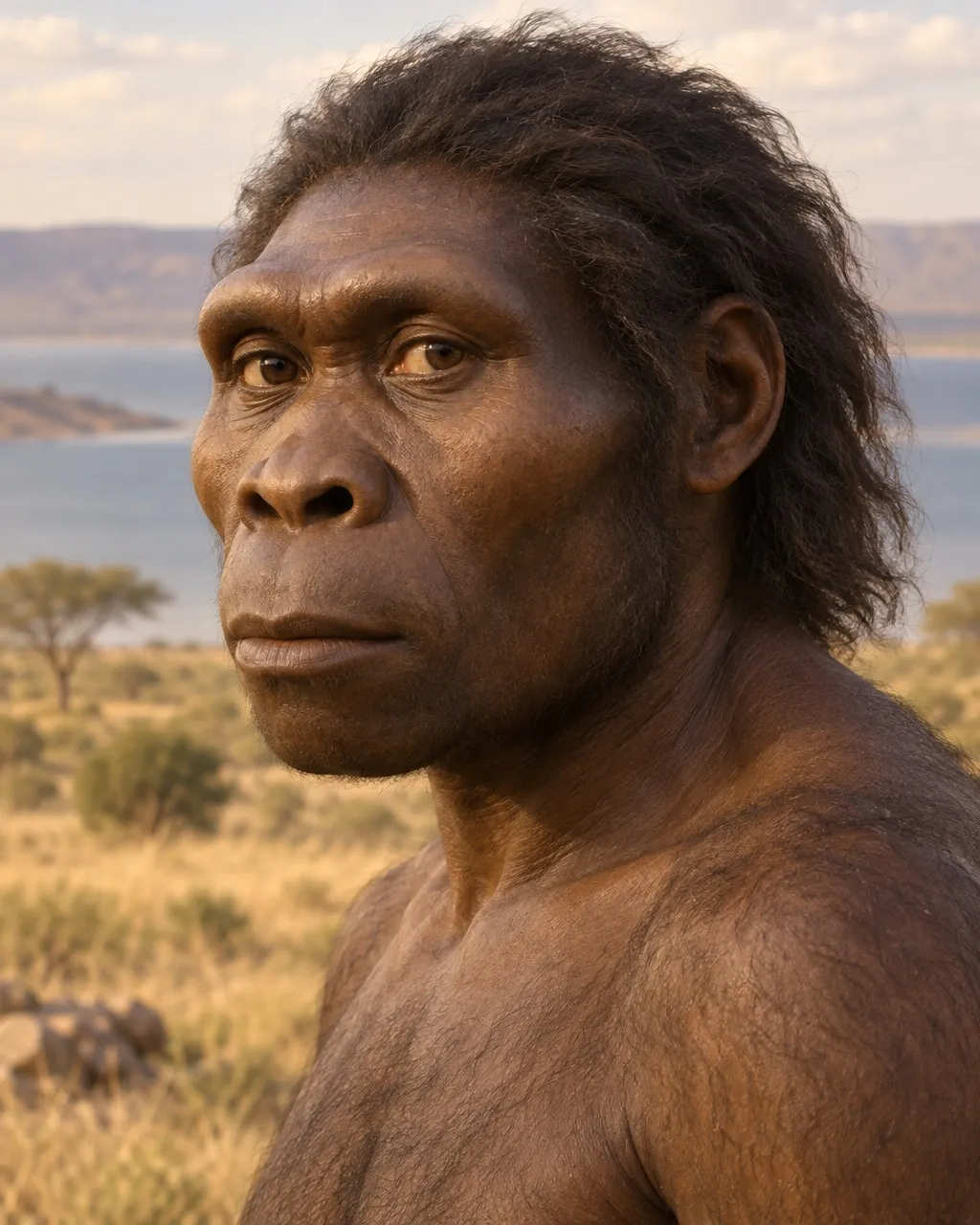
Richard Leakey (1944 to 2022) was a Kenyan paleoanthropologist and conservationist. His teams at Lake Turkana found many of the key fossils of early Homo, including KNM-ER 1470 and Turkana Boy. He ran the National Museums of Kenya, then the Kenya Wildlife Service, and burned Kenya's ivory stockpile in 1989 to fight poaching.
The helicopter ride
In 1967 Richard Leakey, in his early twenties and with no university degree, was on an expedition in southern Ethiopia when he saw layers of ancient sediment east of Lake Turkana from a plane, on a flight between Nairobi and the Omo. In 1968 he borrowed a small helicopter from the American team at the Omo and landed near Ileret. Fossils and stone tools lay on the surface almost at once.
He talked the National Geographic Society into funding a new project there, and set up camp on a sand spit called Koobi Fora. Over the next decades it became one of the richest early human sites in the world.
The Turkana fossils
Many of the finds were made by the team of Kenyan fossil hunters led by Kamoya Kimeu, known as the “Hominid Gang”. Among the best known:
- KNM-ER 406 (1969), a skull of Paranthropus boisei, found by Leakey and H. Mutua (as the Smithsonian credits it).
- KNM-ER 1470 (1972), a large-brained skull of early Homo about 2 million years old, found by Bernard Ngeneo. Leakey’s claim that it was nearly 3 million years old led to years of argument over the dating, and the younger age won.
- KNM-ER 1813 (1973), a small skull of Homo habilis.
- KNM-ER 3733 (1975), a skull of Homo erectus from the same time as Paranthropus, which helped show that more than one kind of hominin lived side by side.
- Turkana Boy (1984), the most complete early human skeleton then known, found by Kimeu west of the lake.
- The Black Skull (1985), found by Alan Walker on Leakey’s West Turkana expedition, now the best-known skull of Paranthropus aethiopicus (the species was named from a jaw found in Ethiopia in 1967).
Museums, elephants and politics
Leakey became director of the National Museums of Kenya in 1968 (Stony Brook gives 1969), the first Kenyan in the post, and ran them until 1989. He wrote popular books, starting with Origins (1977, with Roger Lewin), and argued in public with Donald Johanson over the shape of the human family tree.
In 1989 President Moi put him in charge of Kenya’s wildlife, at a time when poachers were killing elephants by the thousands. He armed and trained the rangers, and in July 1989 set fire to about 12 tonnes of seized ivory in Nairobi National Park, an image that went round the world. In 1993 the small plane he was flying crashed, and both his legs were later amputated below the knee.
He went on to co-found an opposition party, served as head of Kenya’s civil service from 1999 to 2001, and later chaired the Kenya Wildlife Service board. With Stony Brook University he built the Turkana Basin Institute, which still supports research around the lake. He died at home in the Ngong Hills outside Nairobi on 2 January 2022. His wife Meave Leakey and daughter Louise Leakey continue the fieldwork.
Worked with
- Kamoya Kimeu Kenyan fossil hunter who found Turkana Boy and led the Hominid Gang
- Meave Leakey British-born Kenyan paleontologist who named two hominin species
- Mary Leakey British archaeologist who found Zinj and the Laetoli footprints
- Louis Leakey Kenyan-born scientist who put East Africa at the centre of human origins
- Louise Leakey Kenyan paleontologist who leads the Koobi Fora Research Project
- Tim White American paleoanthropologist who led the team that found Ardi
Where to see the finds
- National Museums of Kenya, Nairobi: the Koobi Fora and West Turkana fossils, including KNM-ER 1470 and Turkana Boy
- Turkana Basin Institute field stations, northern Kenya, which he set up with Stony Brook University
Sources
- Leakey, R. E. F. (1973). Evidence for an advanced Plio-Pleistocene hominid from East Rudolf, Kenya. Nature 242: 447 to 450.
- Walker, A. and Leakey, R. (eds.) (1993). The Nariokotome Homo erectus Skeleton. Harvard University Press.
- Nature obituary: Richard Leakey (1944 to 2022) (2022)
- Stony Brook University, Department of Anthropology: Tribute to Richard Leakey
- Wikipedia: Richard Leakey (checked for dates, 2026-11-27)
Last checked 27 November 2026. Spotted a mistake? Tell us.