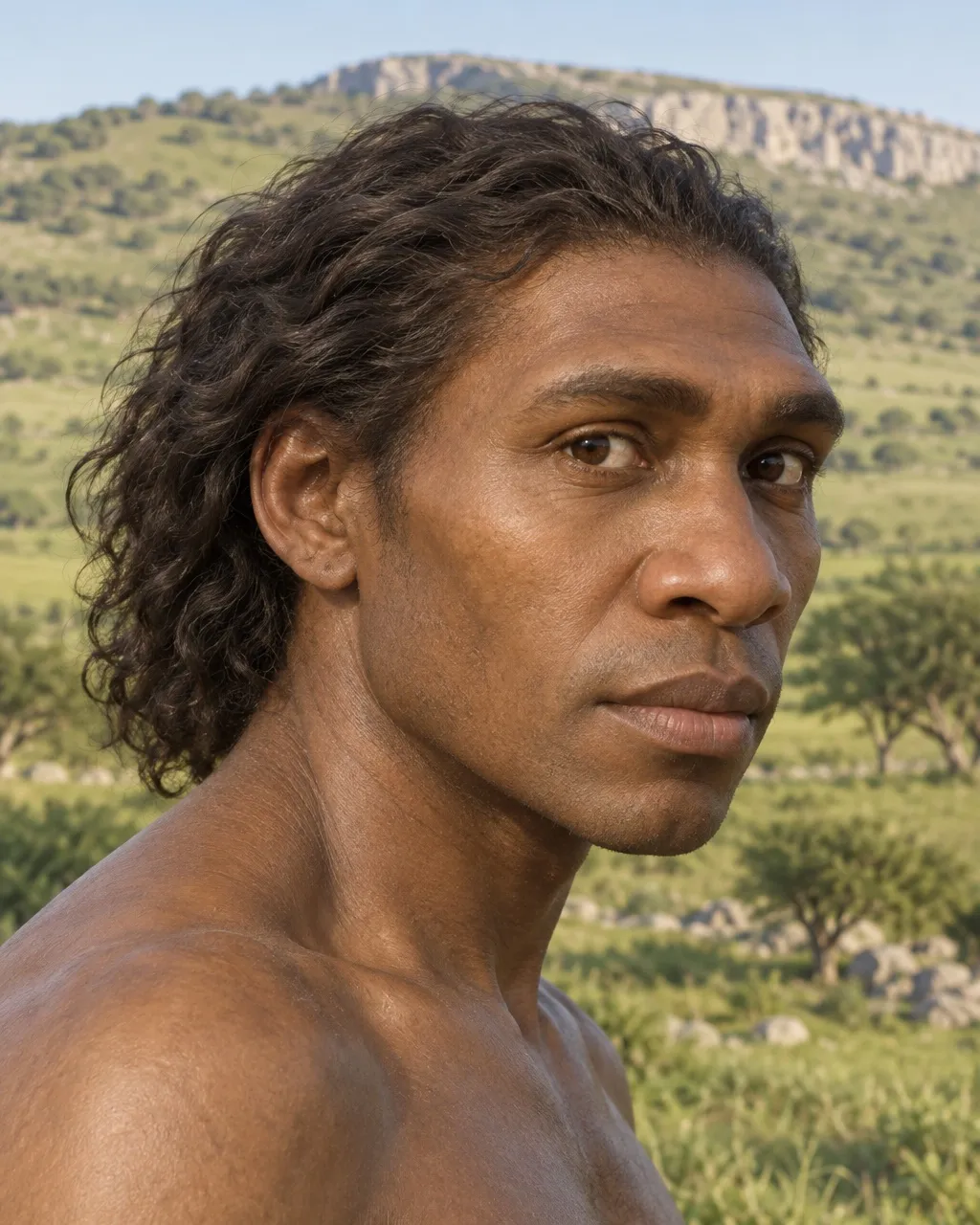
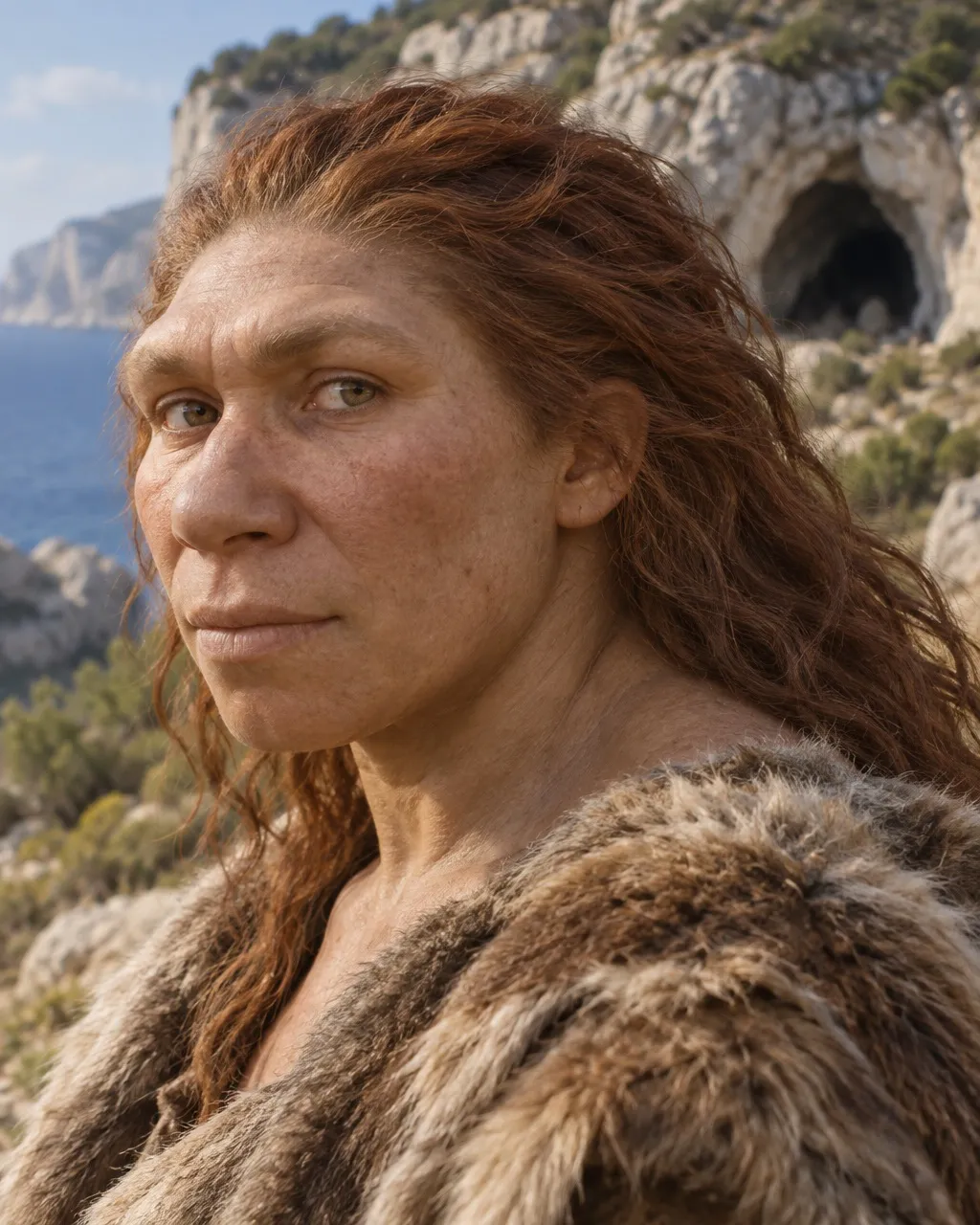
Neanderthals and modern humans (Homo sapiens) were two branches of the same family that split more than half a million years ago. Neanderthals were shorter and stockier, with a long, low skull, a heavy brow and no chin, and brains as big as ours. They lived in Europe and western Asia until about 40,000 years ago, and many people today still carry a little of their DNA.
Side by side
| Neanderthals | Modern humans | |
|---|---|---|
| Scientific name | Homo neanderthalensis | Homo sapiens |
| When | About 430,000 to 40,000 years ago | At least 300,000 years ago to today |
| Where | Europe and western Asia, from Spain to Siberia and south to Iraq and Israel | Africa first, then every continent |
| Skull | Long and low, with a bulge at the back (the “bun”) | High and rounded, like a globe |
| Brow | Heavy, double-arched brow ridge | Small brow, high upright forehead |
| Face and chin | Big nose, face pushed forward in the middle, usually no chin | Flat face tucked under the forehead, a real chin |
| Brain | About 1,400 to 1,500 cc on average, as big as ours or bigger | About 1,350 cc on average today |
| Body | Short, stocky and barrel-chested, built for cold; men about 1.65 m (5 ft 5 in) | Taller and more slender on average, with longer forearms and shins |
| Tools | Mousterian flakes and points, made with the Levallois method; birch-tar glue | Wider kits over time, with blades, bone and antler tools, sewing needles and spear throwers |
| Culture | Fire, some burials, pigments, shell and talon ornaments, care for the injured | All of those, plus art and ornaments in far greater numbers |
| DNA today | Lives on in us: about 1 to 2 percent of the DNA of people with ancestry from outside Africa | Every person alive today |
Two branches of one family
Neanderthals were not our ancestors. They were our closest cousins. Both lines go back to a shared ancestral population in Africa that lived more than half a million years ago. Comparing Neanderthal and modern human genomes puts the split at roughly 550,000 to 765,000 years ago.
One branch moved into Europe and western Asia and became the Neanderthals. The oldest fossils on that branch, about 430,000 years old, come from the Sima de los Huesos, a deep pit in the Sierra de Atapuerca in Spain, where ancient DNA shows they were early Neanderthals. Their close relatives the Denisovans split off further east. The other branch stayed in Africa and became us. The oldest fossils of our species, from Jebel Irhoud in Morocco, are about 300,000 years old (dated to about 315,000).
Which earlier species sat at the fork is still argued. Homo heidelbergensis is often named, though many researchers now think the picture was messier than one ancestor.
Skull and face
The skull is where the difference shows most clearly, and it is how a single fossil is usually told apart.
- Shape of the braincase. A Neanderthal skull is long and low. Seen from the back it is round, like a ball pushed down. Ours is tall and rounded, almost a globe, with a high forehead.
- The “bun”. Neanderthals have a bulge at the back of the skull called the occipital bun, with a small oval dip just above it. Some modern humans have a slight bun, but not the dip.
- Brow ridge. Neanderthals have a thick, continuous brow ridge that arches over each eye. Modern humans have a small brow, or almost none.
- Midface. A Neanderthal face juts forward along the middle, around a very wide nose, with the cheekbones swept back. This is called midfacial projection. Our faces are flatter and sit tucked under the front of the braincase.
- Chin. A true chin, a bony point at the front of the lower jaw, is found only in our species. Neanderthals usually had a sloping jaw with no chin.
- Teeth. Neanderthal front teeth were large and often heavily worn, maybe from being used as a third hand to grip hides and other things. Behind the last molar there is often a gap before the jaw rises, which our jaws lack.
The Old Man of La Chapelle-aux-Saints, La Ferrassie 1 and Amud 1 show the Neanderthal pattern well. For modern humans, compare Cro-Magnon 1 from France and Skhul V from Israel. All five can be turned in 3D in the Hall of skulls.
Brain size
Neanderthal brains were not smaller than ours. On average they were a little bigger: roughly 1,400 to 1,500 cubic centimetres, against about 1,350 for people today. Some Neanderthal men had brains of more than 1,700 cc. Early modern humans in Europe also had larger brains than people do now.
The shape was different, though. Neanderthal brains were longer and lower, while ours became rounder over the last 300,000 years, with a bigger, bulging top and back. What that meant for how they thought is not known. Bigger bodies, and perhaps larger areas for vision and body control, could account for part of their size.
Body build
Neanderthals were short and very strong. Men averaged about 1.65 m (5 ft 5 in) and women about 1.55 m (5 ft 1 in), with heavy, thick-walled bones and big joints. They had a deep, wide chest shaped like a barrel, wide hips and short forearms and shins.
That is the kind of body that keeps heat in, the same pattern seen in people who live in the Arctic today, and it fits a species that lived through ice ages. It also burned a lot of energy. Healed fractures on many Neanderthal skeletons suggest a hard, risky life, much of it spent hunting large animals at close range.
Early modern humans arriving in Europe from Africa were often taller and slimmer, with longer lower legs and arms, a body suited to warmer places.
Where and when they lived
Neanderthals lived across Europe and western Asia, from Portugal, Spain and Britain to Germany’s Neander Valley, where the first named fossils were found in 1856, and on to the Middle East and as far east as the Altai Mountains in Siberia. Famous sites include La Ferrassie and La Chapelle-aux-Saints in France, Shanidar Cave in Iraq, Amud Cave in Israel and Denisova Cave in Siberia. They never reached Africa, East Asia or Australia, as far as anyone knows.
Modern humans began in Africa. Small groups left early: a jaw from Misliya Cave in Israel is about 180,000 years old, and the burials at Skhul in the Mount Carmel Caves are about 100,000 to 135,000. The big spread came later, after about 60,000 years ago, reaching Australia by at least 50,000 years ago and much of Europe by about 45,000. The two met more than once, in the Middle East and then in Europe, where they overlapped for several thousand years.
Tools and culture
Neanderthals made a tool kit called the Mousterian. Using the Levallois method, they shaped a stone core so that a flake of a planned size and shape came off in one blow, then turned those flakes into scrapers and spear points. They made glue from birch bark by heating it, which takes careful control of fire, and used it to fix stone points to handles. They controlled fire and kept hearths.
Their culture went further than the old “caveman” image allows:
- Burials. Several skeletons, at La Chapelle-aux-Saints, La Ferrassie and Shanidar among others, lie in what look like graves.
- Care. Shanidar 1, a man from Iraq, survived a crushed eye socket, a withered arm, a damaged leg and near-deafness for years, which most researchers read as a sign that others looked after him.
- Ornaments and pigment. Eagle talons with cut marks from Krapina in Croatia, about 130,000 years old, pierced and painted shells, and red and black pigments.
- Art? Red marks in three Spanish caves have been dated to more than 64,000 years ago, before modern humans arrived, but those dates are disputed.
Early modern humans in Africa also made Levallois tools at first, along with shell beads and engraved ochre. After about 45,000 years ago in Europe they brought new kits, with long stone blades, tools of bone and antler, eyed needles for sewn clothing, and later spear throwers. Cave paintings like those at Lascaux and Chauvet, carved figurines and musical flutes show up in large numbers. How much of this difference reflects ability, and how much population size, contact and survival of the evidence, is one of the big debates in the field.
Diet
Neanderthals were skilled hunters. Chemical signals in their bones show they ate a lot of meat from big animals such as deer, horses, bison and wild cattle, and sometimes mammoths and rhinos. They were not only meat eaters, though: plaque on their teeth holds traces of cooked plants and grass seeds, and coastal groups in Spain, Portugal and Gibraltar ate shellfish, fish, seals and birds.
Early modern humans ate much the same big game, but in many places they also used a wider range of foods, including more fish, birds and small animals. A broader diet may have helped them in hard times.
The DNA story
In 2010 a team led by Svante Pääbo published a first draft of the Neanderthal genome, and it changed everything. People whose ancestors lived outside Africa carry about 1 to 2 percent Neanderthal DNA, so the two groups met and had children. Most of that mixing seems to have happened around 47,000 years ago, over a few thousand years, as modern humans spread out of Africa. Some people living in Africa today also carry small amounts, brought back by later migrations.
The mixing was close and personal. A modern human jawbone from Peștera cu Oase in Romania, about 40,000 years old, belonged to someone who had a Neanderthal ancestor just four to six generations back.
Some Neanderthal genes we carry affect skin, hair and the immune system. One stretch of Neanderthal DNA is linked to a higher risk of severe COVID-19. Gene flow went the other way too: modern human DNA entered the Neanderthal line much earlier, perhaps more than 200,000 years ago.
Why did the Neanderthals disappear?
Careful dating of bones and tools from sites across Europe puts the end of the Neanderthals at roughly 40,000 years ago, after a long overlap with modern humans. No single cause is agreed. The main ideas are:
- Climate. The last ice age swung between sudden cold snaps and warmer spells, which broke up the places they could live.
- Small numbers. Neanderthal groups were small and scattered. DNA from some shows close inbreeding, which leaves a population fragile.
- Competition. Modern humans arrived in larger, better-connected groups, hunting the same animals in the same places.
- Absorption. Some Neanderthals joined modern human groups, so part of them was taken in rather than lost.
- Disease. New germs carried by newcomers may have played a part, though this is hard to test.
Most researchers think it was a mix, with the balance different from region to region.
Were they a separate species?
Mostly they are called a separate species, Homo neanderthalensis, because their skeletons are so distinct and their line ran apart from ours for more than half a million years. Some researchers prefer to call them a subspecies of our own, Homo sapiens neanderthalensis, because the two groups could have children together who went on to have children.
Interbreeding does not settle the question by itself, since many living species that everyone accepts as separate, such as some kinds of bears and wolves, also interbreed. Bonelore follows the most common usage and calls them Homo neanderthalensis. Either way, they were people, and a part of them is still with us. See the full Neanderthal and Homo sapiens pages for more.
Sources
- Smithsonian National Museum of Natural History, Human Origins Program. Homo neanderthalensis and Homo sapiens.
- Natural History Museum, London. Who were the Neanderthals?
- Hublin, J.-J. and others (2017). New fossils from Jebel Irhoud, Morocco and the pan-African origin of Homo sapiens. Nature 546: 289 to 292.
- Richter, D. and others (2017). The age of the hominin fossils from Jebel Irhoud, Morocco, and the origins of the Middle Stone Age. Nature 546: 293 to 296.
- Meyer, M. and others (2016). Nuclear DNA sequences from the Middle Pleistocene Sima de los Huesos hominins. Nature 531: 504 to 507.
- Green, R. E. and others (2010). A draft sequence of the Neandertal genome. Science 328: 710 to 722.
- Prüfer, K. and others (2014). The complete genome sequence of a Neanderthal from the Altai Mountains. Nature 505: 43 to 49.
- Fu, Q. and others (2015). An early modern human from Romania with a recent Neanderthal ancestor. Nature 524: 216 to 219.
- Chen, L. and others (2020). Identifying and interpreting apparent Neanderthal ancestry in African individuals. Cell 180: 677 to 687.
- Zeberg, H. and Pääbo, S. (2020). The major genetic risk factor for severe COVID-19 is inherited from Neanderthals. Nature 587: 610 to 612.
- Iasi, L. N. M. and others (2024). Neanderthal ancestry through time: insights from genomes of ancient and present-day humans. Science 386: eadq3010.
- Neubauer, S., Hublin, J.-J. and Gunz, P. (2018). The evolution of modern human brain shape. Science Advances 4: eaao5961.
- Higham, T. and others (2014). The timing and spatiotemporal patterning of Neanderthal disappearance. Nature 512: 306 to 309.
- Trinkaus, E. and Villotte, S. (2017). External auditory exostoses and hearing loss in the Shanidar 1 Neandertal. PLoS ONE 12: e0186684.
- Hoffmann, D. L. and others (2018). U-Th dating of carbonate crusts reveals Neandertal origin of Iberian cave art. Science 359: 912 to 915.
- Radovčić, D. and others (2015). Evidence for Neandertal jewelry: modified white-tailed eagle claws at Krapina. PLoS ONE 10: e0119802.
Cite this page
Bonelore. "Neanderthals vs modern humans." https://bonelore.com/neanderthals-vs-modern-humans/
Last checked 27 November 2026. Spotted a mistake? Tell us.